CBSE Class 10  >  Class 10 Test  >  Test: Carbon and its compounds (Easy) - Class 10 MCQ

Carbon and its compounds (Easy) - Free MCQ Practice Test with solutions,


MCQ Practice Test & Solutions: Test: Carbon and its compounds (Easy) (15 Questions)

You can prepare effectively for Class 10 with this dedicated MCQ Practice Test (available with solutions) on the important topic of "Test: Carbon and its compounds (Easy)". These 15 questions have been designed by the experts with the latest curriculum of Class 10 2026, to help you master the concept.

Test Highlights:

  • - Format: Multiple Choice Questions (MCQ)
  • - Duration: 15 minutes
  • - Number of Questions: 15

Sign up on EduRev for free to attempt this test and track your preparation progress.

Test: Carbon and its compounds (Easy) - Question 1

Alcohols may be represented by the general formula:

Detailed Solution: Question 1

The general formula for alcohol may be written as R—OH, where R represents the hydrocarbon (alkane) portion of the molecule and is called an alkyl group. In methanol, R is the methyl group CH3.

Test: Carbon and its compounds (Easy) - Question 2

Potassium soap is hard soap.

Detailed Solution: Question 2

Potassium soap is soft soap.

Test: Carbon and its compounds (Easy) - Question 3

Prefix used for -COOH functional group is:

Detailed Solution: Question 3

Carboxy prefix is used for -COOH group, as it has one carbonyl and one hydroxyl group.

Test: Carbon and its compounds (Easy) - Question 4

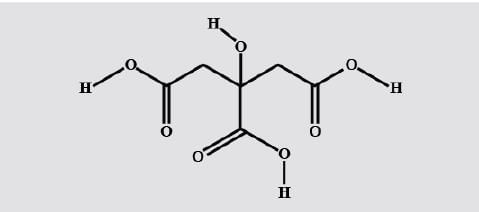
The IUPAC name of compound is:

Detailed Solution: Question 4

The name of the compound would be 2-hydroxypropane-1,2,3-tricarboxylic acid

Test: Carbon and its compounds (Easy) - Question 5

Which of the following structures correctly represents the electron dot structure of a chlorine molecule?

Detailed Solution: Question 5

In an electron dot structure of a molecule there must be shown eight electrons (in the form of dots or crosses) around each element of the molecule, to represent the complete octet of the element.

Test: Carbon and its compounds (Easy) - Question 6

How many 1°, 2° and 3° H atoms are present in (Toluene ) respectively.
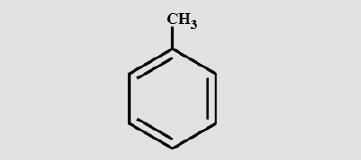
Detailed Solution: Question 6
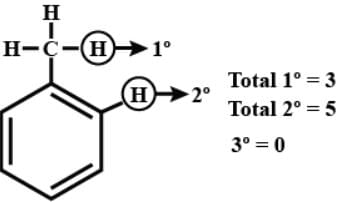
Test: Carbon and its compounds (Easy) - Question 7

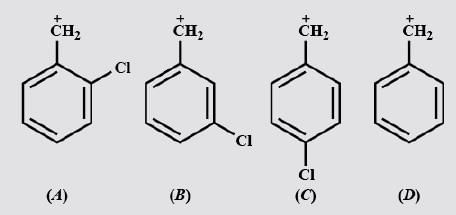
For Carbocation the Stability Order Will be _________________.
Detailed Solution: Question 7

Rules for Naming Hydrocarbons:-

Rule-I Selection of the longest carbon chain.

Rule-ll Numbering the longest chain: Longest chain is numbered starting from a terminal carbon. Numbering is done in such a way that the lowest possible number is given to the sidechain or a functional group.

Rule-Ill Writing names of branched, saturated hydrocarbons, locants are written first in alphabetical order followed by the name of the parent chain.

Rule-IV Some common names are retained in IUP AC system for unsubstituted hydrocarbons only. Stability order: D > C > B > A

Electron withdrawing groups destabilize carbocation. Here, Cl is an electron-withdrawing group hence, it destabilizes the carbonation. But as the distance increases between carbocation and electron-withdrawing groups which can be seen in A, B, and C molecules. Hence, an order is C > B > A and in the case of (D) molecules, there is no electron-withdrawing group. Hence, it's more stable as compared to others.

*Multiple options can be correct
Test: Carbon and its compounds (Easy) - Question 8

Graphite differs from diamond because graphite is:

This question has multiple correct options

Detailed Solution: Question 8

Graphite differs from diamond because graphite is slippery to touch and a good conductor of electricity. In graphite, free electrons move throughout the entire layers, and hence graphite is a good conductor of electricity. Whereas in diamond, there are no mobile electrons in the system. Hence, diamond crystals are non-conductor of electricity. Diamond is a hard beautiful crystalline substance.

Test: Carbon and its compounds (Easy) - Question 9

The IUPAC name of the compound CH3CH = CHC = CH is:

Detailed Solution: Question 9
According to the rules of IUPAC,

In an organic compound having multiples bonds the order of preference is given as,

Triple bond>Double bond>Single bond So,

We should number the carbon from the right. As it can be seen from the figure the correct order of numbering and nomenclature is right one. The left part violated the IUPAC rule stated above and hence the correct IUPAC name of the compound will be pent-3-en-1-yne.

Test: Carbon and its compounds (Easy) - Question 10

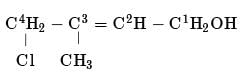
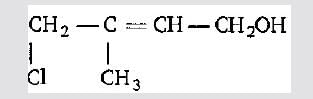
The IUPAC name of the compound is

Detailed Solution: Question 10

Priority of -OH group is greater than halide group. Numbering will be started from the right en(d) IUPAC name: 4-chloro-3-methylbut-2-en-1-ol.

Test: Carbon and its compounds (Easy) - Question 11

The process of making soap by the hydrolysis of fats and oils with alkalis is called:

Detailed Solution: Question 11

Saponification is a process when triglyceride is treated with strong base,lye which accelerates the cleavage of ester bond and releases fatty acids and glycerol. Soaps are precipitated by salting it out with saturated sodium chloride.

Test: Carbon and its compounds (Easy) - Question 12

Trivial name of 2, 3-dihydroxy butanedioic acid is-

Detailed Solution: Question 12

Trivial name or common name of 2,3-dihydroxy butanedioic acid is Tartaric acid It has two forms, Meso and active.

Test: Carbon and its compounds (Easy) - Question 13

The IUPAC name of the given is

Detailed Solution: Question 13

The correct IUPAC name of this compound is 3-ethyl-4,4-dimethylheptane.

Test: Carbon and its compounds (Easy) - Question 14

Which of the following is not a unit of energy

Detailed Solution: Question 14

1 Joule (J) is the MKS unit of energy, equal to the force of one Newton acting through one meter. 1 kilowatt-hour is the energy of one-kilowatt power flowing for one hour.

Test: Carbon and its compounds (Easy) - Question 15

The organic acid present in vinegar is:

Detailed Solution: Question 15

Vinegar is also known as acetic acid and water. Acetic acid is ethanoic acid produced by the fermentation of ethanol by acetic acid bacteria Vinegar is a cooking ingredient and commercially produced by fast or slow fermentation processes.

Information about Test: Carbon and its compounds (Easy) Page
In this test you can find the Exam questions for Test: Carbon and its compounds (Easy) solved & explained in the simplest way possible. Besides giving Questions and answers for Test: Carbon and its compounds (Easy), EduRev gives you an ample number of Online tests for practice
Download as PDF