
Motion- Case Based Type Questions- 2 - Free Questions with solutions
MCQ Practice Test & Solutions: Test: Motion- Case Based Type Questions- 2 (10 Questions)
You can prepare effectively for Class 9 Science Class 9 with this dedicated MCQ Practice Test (available with solutions) on the important topic of "Test: Motion- Case Based Type Questions- 2". These 10 questions have been designed by the experts with the latest curriculum of Class 9 2026, to help you master the concept.
Test Highlights:
- - Format: Multiple Choice Questions (MCQ)
- - Duration: 20 minutes
- - Number of Questions: 10
Sign up on EduRev for free to attempt this test and track your preparation progress.

Direction: The distance moved by a student at different intervals of time, while walking to school, is given in the table below.
A distance time graph for the motion of the student is also shown. Study the table and the graph and choose correct options to answer any four questions given below:


Q. What will be the speed if the body travels a distance of 15 metres in 10 seconds?
Detailed Solution: Question 1
Direction: The distance moved by a student at different intervals of time, while walking to school, is given in the table below.
A distance time graph for the motion of the student is also shown. Study the table and the graph and choose correct options to answer any four questions given below:

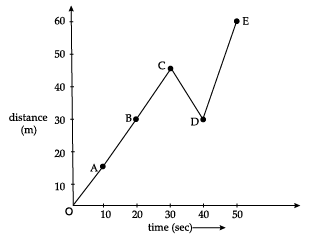
Q. Name the physical quantities denoted by the slope of the distance–time graph.
Detailed Solution: Question 2

Direction: The distance moved by a student at different intervals of time, while walking to school, is given in the table below.
A distance time graph for the motion of the student is also shown. Study the table and the graph and choose correct options to answer any four questions given below:

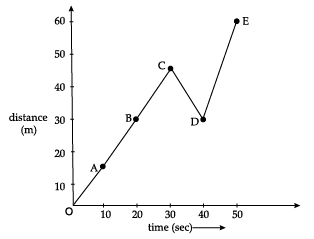
Q. What does the shape of the graph suggest about the type of motion ?
Detailed Solution: Question 3
Direction: The distance moved by a student at different intervals of time, while walking to school, is given in the table below.
A distance time graph for the motion of the student is also shown. Study the table and the graph and choose correct options to answer any four questions given below:

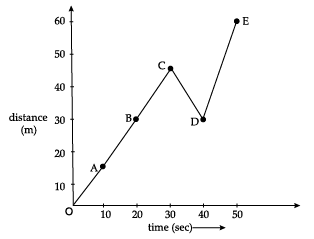
Q. State a condition under which a body moves in such a way that the magnitude of its average velocity is equal to its average speed.
Detailed Solution: Question 4
Direction: The distance moved by a student at different intervals of time, while walking to school, is given in the table below.
A distance time graph for the motion of the student is also shown. Study the table and the graph and choose correct options to answer any four questions given below:

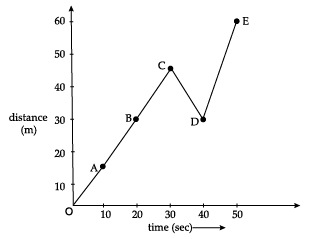
Q. An object is said to be moving with ___________ if it covers equal distances in equal intervals of time.
Detailed Solution: Question 5
Direction: The graph shows the distance-time graph of three objects A, B and C. Study the graph and answer any four questions.
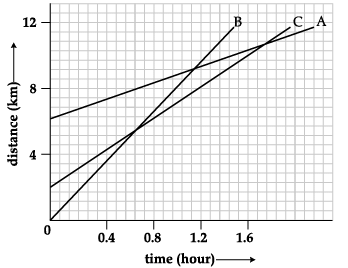
Q. How far has B travelled by the time it passes C
Detailed Solution: Question 6
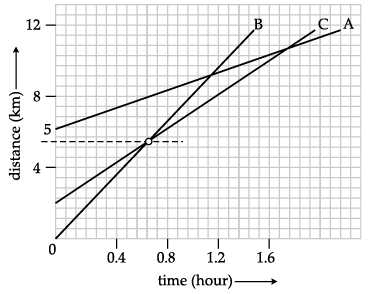
Direction: The graph shows the distance-time graph of three objects A, B and C. Study the graph and answer any four questions.
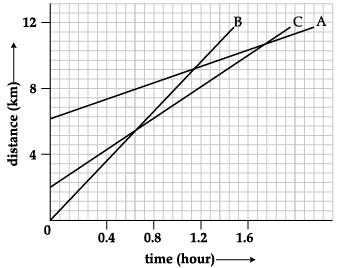
Q. All the three objects A,B & C __________
Detailed Solution: Question 7
Direction: The graph shows the distance-time graph of three objects A, B and C. Study the graph and answer any four questions.
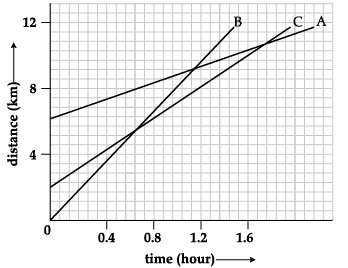
Q. Which of the three is travelling the fastest?
Detailed Solution: Question 8
Direction: The graph shows the distance-time graph of three objects A, B and C. Study the graph and answer any four questions.
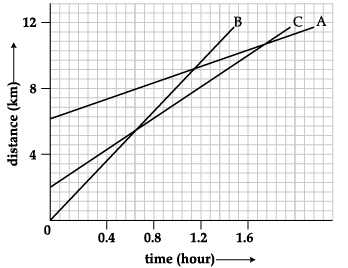
Q. How far has C travelled when B passes A?
Detailed Solution: Question 9
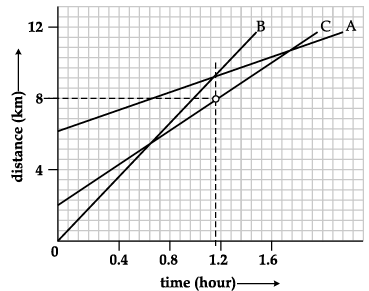
Direction: The graph shows the distance-time graph of three objects A, B and C. Study the graph and answer any four questions.

Q. The distance-time graph is a ______________ when the object is at rest.
Detailed Solution: Question 10
88 videos|481 docs|61 tests |
