CBSE Class 9  >  Class 9 Test  >  Mathematics (Maths)   >  Test: Polynomials - 1 - Class 9 MCQ

Polynomials - 1 - Free MCQ Practice Test with solutions, Class 9 Maths


MCQ Practice Test & Solutions: Test: Polynomials - 1 (25 Questions)

You can prepare effectively for Class 9 Mathematics (Maths) Class 9 with this dedicated MCQ Practice Test (available with solutions) on the important topic of "Test: Polynomials - 1". These 25 questions have been designed by the experts with the latest curriculum of Class 9 2026, to help you master the concept.

Test Highlights:

  • - Format: Multiple Choice Questions (MCQ)
  • - Duration: 25 minutes
  • - Number of Questions: 25

Sign up on EduRev for free to attempt this test and track your preparation progress.

Test: Polynomials - 1 - Question 1

A cubic polynomial is a polynomial with degree

Detailed Solution: Question 1

A cubic polynomial is a polynomial of degree 3. A univariate cubic polynomial has the form f(x) = a3 x3 + a2 x2 + a1 x + a0. An equation involving a cubic polynomial is called a cubic equation. A closed-form solution known as the cubic formula exists for the solutions of an arbitrary cubic equation.

Test: Polynomials - 1 - Question 2

A polynomial of degree 5 in x has at most

Detailed Solution: Question 2

A polynomial of degree 5 is of the form p(x) =, where a, b, c, d, e, and f are real numbers and a ≠ 0.

Thus, p(x) can have at most 6 terms and at least one term containing

Test: Polynomials - 1 - Question 3

The coefficient of x3 in the polynomial 5 + 2x + 3x2 – 7x3 is

Detailed Solution: Question 3

To determine the coefficient of x3 in the polynomial 5 + 2x + 3x2 - 7x3, identify the term containing x3. In this case, the term is -7x3, so the coefficient is -7.

Test: Polynomials - 1 - Question 4

The quadratic polynomial whose sum of zeroes is 3 and the product of zeroes is –2 is :

Detailed Solution: Question 4

Sum of zeros = 3/1 
-b/a = 3/1 .....................(1)

Product of zeros = -2/1
c/a = -2/1 ...................(2)

From equation (1) and (2)
a = 1
-b = 3, b = -3
c = -2

The required quadratic equation is 
ax2+bx+c
= x2-3x-2

Test: Polynomials - 1 - Question 5

A linear polynomial :-

Detailed Solution: Question 5

A number of zeroes of an n -degree polynomial = n. 

First, a linear polynomial is in the form of ax + b, a≠0, a,b ∈R 

The degree of the polynomial = highest degree of the terms 
So here the highest degree is 1. 

Hence, Linear polynomial has only one zero.

Test: Polynomials - 1 - Question 6

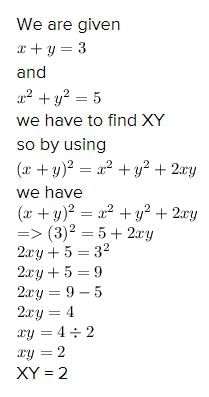
If x + y = 3, x2 + y2 = 5 then xy is

Detailed Solution: Question 6

Test: Polynomials - 1 - Question 7

When the polynomial x3 + 3x2 + 3x + 1 is divided by x + 1, the remainder is :-

Detailed Solution: Question 7

The zero of x + 1 is –1

                And by remainder theorem, when

                p(x) = x3 + 3x2 + 3x + 1 is divided by x + 1, then remainder is p(–1).

                ∴ p(–1) = (–1)3 + 3 (–1)2 + 3(–1) + 1

                = –1 + (3 × 1) + (–3) + 1

                = –1 + 3 – 3 + 1

                = 0

                Thus, the required = 0

Test: Polynomials - 1 - Question 8

If the polynomial 2x3 – 3x2 + 2x – 4 is divided by x – 2, then the remainder is :-

Detailed Solution: Question 8

Using the Remainder Theorem, we substitute x = 2 into the polynomial: f(2) = 2(2)3 - 3(2)2 + 2(2) - 4 = 16 - 12 + 4 - 4 = 4. Therefore, the remainder is 4, which corresponds to option B.

Test: Polynomials - 1 - Question 9

The value of k for which x – 1 is a factor of the polynomial 4x3+ 3x2 – 4x + k is :-

Detailed Solution: Question 9

X - 1 is a factor of 4x3 + 3x2 -4x +k
then x=1 is one root of 4x3 + 3x2 -4x +k

put x= 1
4x3 +3x2 -4x +k = 0

=> 4 (1)3 +3 (1)2-4 (1) +k =0

=> 4 + 3 - 4 + k = 0

=> k = -3 

Test: Polynomials - 1 - Question 10

The value of k for which x + 1 is a factor of the polynomial x3 + x2 + x + k is :-

Detailed Solution: Question 10

To determine the value of k, we use the Factor Theorem, which states that if x + 1 is a factor of the polynomial P(x) = x3 + x2 + x + k, then P(-1) = 0. Substituting x = -1:P(-1) = (-1)3 + (-1)2 + (-1) + k = -1 + 1 - 1 + k = -1 + k. Setting this equal to zero gives:-1 + k = 0 implies k = 1. Thus, the value of k is 1.

Test: Polynomials - 1 - Question 11

The value of m for which x – 2 is a factor of the polynomial x4 – x3 + 2x2 – mx + 4 is :-

Detailed Solution: Question 11

To determine the value of m, we use the Factor Theorem, which states that if x - a is a factor of a polynomial P(x), then P(a) = 0. Here, a = 2. Substitute x = 2 into the polynomial: P(2) = (2)4 - (2)3 + 2(2)2 - m(2) + 4. Calculate each term: - (2)4 = 16, - (2)3 = -8, - 2 * (2)2 = 8, - m * 2 = -2m, - Constant term is 4. Combine the terms: 16 - 8 + 8 - 2m + 4 = 20 - 2m. Set equal to zero and solve for m: 20 - 2m = 0, -2m = -20, m = 10. Verification using synthetic division confirms that the remainder is zero when m = 10, ensuring x - 2 is a factor. Thus, the correct answer is A. 10.

Test: Polynomials - 1 - Question 12

The factors of 2x2 – 3x – 2 are :-

Detailed Solution: Question 12

2x2 – 3x – 2

2x2 - 4x + x - 2 = 0

2x2(x-2) +1(x-2) = 0

(2x+1) (x-2)

Test: Polynomials - 1 - Question 13

If x + 2 is a factor of x3 – 2ax2 + 16, then value of a is

Detailed Solution: Question 13

To determine the value of a when x + 2 is a factor of x3 - 2ax2 + 16, we apply the Factor Theorem, which states that substituting x = -2 into the polynomial should yield zero. Substituting x = -2: -8 - 8a + 16 = 0. Simplify each term: 8 - 8a = 0. Solving for a: -8a = -8 implies a = 1. Thus, the value of a is 1.

Test: Polynomials - 1 - Question 14

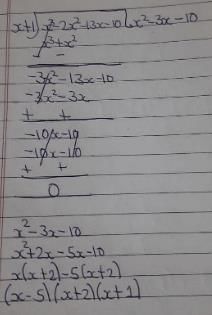
The factors of x3 – 2x2 – 13x – 10 are :-

Detailed Solution: Question 14

Test: Polynomials - 1 - Question 15

The expanded form of (2x – 3y – z)2 is :-

Detailed Solution: Question 15

To expand (2x - 3y - z)2, we use the formula for squaring a trinomial: (a + b + c)2 = a2 + b2 + c2 + 2ab + 2ac + 2bc. Here, a = 2x, b = -3y, and c = -z. Applying the formula: 1. Compute the squares of each term: (2x)2 = 4x2, (-3y)2 = 9y2, (-z)2 = z2. 2. Compute the cross terms: 2(2x)(-3y) = -12xy, 2(2x)(-z) = -4xz, 2(-3y)(-z) = 6yz. Combine all these results: 4x2 + 9y2 + z2 - 12xy - 4xz + 6yz. This matches option D.

Test: Polynomials - 1 - Question 16

The expanded form of (x + y + 2z)2 is :-

Detailed Solution: Question 16

To expand (x + y + 2z)2, we use the formula for trinomial expansion: (x + y + z)2 = x2 + y2 + z2 + 2xy + 2xz + 2yz. Here, substituting z with 2z: = x2 + y2 + (2z)2 + 2*x*y + 2*x*(2z) + 2*y*(2z) = x2 + y2 + 4z2 + 2xy + 4xz + 4yz. Thus, the expanded form is x2 + y2 + 4z2 + 2xy + 4yz + 4zx, which corresponds to option C.

Test: Polynomials - 1 - Question 17

The expanded form of (x+1/3)3 is :-  

Detailed Solution: Question 17

To expand (x + 1/3)3, we use the binomial expansion formula for (a + b)3, which is a3 + 3a2b + 3ab2 + b3.Applying this to (x + 1/3)3:- First term: x3- Second term: 3 * x2 * (1/3) = x2- Third term: 3 * x * (1/3)2 = 3 * x * 1/9 = (1/3)x- Fourth term: (1/3)3 = 1/27Combining these terms, the expanded form is:x3 + x2 + (1/3)x + 1/27Therefore, the correct option is B.

Test: Polynomials - 1 - Question 18

x3 + y3 + z3 – 3xyz is :-

Detailed Solution: Question 18

We know that x3 + y3 + z3 – 3xyz = (x + y + z) (x2 + y2 + z2 – xy – yz – zx).
If x + y + z = 0, then x3 + y3 + z3 – 3xyz = 0 or x3 + y3 + z3 = 3xyz.

Test: Polynomials - 1 - Question 19

(a – b)3 + (b – c)3 + (c – a)3 is equal to :-

Detailed Solution: Question 19

Let x = (a – b), y = (b – c) and z = (c – a)
Consider, x + y + z = (a – b) + (b – c) + (c – a) = 0
⇒ x3 + y3 + z3 = 3xyz
That is (a – b)3 + (b – c)3 + (c – a)3 = 3(a – b)(b – c)(c – a)

Test: Polynomials - 1 - Question 20

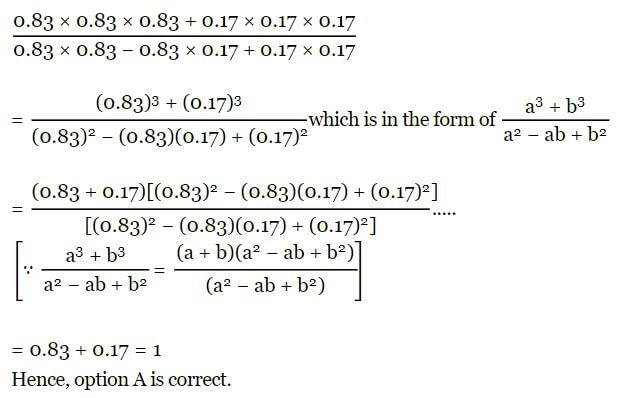
 is equal to :-

Detailed Solution: Question 20

Test: Polynomials - 1 - Question 21

√2 is a polynomial of degree

Detailed Solution: Question 21

The highest power of the variable is known as the degree of the polynomial.

√2x^0 = √2
hence the degree of the polynomial is zero.

Test: Polynomials - 1 - Question 22

The degree of the polynomial 4x4+0x3+0x5+5x+74x4+0x3+0x5+5x+7 is

Detailed Solution: Question 22

The degree of the polynomial 4x4+0x3+0x5+5x+74x4+0x3+0x5+5x+7 is

Test: Polynomials - 1 - Question 23

The degree of the zero polynomial is

Detailed Solution: Question 23

The degree of zero polynomial is not defined, because, in zero polynomial, the coefficient of any variable is zero i.e., Oxor Ox5, etc. Hence, we cannot exactly determine the degree of the variable.  

Test: Polynomials - 1 - Question 24

The value of the polynomial 5x−4x2+3, when x = −1 is

Detailed Solution: Question 24

 Let p (x) = 5x – 4x2 + 3 …(i)
On putting x = -1 in Eq. (i), we get
p(-1) = 5(-1) -4(-1)2 + 3= - 5 - 4 + 3 = -6

Test: Polynomials - 1 - Question 25

If p(x) = x + 3, then p(x) + p(-x) is equal to

Detailed Solution: Question 25

Given the function p(x) = x + 3, we can find p(-x) by substituting -x into the function:

p(-x) = -x + 3

Now, add p(x) and p(-x):

p(x) + p(-x) = (x + 3) + (-x + 3)

  • p(x) + p(-x) = x + 3 - x + 3
  • p(x) + p(-x) = x - x + 3 + 3
  • p(x) + p(-x) = 6

Thus, the result is 6.

40 videos|468 docs|55 tests
Information about Test: Polynomials - 1 Page
In this test you can find the Exam questions for Test: Polynomials - 1 solved & explained in the simplest way possible. Besides giving Questions and answers for Test: Polynomials - 1, EduRev gives you an ample number of Online tests for practice
40 videos|468 docs|55 tests
Download as PDF