NEET Exam  >  NEET Test  >  Biology Class 11  >  Test: Cell Cycle & Cell Division - 1 - NEET MCQ

Cell Cycle & Division - 1 - NEET Biology Class 11 Free MCQ Test with solutions


MCQ Practice Test & Solutions: Test: Cell Cycle & Cell Division - 1 (15 Questions)

You can prepare effectively for NEET Biology Class 11 with this dedicated MCQ Practice Test (available with solutions) on the important topic of "Test: Cell Cycle & Cell Division - 1". These 15 questions have been designed by the experts with the latest curriculum of NEET 2026, to help you master the concept.

Test Highlights:

  • - Format: Multiple Choice Questions (MCQ)
  • - Duration: 15 minutes
  • - Number of Questions: 15

Sign up on EduRev for free to attempt this test and track your preparation progress.

Test: Cell Cycle & Cell Division - 1 - Question 1

Plants show mitotic divisions in

Detailed Solution: Question 1

Mitosis is the type of cell division that ensures equal distribution of genetic material in daughter cells. Mitosis can occur both in diploid and haploid cells.
The main function of mitosis is to make copies of cells for growth and regeneration.

Topic in NCERT: Significance of Mitosis
Line in NCERT: "Against this, the plants can show mitotic divisions in both haploid and diploid cells."

Test: Cell Cycle & Cell Division - 1 - Question 2

Plant Cytokinesis differ from animals Cytokinesis in having

Detailed Solution: Question 2

In plants, cytokinesis or division of cytoplasm occurs due to the formation of the cell plate.

In animals, cytokinesis occurs due to the formation of constriction in the middle cell membrane.

Cytokinesis- Definition and Process (in animal and plant cells)

Topic in NCERT: Cytokinesis in Plant Cells
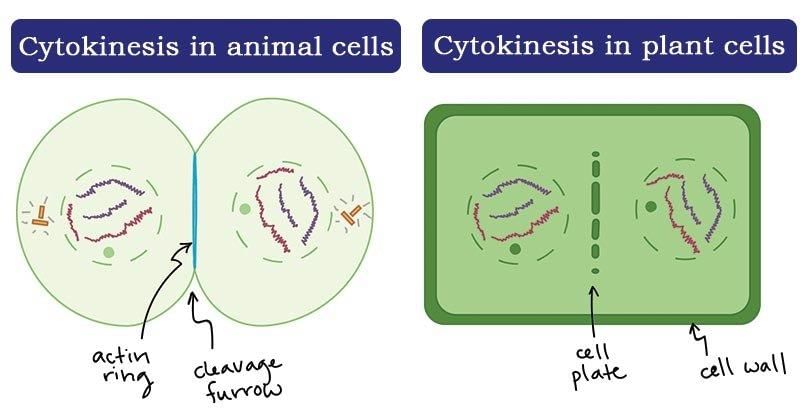
Line in NCERT: "The formation of the new cell wall begins with the formation of a simple precursor, called the cell-plate that represents the middle lamella between the walls of two adjacent cells."

Test: Cell Cycle & Cell Division - 1 - Question 3

Cell growth results in disturbing the ratio between

Detailed Solution: Question 3

Cell growth results in disturbing the ratio between the nucleus and the cytoplasm.
Therefore, it becomes essential for the cell to divide to restore the nucleo-cytoplasmic ratio.

Topic in NCERT: CELL CYCLE

Line in NCERT: "Cell growth results in disturbing the ratio between the nucleus and the cytoplasm. It therefore becomes essential for the cell to divide to restore the nucleo-cytoplasmic ratio."

Test: Cell Cycle & Cell Division - 1 - Question 4

The transition period between M- phase I and M- phase II without DNA replication

Detailed Solution: Question 4

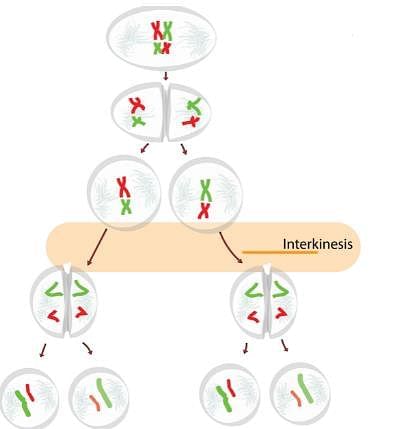
The transition period between the M-phase of Meiosis I and M-phase II during which no replication of DNA occurs is called interkinesis.

Topic in NCERT: Meiosis I

Line in NCERT: "The stage between the two meiotic divisions is called interkinesis and is generally short lived. There is no replication of DNA during interkinesis."

Test: Cell Cycle & Cell Division - 1 - Question 5

What is the average cell cycle span for a mammalian cell?

Detailed Solution: Question 5

The average cell cycle span for a mammalian cell is approximately 24 hours.

Topic in NCERT: PHASES OF CELL CYCLE

Line in NCERT: "A typical eukaryotic cell cycle is illustrated by human cells in culture. These cells divide once in approximately every 24 hours."

Test: Cell Cycle & Cell Division - 1 - Question 6

During which stage do the chromatids of a bivalent become distinct?

Detailed Solution: Question 6

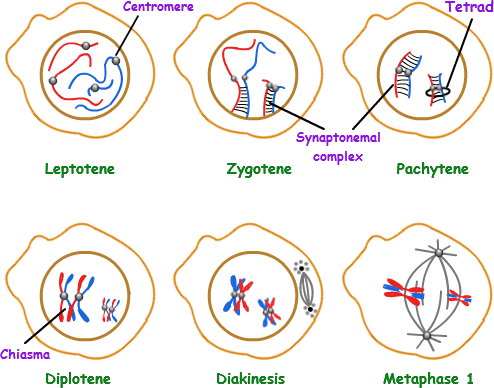
Bivalent or tetrad formation takes place during the zygotene stage of prophase I, after synapsis has occurred and homologous chromosomes form pairs. However, the bivalent is distinct only in the next stage, pachytene.

Topic in NCERT: Prophase I

Line in NCERT: The first two stages of prophase I are relatively short-lived compared to the next stage that is pachytene. During this stage, the four chromatids of each bivalent chromosomes becomes distinct and clearly appears as tetrads. This stage is characterised by the appearance of recombination nodules, the sites at which crossing over occurs between non-sister chromatids of the homologous chromosomes.

Test: Cell Cycle & Cell Division - 1 - Question 7

During which stage of prophase I the crossing over takes place?

Detailed Solution: Question 7

Pachytene: During the third substage of meiosis, the chromosomes continue to condense. Crossing over takes place at this stage and at each point of crossing over a chiasma is formed (singular: chiasma) between non-sister chromatids of homologous chromosomes.

Explain the stages of prophase I of meiosis.
Fig: Stages of Prophase I of Meiosis

Topic in NCERT: Pachytene

Line in NCERT: "During this stage, the four chromatids of each bivalent chromosomes becomes distinct and clearly appears as tetrads. This stage is characterised by the appearance of recombination nodules, the sites at which crossing over occurs between non-sister chromatids of the homologous chromosomes."

Test: Cell Cycle & Cell Division - 1 - Question 8

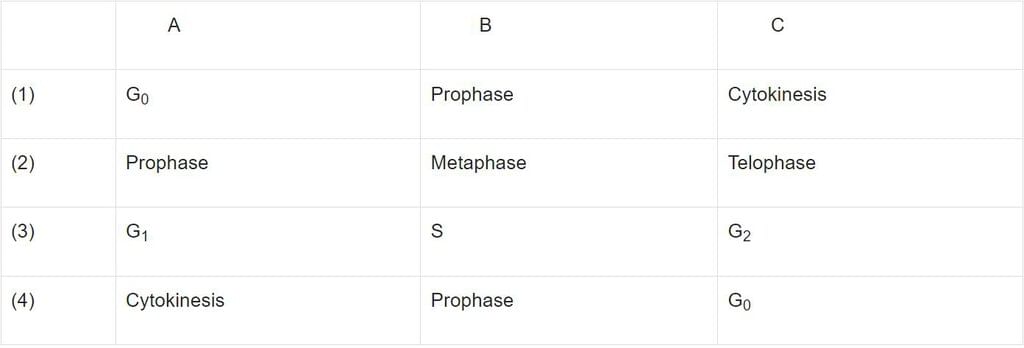
Identify the symbols A, B and C in the figure given below
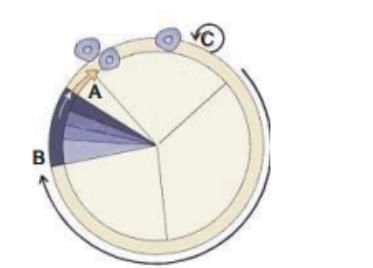
Detailed Solution: Question 8
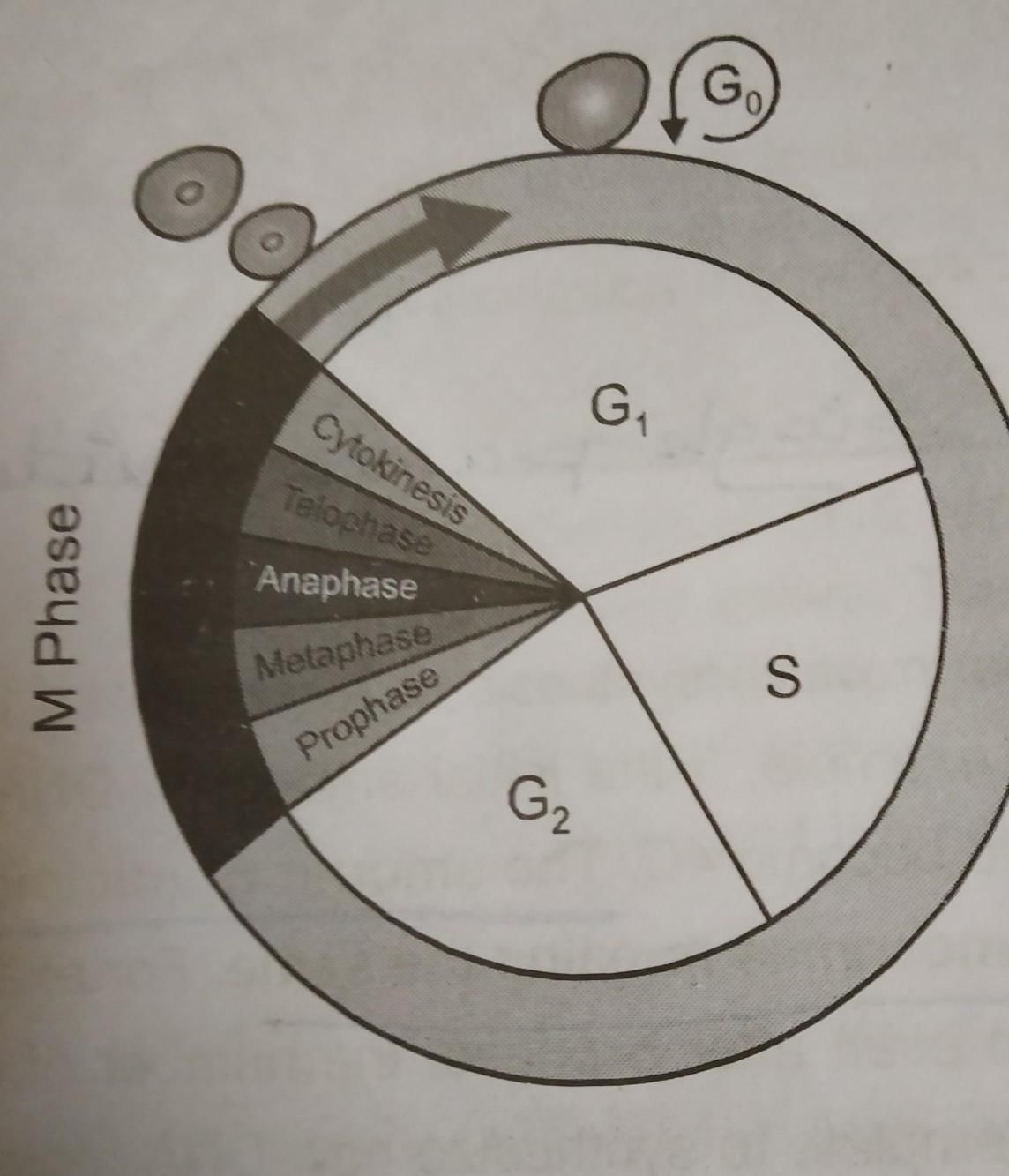
Give the diagrammatic view of cell cycle and describe the events taking place during interphase brainly - Brainly.in

Test: Cell Cycle & Cell Division - 1 - Question 9

Crossing over results in the exchange of genetic material, which occurs between:

Detailed Solution: Question 9

In meiosis I, during pachytene, crossing over occurs between the non-sister chromatids of the homologous chromosomes. The exchange of genetic material (DNA) between the non-sister chromatids of the homologous chromosomes is known as crossing over. It leads to the recombination of genetic material which involves a mutual exchange of the corresponding segments of non-sister chromatids of homologous chromosomes. It takes place by breakage and reunion of chromatid segments.

Topic in NCERT: Pachytene

Line in NCERT: "the sites at which crossing over occurs between non-sister chromatids of the homologous chromosomes."

Test: Cell Cycle & Cell Division - 1 - Question 10

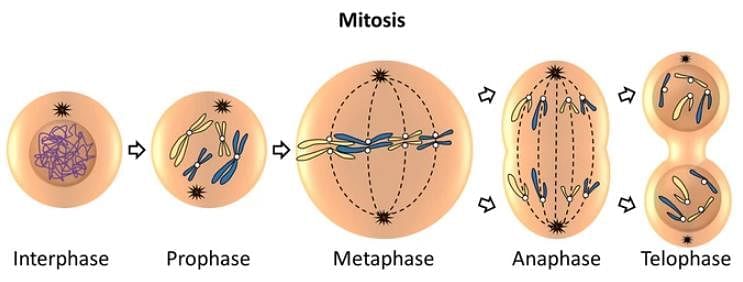
The figures below shows 3 phases of mitosis select the option given correct identification together with the correct event ?
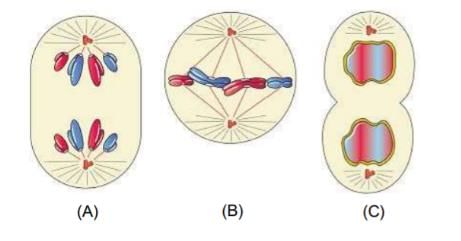
Detailed Solution: Question 10

Topic in NCERT: Telophase
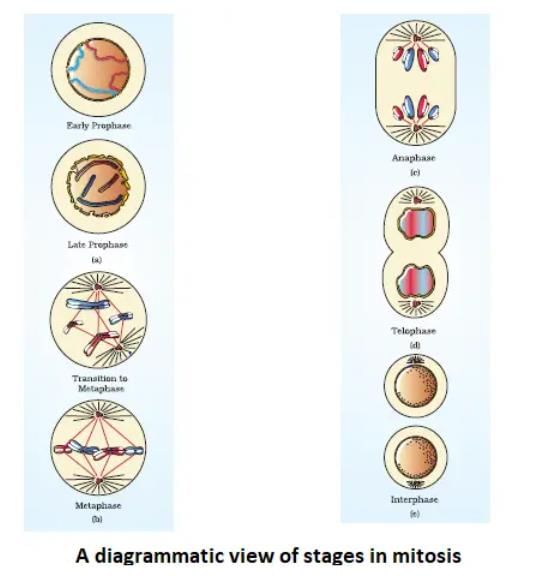
Line in NCERT: "At the beginning of the final stage of karyokinesis, i.e., telophase, the chromosomes that have reached their respective poles decondense and lose their individuality. The individual chromosomes can no longer be seen and each set of chromatin material tends to collect at each of the two poles."

Test: Cell Cycle & Cell Division - 1 - Question 11

Which is the longest phase of the cell cycle?

Detailed Solution: Question 11

Cell cycle is divided into 2 phase. (i) Interphase (a period of preparation for cell division), (ii) M phase (the actual period of cell division). The interphase cell is metabolically quite active. Interphase is the long non dividing phase further divided into G1, S and G2. It occupies 75 to 90 % of entire cell division time.

Topic in NCERT: CELL CYCLE AND CELL DIVISION

Line in NCERT: "The interphase lasts more than 95% of the duration of cell cycle."

Test: Cell Cycle & Cell Division - 1 - Question 12

If the DNA content of an onion tip cell is 2C at the end of the M-phase, what would be its DNA content at the end of the S-phase?

Detailed Solution: Question 12

If the DNA content of an onion tip cell is 2C at the end of the M-phase, then its DNA content would be 4C at the end of the S-phase. During the S-phase of the cell cycle, DNA replication takes place, and the amount of DNA in the cell doubles. At the end of the S-phase, each chromosome consists of two identical sister chromatids, which are held together at the centromere. Thus, the DNA content of the cell is doubled from the G1 phase (2C) to the end of the S-phase (4C), and it remains the same through the G2 phase. Therefore, if the DNA content of an onion tip cell is 2C at the end of the M-phase, it means that the cell has completed the mitotic division and has two sets of chromosomes. If the cell then enters the S-phase, it will replicate its DNA, resulting in the DNA content of 4C at the end of the S-phase.

Topic in NCERT: S phase (Synthesis)

Line in NCERT: "During this time the amount of DNA per cell doubles. If the initial amount of DNA is denoted as 2C then it increases to 4C."

Test: Cell Cycle & Cell Division - 1 - Question 13

Consider the given two statements:

I. During G1 phase, the cell is metabolically active and continuously grows but does not replicate its DNA.
II. During G2 phase, proteins are synthesized in preparation for mitosis while cell growth continues.

Which of the following is correct?

Detailed Solution: Question 13

Statement I is correct: During the G1 phase, the cell grows, is metabolically active, but does not replicate its DNA. DNA replication occurs in the S phase.
Statement II is also correct: During the G2 phase, the cell synthesizes proteins needed for mitosis and continues growing in preparation for cell division.

Topic in NCERT: CELL CYCLE AND CELL DIVISION

Line in NCERT: "G1 phase corresponds to the interval between mitosis and initiation of DNA replication. During G1 phase the cell is metabolically active and continuously grows but does not replicate its DNA. During the G2 phase, proteins are synthesised in preparation for mitosis while cell growth continues."

Test: Cell Cycle & Cell Division - 1 - Question 14

“The synaptonemal complex is formed during A stage and dissolves during B stage”.
Complete the above statement by choosing the correct option for A and B.

Detailed Solution: Question 14

 
  • The synaptonemal complex is a protein structure that forms between homologous chromosomes during meiosis, facilitating their pairing and recombination.
  • It begins forming during the Zygotene stage of prophase I as homologous chromosomes start pairing (synapsis).
  • It dissolves during the Diplotene stage when the homologous chromosomes begin to separate, although they remain connected at chiasmata.

Test: Cell Cycle & Cell Division - 1 - Question 15

When a cell is viewed under the microscope, it does not show the Golgi complex, endoplasmic reticulum, nucleolus, and nuclear envelope in which stage of cell division?

Detailed Solution: Question 15

In late prophase, the nuclear envelope, nucleolus, Golgi complex, and endoplasmic reticulum disappear, allowing the chromosomes to become fully condensed and visible. This marks the transition into metaphase, where the mitotic spindle fully forms.

Topic in NCERT: CELL CYCLE AND CELL DIVISION

Line in NCERT: "Cells at the end of prophase, when viewed under the microscope, do not show golgi complexes, endoplasmic reticulum, nucleolus and the nuclear envelope."

142 videos|410 docs|135 tests
Information about Test: Cell Cycle & Cell Division - 1 Page
In this test you can find the Exam questions for Test: Cell Cycle & Cell Division - 1 solved & explained in the simplest way possible. Besides giving Questions and answers for Test: Cell Cycle & Cell Division - 1, EduRev gives you an ample number of Online tests for practice
142 videos|410 docs|135 tests
Download as PDF