
Distance-Time Graphs - Free MCQ Practice Test with solutions, Class 9 Science
MCQ Practice Test & Solutions: MCQ: Distance-Time Graphs (10 Questions)
You can prepare effectively for Class 9 Science Class 9 with this dedicated MCQ Practice Test (available with solutions) on the important topic of "MCQ: Distance-Time Graphs". These 10 questions have been designed by the experts with the latest curriculum of Class 9 2026, to help you master the concept.
Test Highlights:
- - Format: Multiple Choice Questions (MCQ)
- - Duration: 10 minutes
- - Number of Questions: 10
Sign up on EduRev for free to attempt this test and track your preparation progress.

In a distance-time graph, if the line is horizontal, then the object is:
Detailed Solution: Question 1
The area under speed-time graph represents a physical quantity which has the unit of?
Detailed Solution: Question 2

The acceleration of an object moving in a straight line can be determined from:
Detailed Solution: Question 3
Topic in NCERT: VELOCITY-TIME GRAPHS
Line in NCERT: "The area under the velocity-time graph gives the distance (magnitude of displacement) moved by the car in a given interval of time."
If the speed-time graph is a straight line parallel to the time axis, then the body is
Detailed Solution: Question 4
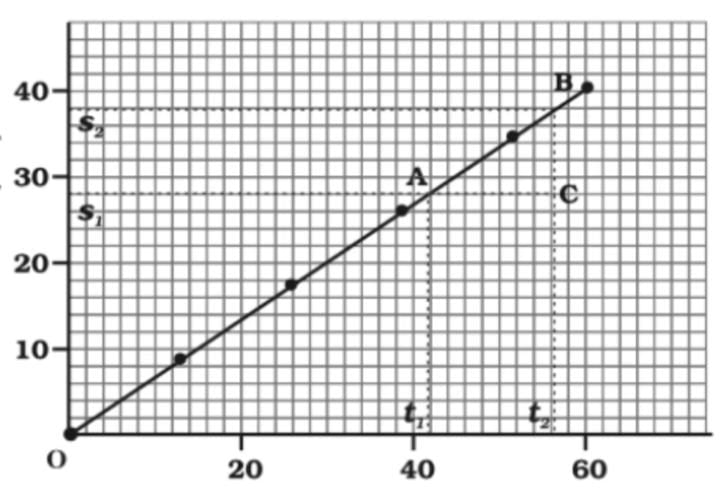
On the distance-time graph, the Y-axis should be labeled as:
Detailed Solution: Question 5
Detailed Solution: Question 6
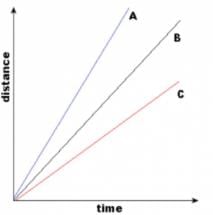
For a body performing motion with uniform speed, the distance-time graph is:
Detailed Solution: Question 7
Topic in NCERT: Distance-Time Graphs for Non-Uniform Motion
Line in NCERT: "The distance-time graph for the motion of the car is shown in Fig. 7.4. Note that the shape of this graph is different from the earlier distance-time graph (Fig. 7.3) for uniform motion."
What is the slope of distance-time graph when object is at rest?
Detailed Solution: Question 8
In a distance-time graph, which variable is plotted on the Y-axis?
Detailed Solution: Question 9
The following graph shows the distance–time relationship for two objects, A and B, starting from the same point.
- The slope of a distance–time graph represents the speed of the object (the greater the slope, the higher the speed).
- Observe the two straight lines: line A has a smaller slope, while line B has a steeper slope.
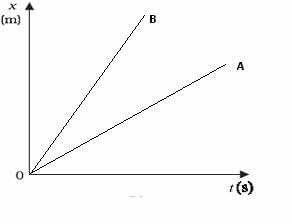
Based on the graph, which statement is true about the speeds of object A and object B?
a) The speed of object B is greater than the speed of object A
b) The speed of object B is less than the speed of object A
c) Both objects have the same speed
d) None of the above
b) The speed of object B is less than the speed of object A
c) Both objects have the same speed
d) None of the above
Detailed Solution: Question 10
88 videos|481 docs|61 tests |
