CBSE Class 9  >  Class 9 Test  >  Mathematics (Maths)   >  Test: Number Systems - 1 - Class 9 MCQ

Number Systems - 1 - Class 9 Maths Free MCQ Test with solutions


MCQ Practice Test & Solutions: Test: Number Systems - 1 (25 Questions)

You can prepare effectively for Class 9 Mathematics (Maths) Class 9 with this dedicated MCQ Practice Test (available with solutions) on the important topic of "Test: Number Systems - 1". These 25 questions have been designed by the experts with the latest curriculum of Class 9 2026, to help you master the concept.

Test Highlights:

  • - Format: Multiple Choice Questions (MCQ)
  • - Duration: 50 minutes
  • - Number of Questions: 25

Sign up on EduRev for free to attempt this test and track your preparation progress.

Test: Number Systems - 1 - Question 1

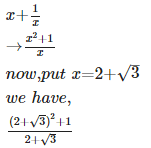
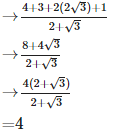
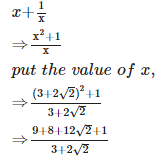
If x = 2+√3, then Find  

Detailed Solution: Question 1


Test: Number Systems - 1 - Question 2

The value of  is 

Detailed Solution: Question 2

Test: Number Systems - 1 - Question 3

The value of  is 

Detailed Solution: Question 3


Test: Number Systems - 1 - Question 4

Which of the following is an rational number?

Detailed Solution: Question 4

- A rational number is a number that can be expressed as a fraction where both the numerator and denominator are integers.
- √196 is a rational number because it simplifies to 14/1, which is a fraction where both the numerator and denominator are integers.
- Options B and C are irrational numbers because they cannot be expressed as fractions.
- Option A is a repeating decimal, which can be rational if it eventually settles into a repeating pattern, but without further information, it is not clear if this is the case.

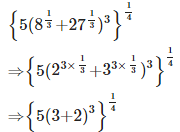
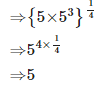
Test: Number Systems - 1 - Question 5

Detailed Solution: Question 5

Test: Number Systems - 1 - Question 6

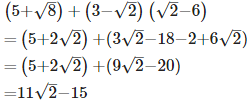
(5+√8)+(3−√2)(√2−6) is

Detailed Solution: Question 6


And we know that the value of 11√2 is greater than 15 so it's value will be positive, And also sum or differences of rational and irrational is irrational

Test: Number Systems - 1 - Question 7

√8+2√32−5√2 is equal to

Detailed Solution: Question 7

√8 = 2√2.

√32 = 4√2.

Substitute these into the expression to get: 2√2 + 2×4√2 - 5√2

Combine like terms: (2 + 8 - 5)√2 = 5√2

Therefore the value of the expression is 5√2,
So, option A is correct.

Test: Number Systems - 1 - Question 8

Every rational number is

Detailed Solution: Question 8

Every rational number is a real number. Real Number is a set of numbers formed by both Rational and Irrational numbers are combined.

Test: Number Systems - 1 - Question 9

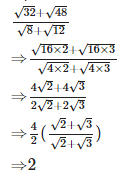
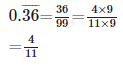
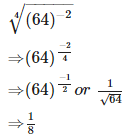
The simplest form of   is

Detailed Solution: Question 9

Test: Number Systems - 1 - Question 10

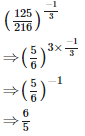
(125/216) -1/3 =

Detailed Solution: Question 10

Test: Number Systems - 1 - Question 11

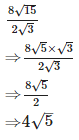
8√15 ÷ 2√3

Detailed Solution: Question 11

Test: Number Systems - 1 - Question 12

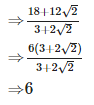
Ifn x = 3+2√2, then the value of 

Detailed Solution: Question 12


Test: Number Systems - 1 - Question 13

Decimal representation of a rational number cannot be 

Detailed Solution: Question 13

A rational number is a number that can be expressed as a fraction p/q, where p and q are integers and q ≠ 0 

  • Its decimal representation is either terminating (like 0.75 = ¾)
    or non-terminating but repeating (like 0.333... = ⅓).

  • It cannot be non-terminating and non-repeating, because that form represents an irrational number (like π or √2).

 Therefore, the decimal representation of a rational number cannot be non-terminating and non-repeating.

Test: Number Systems - 1 - Question 14

The simplest form of  is

Detailed Solution: Question 14

Test: Number Systems - 1 - Question 15

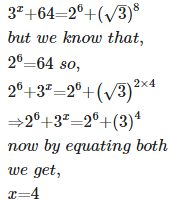
If 3x + 64 = 26 + (√3)8, then the value of ‘x’ is 

Detailed Solution: Question 15

Test: Number Systems - 1 - Question 16

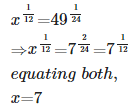
If x1/12 = 491/24, then the value of ‘x’ is

Detailed Solution: Question 16

Test: Number Systems - 1 - Question 17

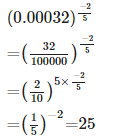
The value of (0.00032)-2/5 is

Detailed Solution: Question 17

Test: Number Systems - 1 - Question 18

The decimal representation of an irrational number is

Detailed Solution: Question 18

An irrational number is a type of number that cannot be expressed as a simple fraction. Its decimal representation has unique characteristics:

  • Non-terminating: The decimal goes on forever without ending.
  • Non-repeating: There are no repeating patterns in the digits.

Examples of irrational numbers include:

  • Pi (π): Approximately 3.14159, it continues infinitely without repetition.
  • The square root of 2: Approximately 1.41421, also non-terminating and non-repeating.

In summary, the decimal representation of an irrational number is neither terminating nor repeating.

Test: Number Systems - 1 - Question 19

A number which can neither be expressed as a terminating decimal nor as a repeating decimal is called

Detailed Solution: Question 19

A number that cannot be expressed as a terminating or repeating decimal is classified as an irrational number. Here are some key points to understand this concept:

  • Rational numbers can be written as fractions, which either terminate (like 0.5) or repeat (like 0.333...).
  • Irrational numbers, on the other hand, cannot be written as simple fractions. Their decimal representations are non-terminating and non-repeating.
  • Examples of irrational numbers include π (pi) and √2 (the square root of 2).
  • Irrational numbers are essential in mathematics, particularly in geometry and calculus.

In summary, a number that cannot be expressed as either a terminating or a repeating decimal is indeed called an irrational number.

Test: Number Systems - 1 - Question 20

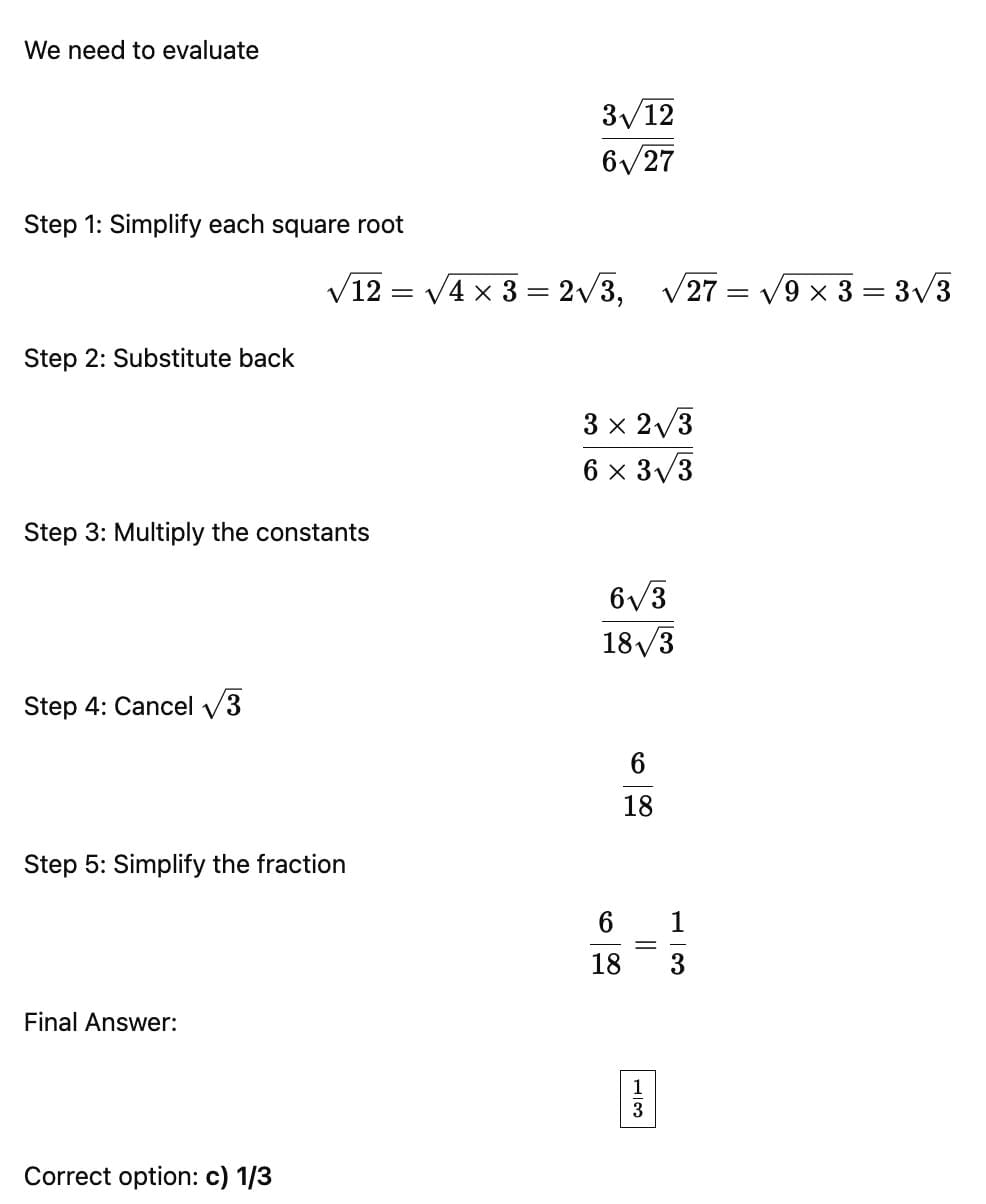
The value of  is 

Detailed Solution: Question 20

Test: Number Systems - 1 - Question 21

Which of the following is a rational number?

Detailed Solution: Question 21

Zero (0) is an integer, and all integers are rational numbers because they can be expressed as a fraction where the denominator is 1 (e.g., 0/1).

The other options involve irrational numbers that cannot be expressed as simple fractions. Thus, 0 is the only rational number among the given choices.

Test: Number Systems - 1 - Question 22

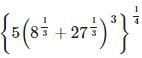
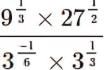
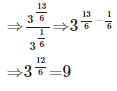
The value of  is 

Detailed Solution: Question 22

Step 1: Express all numbers as powers of 3.
9 = 32, 27 = 33
Step 2: Rewrite the expression using these:
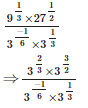
(91/3 × 271/2) ÷ (3-1/6 × 31/3)
= (32×1/3 × 33×1/2) ÷ (3-1/6 × 31/3)
= (32/3 × 33/2) ÷ (3-1/6 + 1/3)
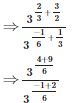
Step 3: Simplify exponents by addition and subtraction:
Numerator: 32/3 + 3/2 = 3(4/6 + 9/6) = 313/6
Denominator exponent: -1/6 + 1/3 = -1/6 + 2/6 = 1/6
So denominator = 31/6
Step 4: Complete division:
313/6 ÷ 31/6 = 313/6 - 1/6 = 312/6 = 32 = 9
Therefore, the value of the expression is 9.


Test: Number Systems - 1 - Question 23

The number (3 − √3)(3 + √3) is:

Detailed Solution: Question 23

The given expression is in the form of (a - b)(a + b), which is a standard identity:

(a - b)(a + b) = a² - b²

Here,
a = 3
b = √3

Now apply the identity:

(3 - √3)(3 + √3) = 3² - (√3)² = 9 - 3 = 6

So, the result is 6, which is a rational number.

Test: Number Systems - 1 - Question 24

On simplifying (√5 + √7)², we get

Detailed Solution: Question 24

We use the identity
(a + b)² = a² + 2ab + b²

Here,
a = √5
b = √7

Now apply the identity:

(√5 + √7)² = (√5)² + 2 × √5 × √7 + (√7)²
= 5 + 2√35 + 7
= 12 + 2√35

Test: Number Systems - 1 - Question 25

Express 0.375 as a fraction in its simplest form.

Detailed Solution: Question 25

0.375 = 375/1000 because there are three digits after the decimal point, so the denominator is 1000

Find the highest common factor of 375 and 1000
HCF (375,1000) = 125
Divide both numerator and denominator by 125
So, 375 ÷ 125 = 3 and 1000 ÷ 125 = 8

Therefore the fraction in simplest form is 3/8
So, option A is correct.

40 videos|468 docs|55 tests
Information about Test: Number Systems - 1 Page
In this test you can find the Exam questions for Test: Number Systems - 1 solved & explained in the simplest way possible. Besides giving Questions and answers for Test: Number Systems - 1, EduRev gives you an ample number of Online tests for practice
40 videos|468 docs|55 tests
Download as PDF