CBSE Class 8  >  Class 8 Test  >  Advance Learner Course: Mathematics (Maths)   >  Test: Number System- Assertion & Reason Type Questions - Class 8 MCQ

Number System- Assertion & Reason Type Questions - Free AR with Solutions


MCQ Practice Test & Solutions: Test: Number System- Assertion & Reason Type Questions (10 Questions)

You can prepare effectively for Class 8 Advance Learner Course: Mathematics (Maths) Class 8 with this dedicated MCQ Practice Test (available with solutions) on the important topic of "Test: Number System- Assertion & Reason Type Questions". These 10 questions have been designed by the experts with the latest curriculum of Class 8 2026, to help you master the concept.

Test Highlights:

  • - Format: Multiple Choice Questions (MCQ)
  • - Duration: 20 minutes
  • - Number of Questions: 10

Sign up on EduRev for free to attempt this test and track your preparation progress.

Test: Number System- Assertion & Reason Type Questions - Question 1

DIRECTION : In the following questions, a statement of assertion (A) is followed by a statement of reason (R). Mark the correct choice as:

Assertion : 5 is a rational number.

Reason : The square roots of all positive integers are irrationals.

Detailed Solution: Question 1

Here reason is not true.

√4 = ±2, which is not an irrational number.

Correct option is (c) Assertion (A) is true but reason (R) is false.

Test: Number System- Assertion & Reason Type Questions - Question 2

DIRECTION : In the following questions, a statement of assertion (A) is followed by a statement of reason (R). Mark the correct choice as:

Assertion : Sum of two irrational numbers is an irrational number.

Reason : Sum of a rational number and an irrational numbers is always an irrational number.

Detailed Solution: Question 2

The correct answer is:

1. Assertion (A) is true but reason (R) is false.

Explanation:

  • Assertion (A): "Sum of two irrational numbers is an irrational number." This is not always true. For example, 2\sqrt{2}2​ and −2-\sqrt{2}−2​ are both irrational numbers, but their sum is 000, which is a rational number. Thus, the assertion is false.

  • Reason (R): "Sum of a rational number and an irrational number is always an irrational number." This is true because adding any non-zero rational number to an irrational number will not cancel out the irrational part, so the result is irrational.

So, the assertion is false, but the reason is true.

Test: Number System- Assertion & Reason Type Questions - Question 3

DIRECTION : In the following questions, a statement of assertion (A) is followed by a statement of reason (R). Mark the correct choice as:

Assertion : 78 ፥ 74 = 74

Reason : If a > 0 be a real number and p and q be rational numbers. Then ap x aq = ap + q.

Detailed Solution: Question 3

We know that If a > 0 be a real number and p and q be rational numbers then ap x aq = ap+q.

So, Reason is correct.

Now, 78 ፥ 74 = 78 – 4 = 74 (∵ ap ፥ aq = ap – q) So, Assertion is also correct.

But reason (R) is not the correct explanation of assertion (A)

Correct option is (b) Both assertion (A) and reason (R) are true but reason (R) is not the correct explanation of assertion (A).

Test: Number System- Assertion & Reason Type Questions - Question 4

DIRECTION : In the following questions, a statement of assertion (A) is followed by a statement of reason (R). Mark the correct choice as:

Assertion : √5 is an irrational number.

Reason : A number is called irrational, if it cannot be written in the form p/q, where p and q are integers and q ≠ 0.

Detailed Solution: Question 4

We know that “A number is called irrational, if it cannot be written in the form p/q, where p and q are integers and q ≠ 0.” So, Reason is correct.

Since, √5 cannot be written in the form of p/q, therefore it is an irrational number. Hence assertion is correct follows from reason.

Correct option is (a) Both assertion (A) and reason (R) are true and reason (R) is the correct explanation of assertion (A).

Test: Number System- Assertion & Reason Type Questions - Question 5

DIRECTION : In the following questions, a statement of assertion (A) is followed by a statement of reason (R). Mark the correct choice as:

Assertion : The rationalizing factor of 3 + 2√5 is 3 – 2√5.

Reason : If the product of two irrational numbers is rational then each one is called the rationalising factor of the other.

Detailed Solution: Question 5

We know that If the product of two irrational numbers is rational then each one is called the rationalising factor of the other. So, Reason is correct.

Now, (3 + 2√5) x (3 – 2√5) = 32 – (2√5)2

= 9 – 20 = – 11

So, both Assertion and Reason are correct and Reason explains Assertion.

Correct option is (a) Both assertion (A) and reason (R) are true and reason (R) is the correct explanation of assertion (A).

Test: Number System- Assertion & Reason Type Questions - Question 6

DIRECTION : In the following questions, a statement of assertion (A) is followed by a statement of reason (R). Mark the correct choice as:

Assertion : Rational number lying between two rational numbers x and y is

½ (x + y).

Reason : There is one rational number lying between any two rational numbers.

Detailed Solution: Question 6

We know that there are infinitely many rational numbers between any two given rational numbers.

So, Reason is not correct.

One of the rational number lying between two rational numbers x and y is ½ (x + y).

So, Assertion is correct

Correct option is (c) Assertion (A) is true but reason (R) is false.

Test: Number System- Assertion & Reason Type Questions - Question 7

DIRECTION : In the following questions, a statement of assertion (A) is followed by a statement of reason (R). Mark the correct choice as:

Assertion : Sum of two irrational numbers 2 + √3 and 4 + √3 is irrational number.

Reason : Sum of two irrational numbers is always an irrational number.

Detailed Solution: Question 7

Here, 2 + √3 + 4 + √3 = 6 + 2√3 which is an irrational number.

So, Assertion is correct.

Now, 2 + √3 and 4 – √3 are two irrational numbers Sum = 2 + √3 + 4 – √3 = 6 which is a rational number.

So, Reason is not correct.

Correct option is (c) Assertion (A) is true but reason (R) is false.

Test: Number System- Assertion & Reason Type Questions - Question 8

DIRECTION : In the following questions, a statement of assertion (A) is followed by a statement of reason (R). Mark the correct choice as:

Assertion : 113 x 114 = 1112

Reason : If a > 0 be a real number and p and q be rational numbers.

Then ap x aq = ap + q.

Detailed Solution: Question 8

We know that If a > 0 be a real number and p and q be rational numbers then ap x aq = ap+q.

So, Reason is true.

Now, 113 x 114 = 113+4 = 117

Here assertion is incorrect but reason is correct.

Correct option is (d) Assertion (A) is false but reason (R) is true.

Test: Number System- Assertion & Reason Type Questions - Question 9

DIRECTION : In the following questions, a statement of assertion (A) is followed by a statement of reason (R). Mark the correct choice as:

Q. Assertion : Rational number lying between
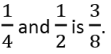
Reason : Rational number lying between two rational numbers x and y is ½(x y).

Detailed Solution: Question 9

We know that Rational number lying between two rational numbers x and y is ½ (x + y).

So, Reason is not correct.

Now,

So, Assertion is correct

Correct option is (c) Assertion (A) is true but reason (R) is false.

Test: Number System- Assertion & Reason Type Questions - Question 10

DIRECTION : In the following questions, a statement of assertion (A) is followed by a statement of reason (R). Mark the correct choice as:

Assertion : 0.329 is a terminating decimal.

Reason : A decimal in which a digit or a set of digits is repeated periodically, is called a repeating, or a recurring, decimal.

Detailed Solution: Question 10

We know that a decimal in which a digit or a set of digits is repeated periodically, is called a repeating, or a recurring, decimal.

So, Reason is correct.

Also, we know that a decimal that ends after a finite number of digits is called a terminating decimal.

Hence Assertion is correct but reason is not the correct explanation of Assertion Correct option is (b) Both assertion (A) and reason (R) are true but reason (R) is not the correct explanation of assertion (A).

5 videos|58 docs|20 tests
Information about Test: Number System- Assertion & Reason Type Questions Page
In this test you can find the Exam questions for Test: Number System- Assertion & Reason Type Questions solved & explained in the simplest way possible. Besides giving Questions and answers for Test: Number System- Assertion & Reason Type Questions, EduRev gives you an ample number of Online tests for practice
Download as PDF