CBSE Class 9  >  Class 9 Test  >  Mathematics (Maths)   >  Test: Angle Relations In Parallelogram - Class 9 MCQ

Angle Relations In Parallelogram - Free MCQ Practice Test with solutions,


MCQ Practice Test & Solutions: Test: Angle Relations In Parallelogram (10 Questions)

You can prepare effectively for Class 9 Mathematics (Maths) Class 9 with this dedicated MCQ Practice Test (available with solutions) on the important topic of "Test: Angle Relations In Parallelogram". These 10 questions have been designed by the experts with the latest curriculum of Class 9 2026, to help you master the concept.

Test Highlights:

  • - Format: Multiple Choice Questions (MCQ)
  • - Duration: 15 minutes
  • - Number of Questions: 10

Sign up on EduRev for free to attempt this test and track your preparation progress.

Test: Angle Relations In Parallelogram - Question 1

In a parallelogram the sum of two consecutive angles is

Detailed Solution: Question 1

The sum of any two consecutive angles in a parallelogram is always 180 degrees because they are supplementary. This occurs due to the following reasons:

  • Opposite sides of a parallelogram are parallel.
  • A transversal line intersects these parallel sides.
  • This creates same-side interior angles that add up to 180 degrees.

Test: Angle Relations In Parallelogram - Question 2

Bisectors of angles of a parallelogram form a

Detailed Solution: Question 2
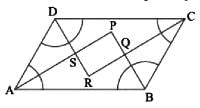
Let P, Q, R, and S be the points of intersection of the bisectors of ∠A and ∠B, ∠B and ∠C, ∠C and ∠D, and ∠D and ∠A respectively of parallelogram ABCD.

Properties of Parallelogram:

  • In any parallelogram, opposite angles are equal.
  • The sum of adjacent angles is 180

When we draw the angle bisectors of a parallelogram:

  • Each bisector divides the angle into two equal parts.
  • If we connect the points where bisectors intersect adjacent sides, the quadrilateral formed has all sides equal (because of Symmetry) and opposite angles are 90°.

A quadrilateral with all sides equal and all angles 90° is called a square.

Final Answer: Square
 

Test: Angle Relations In Parallelogram - Question 3

In a parallelogram PQRS, if diagonal PR bisects the ∠P, then it also bisects _____.

Detailed Solution: Question 3

In a parallelogram, if a diagonal bisects one angle, it also bisects another angle. This is due to the properties of a parallelogram where opposite angles are equal.

  • If diagonal PR bisects angle P, it also bisects angle R.
  • This is because the diagonals of a parallelogram create two congruent triangles.
  • Thus, the angles opposite to these triangles are equal, leading to the bisecting of angle R.

Test: Angle Relations In Parallelogram - Question 4

Which of the following statements is true about the diagonal of a parallelogram?

Detailed Solution: Question 4

Answer: A
Solution:
A diagonal of a parallelogram divides the parallelogram into two congruent triangles. This is a fundamental property of parallelograms as stated in Theorem 8.1.
Correct Answer: (A) A diagonal of a parallelogram divides it into two congruent triangles.

Test: Angle Relations In Parallelogram - Question 5

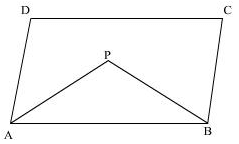
ABCD is a parallelogram in which the bisectors of angles ∠A and ∠B intersect at point P then ∠APB is
Detailed Solution: Question 5

Since ABCD is a Parallelogram. Therefore,
AD || BC
AB is a transversal . Therefore ,
A + B = 180°. [ Consecutive interior angles]
Multiply both sides by 1/2 ,
1/2 A + 1/2 B = 1/2 (180°) 
1/2 A + 1/2 B = 90° __【1】
Since, AP and PB are angle bisectors of A and B . Therefore,
Angle 1 = 1/2 A
Angle 2 = 1/2 B
Substitute the values in【1】,
Angle 1 + Angle 2 = 90°____【2】
Now, in ∆ APB,
1 + APB + 2 = 180°
90° + APB = 180°. [From 【2】]
APB = 90°
- HENCE PROVED

Test: Angle Relations In Parallelogram - Question 6

Which of the following statements correctly proves that each angle of a rectangle is a right angle?

Detailed Solution: Question 6

Answer: C
Solution:
A rectangle is a parallelogram where one angle is a right angle (90 degrees). Using the properties of parallelograms:

  1. Interior angles on the same side of the transversal add up to 180 degrees
  2. Opposite angles are equal.

Since one angle is 90 degrees , all other angles (∠B,∠C,∠D)  are also 90 degrees
Correct Answer: (C) A rectangle is a parallelogram where one angle is a right angle, and all opposite and adjacent angles are equal to 90°.

Test: Angle Relations In Parallelogram - Question 7

In a triangle, the line segment joining the midpoints of two sides has which of the following properties?

Detailed Solution: Question 7

Answer: C
Solution:
In a triangle, if a line segment joins the midpoints of two sides, it is parallel to the third side and half of its length. This is derived from the property of midpoints and parallelograms formed in the figure.
Correct Answer: (C) It is parallel to the third side and half of its length.

Test: Angle Relations In Parallelogram - Question 8

 Which of the following is not true for a parallelogram?    

Detailed Solution: Question 8

The statement that opposite angles are bisected by the diagonals is not generally true. This property does not hold for every parallelogram; it only occurs in special cases such as a rectangle or a rhombus under certain conditions.

Thus, the option that is not always true for a parallelogram is:
Option D:  Opposite angles are bisected by the diagonals.

Test: Angle Relations In Parallelogram - Question 9

If PQRS is a parallelogram, then ∠Q – ∠S is equal to:

Detailed Solution: Question 9

In a parallelogram, opposite angles are always equal. Since ∠Q and ∠S are opposite angles, it follows that:

∠Q = ∠S

Therefore:

∠Q – ∠S = 0°

The correct answer is D: 0°.

Test: Angle Relations In Parallelogram - Question 10

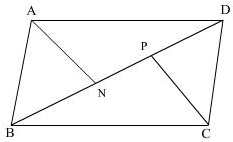
AN and CP are perpendiculars to the diagonal BD of a parallelogram ABCD. Choose the correct option
Detailed Solution: Question 10

Here, AN and CP are perpendiculars dropped from points A and C, respectively, to the diagonal BD of the parallelogram ABCD.

From properties of parallelograms and the perpendiculars drawn from vertices to the diagonal, it can be concluded that the two perpendiculars AN and CP must be equal in length. This is because in any parallelogram, the perpendicular distances from opposite vertices to the diagonal are always equal.

Thus, the correct option is: d) AN = CP

40 videos|468 docs|55 tests
Information about Test: Angle Relations In Parallelogram Page
In this test you can find the Exam questions for Test: Angle Relations In Parallelogram solved & explained in the simplest way possible. Besides giving Questions and answers for Test: Angle Relations In Parallelogram, EduRev gives you an ample number of Online tests for practice
40 videos|468 docs|55 tests
Download as PDF