NEET Exam  >  NEET Test  >  Biology Class 11  >  Test: Roots, Stems and Leaves - 2 - NEET MCQ

Roots, Stems and Leaves - 2 - Free MCQ Practice Test with solutions, NEET


MCQ Practice Test & Solutions: Test: Roots, Stems and Leaves - 2 (10 Questions)

You can prepare effectively for NEET Biology Class 11 with this dedicated MCQ Practice Test (available with solutions) on the important topic of "Test: Roots, Stems and Leaves - 2". These 10 questions have been designed by the experts with the latest curriculum of NEET 2026, to help you master the concept.

Test Highlights:

  • - Format: Multiple Choice Questions (MCQ)
  • - Duration: 10 minutes
  • - Number of Questions: 10

Sign up on EduRev for free to attempt this test and track your preparation progress.

Test: Roots, Stems and Leaves - 2 - Question 1

Inflorescence is collection of:

Detailed Solution: Question 1

The inflorescence is a collection of flowers in a particular branching pattern that does not contain full-size leaves among the flowers.

Topic in NCERT: THE INFLORESCENCE

Line in NCERT: "The arrangement of flowers on the floral axis is termed as inflorescence."

Test: Roots, Stems and Leaves - 2 - Question 2

Function of stem is:

Detailed Solution: Question 2

Functions of Stem:

  • It supports and holds leaves, flowers, and fruits.
  • The stem allows the leaves to arrange in a way that they are able to receive direct sunlight in order to efficiently perform photosynthesis. The arrangement and position of leaves also allow for gas exchange.
  • The xylem and phloem present in the vascular bundles of stems conduct water and minerals across the plant.
  • Stems bear flowers and fruits in a position that facilitates the processes of pollination, fertilization, and dispersion of seeds.
  • Some stems undergo modification to store food and water.
    Example: Succulents
  • Few green stems contain chloroplasts and are capable of carrying out photosynthesis as well.
  • Some stems are modified to carry out vegetative propagation which is a form of asexual reproduction seen in plants.

Topic in NCERT: THE STEM

Line in NCERT: "The main function of the stem is spreading out branches bearing leaves, flowers and fruits. It conducts water, minerals and photosynthates. Some stems perform the function of storage of food, support, protection and of vegetative propagation."

Test: Roots, Stems and Leaves - 2 - Question 3

Arrangement of leaves on a stem branch is: [MPPMT–1996]

Detailed Solution: Question 3

Option A: The arrangement of veins on the leaves is known as venation.

Option B: Vernation is the phenomenon of the arrangement of leaves in the bud.

Option C: The arrangement of the flowers on a plant is known as Inflorescence.

Option D: The arrangement of leaves on the stem branches is known as phyllotaxy. Alternate, opposite, whorled, and basal are different arrangements of leaves on the stem.

Hence, option D is correct.

Topic in NCERT: Phyllotaxy

Line in NCERT: "Phyllotaxy is the pattern of arrangement of leaves on the stem or branch."

Test: Roots, Stems and Leaves - 2 - Question 4

Which of the following statements is/are false about the leaf?

a. The leaf develops at the node and bears a bud in its axil.
b. The leaf is the most important vegetative organ for photosynthesis.
c. Pulvinus provides rigidity to the leaf blade and acts as a channel for transporting water, minerals and food materials.

Detailed Solution: Question 4

This is the correct option as this statement is false. Veins provide rigidity to the leaf blade and act as channels for transporting water, minerals and food materials.

Topic in NCERT: THE LEAF

Line in NCERT: "The leaf develops at the node and bears a bud in its axil."

Test: Roots, Stems and Leaves - 2 - Question 5

Which among the following is correct about the following structure?
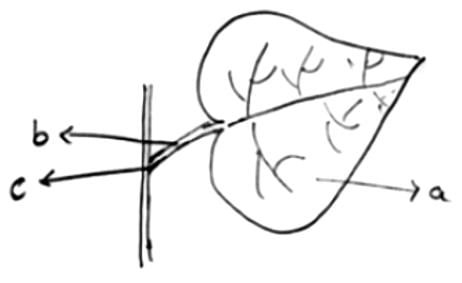
Detailed Solution: Question 5

  • The green expanded surface on the leaf is called Lamina or leaf blade.
  • The stalk like structure that attaches the leaf to the stem is called petiole.
  • The part of the leaf at one end of the petiole that attaches the leaf to the node is called the leaf base.

Hence, the correct option is C
NCERT Reference: Topic “THE LEAF” of the chapter "Morphology of Flowering Plants" of NCERT.
NCERT Line: The source describes a typical leaf as consisting "of three main parts: leaf base, petiole, and lamina.

Test: Roots, Stems and Leaves - 2 - Question 6

Which among the following is incorrect about phyllotaxy?

Detailed Solution: Question 6

  • The arrangement of leaves in the plant is called phyllotaxy.
  • In alternate phyllotaxy, a single leaf is present at each node. This kind of phyllotaxy is seen in China rose. In whorled phyllotaxy, multiple leaves are present at each node.

Hence, the correct option is C
NCERT Reference: Ttopic - Phyllotaxy of chapter "Morphology of Flowering Plants" of NCERT.
 NCERT Line: In an alternate type of phyllotaxy, a single leaf arises at each node in alternate manner, as in china rose, mustard and sun flower plants.

Test: Roots, Stems and Leaves - 2 - Question 7

Which among the following statements is incorrect about stem?

Detailed Solution: Question 7

The stem bears fruits, flowers, buds, and leaves, but these are not part of the stem system itself.The stem system mainly includes nodes, internodes, axillary buds, and terminal buds.Fruits and flowers are reproductive structures and are not considered part of the stem system.

The other statements are correct: (a) Nodes are the points where buds arise. (b) The internode is the region between two nodes. (d) The stem indeed helps in the conduction of water and nutrients between the root and shoot.

NCERT Reference: Topic “THE STEM” of the chapter "Morphology of Flowering Plants" of NCERT.
NCERT Line: "The ascending part of the axis bearing branches, leaves, flowers, and fruits." "The main function of the stem is spreading out branches bearing leaves, flowers, and fruits." 

Test: Roots, Stems and Leaves - 2 - Question 8

Which of the following statement is true?

Detailed Solution: Question 8

Correct option: D.

  • Statement 1 - False. Alstonia typically exhibits whorled phyllotaxy, where more than two leaves arise at a node, not alternate arrangement.

  • Statement 2 - False. A cymose inflorescence is determinate: the main axis ends in a flower and further flowering proceeds in basipetal order. The description given (main axis continues to grow; acropetal succession) corresponds to a racemose inflorescence.

  • Statement 3 - False. The corolla of Calotropis shows valvate aestivation, where petal (or sepal) margins meet without overlapping. Imbricate means overlapping margins, so imbricate aestivation does not apply to Calotropis.

  • Statement 4 - True. In palmately compound leaves all leaflets arise from a common point at the tip of the petiole (example: silk cotton, Bombax), so this statement is correct.

Therefore, option D is the correct choice.

Test: Roots, Stems and Leaves - 2 - Question 9

What is the primary function of the root cap in a plant's root system?

Detailed Solution: Question 9

The root cap serves the essential function of protecting the delicate growing tip of the root as it pushes through the soil. This thimble-like structure helps to shield the root from mechanical damage and desiccation, allowing the root to effectively explore and anchor itself into the soil. An interesting fact about root caps is that they also secrete a slimy substance that helps reduce friction as the root grows downward, making the process more efficient.
NCERT References: Topic “The Root” of the chapter "Morphology of Flowering Plants" of NCERT.
NCERT Line: . It protects the tender apex of the root as it makes its way through the soil

Test: Roots, Stems and Leaves - 2 - Question 10

Which type of root system is characterized by a main root that grows deep into the soil and bears several lateral roots?

Detailed Solution: Question 10

The tap root system is characterized by a primary root that grows deep into the soil and gives rise to lateral roots of varying orders. This structure provides stability and efficient nutrient absorption, as seen in plants like mustard. An interesting fact is that tap roots can store significant amounts of food, which is why plants like carrots and radishes are often used for storage purposes in agriculture.
NCERT References: Topic “The Root” of the chapter "Morphology of Flowering Plants" of NCERT.
NCERT Line: In the majority of the dicotyledonous plants, the direct elongation of the radicle leads to the formation of primary root which grows inside the soil. It bears lateral roots of several orders that are referred to as secondary, tertiary, etc. roots.

142 videos|410 docs|135 tests
Information about Test: Roots, Stems and Leaves - 2 Page
In this test you can find the Exam questions for Test: Roots, Stems and Leaves - 2 solved & explained in the simplest way possible. Besides giving Questions and answers for Test: Roots, Stems and Leaves - 2, EduRev gives you an ample number of Online tests for practice
142 videos|410 docs|135 tests
Download as PDF