NEET Exam  >  NEET Test  >  Biology Class 11  >  Test: Morphology of Flowering Plants - 1 - NEET MCQ

Morphology of Flowering Plants - 1 - Free MCQ Practice Test with solutions,


MCQ Practice Test & Solutions: Test: Morphology of Flowering Plants - 1 (15 Questions)

You can prepare effectively for NEET Biology Class 11 with this dedicated MCQ Practice Test (available with solutions) on the important topic of "Test: Morphology of Flowering Plants - 1". These 15 questions have been designed by the experts with the latest curriculum of NEET 2026, to help you master the concept.

Test Highlights:

  • - Format: Multiple Choice Questions (MCQ)
  • - Duration: 15 minutes
  • - Number of Questions: 15

Sign up on EduRev for free to attempt this test and track your preparation progress.

Test: Morphology of Flowering Plants - 1 - Question 1

In which of the following combinations, all plants show the SAME type of root system?

Detailed Solution: Question 1

Option B is correct.

Banyan develops prop/aerial roots that arise from the stem and branches; these roots are adventitious in origin.

Monstera produces aerial/adventitious roots used for climbing and absorption; these roots are also adventitious.

Grass has a fibrous root system which is formed mainly by adventitious roots arising from the base of the stem; the roots are adventitious in origin.

All three plants therefore share the same root-origin type: roots that are adventitious. Hence Option B is the correct choice.

Test: Morphology of Flowering Plants - 1 - Question 2

A student observes a flower that cannot be divided into two equal halves by ANY vertical plane. Which of the following best describes this flower, and which plant is the correct example?

Detailed Solution: Question 2

Asymmetric flowers cannot be divided into two similar halves by ANY vertical plane — this is seen in Canna. Zygomorphic flowers (pea, bean, Cassia, gulmohur) allow division in only ONE particular plane. Actinomorphic flowers (mustard, datura, chilli) allow division in ANY radial plane. Students frequently confuse zygomorphic with asymmetric at NEET level.

Test: Morphology of Flowering Plants - 1 - Question 3

Which of the following correctly matches the type of placentation with the ovary condition and example?

Detailed Solution: Question 3

Axile placentation occurs in a multilocular ovary where ovules attach to the central axis (e.g., china rose, tomato, lemon). Parietal placentation has ovules on the inner wall; the ovary is one-chambered but becomes two-chambered due to a false septum (mustard, Argemone) — making Option A wrong. Free central placentation has no septa (not with septa), making Option C wrong. Marginal placentation has ovules along the ventral suture, not on an axial placenta, making Option D wrong.

Test: Morphology of Flowering Plants - 1 - Question 4

Consider the floral formula: ⊕ ♀ K(5) C(5) A5 G(2)
Which of the following correctly interprets this formula?

Detailed Solution: Question 4

⊕ = actinomorphic; ♀ = female flower (not bisexual — bisexual is represented by ♀ with a combined male symbol); K(5) = 5 united sepals (brackets = fusion); C(5) = 5 united petals; A5 = 5 free stamens; G(2) = bicarpellary syncarpous superior ovary (G with overline = inferior). This matches the Solanaceae floral formula pattern. Reading floral formulae precisely is a high-frequency NEET skill.

Test: Morphology of Flowering Plants - 1 - Question 5

Which of the following statements about the androecium is INCORRECT?

Detailed Solution: Question 5

Correct answer: C

Diadelphous condition means the stamens are united into two bundles. A standard example is pea (Pisum sativum).

China rose (Hibiscus rosa-sinensis) shows the monadelphous condition, where the filaments are united into a single bundle, so statement C is incorrect.

Epipetalous stamens are attached to the petals; this is seen in brinjal (Solanum), so statement A is correct.

Polyadelphous means stamens are united into more than two bundles; this occurs in plants like Citrus, so statement B is correct.

Epiphyllous (stamens inserted on the perianth/tepals) is observed in plants such as lily (Lilium), so statement D is correct.

Test: Morphology of Flowering Plants - 1 - Question 6

The underground stem of potato differs from a root because it:

Detailed Solution: Question 6

The key morphological distinction between a stem and a root is the presence of nodes, internodes, and buds/scale leaves in stems. Potato (Solanum tuberosum) has an underground stem (tuber) that shows these features. Storage of food and lack of chlorophyll are not exclusive to stems — roots also store food, making Options A and B insufficient distinguishing features.

Test: Morphology of Flowering Plants - 1 - Question 7

Consider the following four statements about cymose and racemose inflorescences:
1. In racemose inflorescence, the main axis continues to grow indefinitely.
2. In cymose inflorescence, flowers are arranged in acropetal succession.
3. In racemose inflorescence, older flowers are present towards the base.
4. In cymose inflorescence, the main axis terminates in a flower.
How many of the above statements are CORRECT?

Detailed Solution: Question 7

Statement 1 is correct — the main axis in racemose inflorescence continues to grow. Statement 2 is INCORRECT — acropetal succession belongs to racemose; cymose inflorescence shows basipetal order. Statement 3 is correct — in racemose, older flowers are at the base (acropetal = younger towards apex). Statement 4 is correct — in cymose, the main axis terminates in a flower, limiting growth. Three statements are correct.

Test: Morphology of Flowering Plants - 1 - Question 8

Consider the following statements about the gynoecium:
1. Stigma is the receptive surface for pollen and is usually at the tip of the style.
2. In apocarpous gynoecium, carpels are fused as in mustard and tomato.
3. After fertilisation, ovules develop into seeds and the ovary matures into a fruit.
4. Each ovary bears ovules attached to a cushion-like placenta.
Which of the above statements are INCORRECT?

Detailed Solution: Question 8

Statement 2 is the only incorrect one — apocarpous means carpels are FREE (as in lotus and rose). When carpels are FUSED, it is called syncarpous (as in mustard and tomato). Statements 1, 3, and 4 are all correctly stated per the NCERT text. This reversal of apocarpous/syncarpous is a very common NEET trick question.

Test: Morphology of Flowering Plants - 1 - Question 9

Which combination of features CORRECTLY describes the Solanaceae family?
1. Bicarpellary, syncarpous, superior ovary
2. Axile placentation with many ovules
3. Stamens polyadelphous
4. Valvate aestivation in both calyx and corolla
5. Fruits: berry or capsule

Detailed Solution: Question 9

The Solanaceae family has five epipetalous stamens (NOT polyadelphous — that's citrus/polyadelphous = more than two bundles). Hence Statement 3 is incorrect. Statements 1, 2, 4, and 5 are all accurate per the NCERT description of Solanaceae. Epipetalous vs. polyadelphous is a high-yield NEET distinction.

Test: Morphology of Flowering Plants - 1 - Question 10

Which of the following statements about aestivation is/are CORRECT?
1. Valvate aestivation — sepals/petals touch at margins without overlapping — seen in Calotropis.
2. Twisted aestivation — one margin overlaps the next in a consistent direction — seen in cotton, lady's finger.
3. Imbricate aestivation — overlapping but not in any specific direction — seen in Cassia and gulmohur.
4. Vexillary aestivation — the two smallest petals (keel) overlap the wings, which overlap the standard.

Detailed Solution: Question 10

Statement 4 is incorrect — it is REVERSED. In vexillary aestivation, the LARGEST petal (standard) overlaps the two lateral wings, which in turn overlap the two smallest anterior petals (keel) — not the other way around. This reversal is a classic NEET MCQ trap. Statements 1, 2, and 3 are correctly described.

Test: Morphology of Flowering Plants - 1 - Question 11

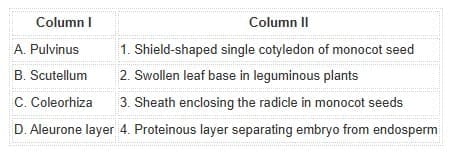
Match the following plant parts with their correct descriptions:
Detailed Solution: Question 11

Pulvinus = swollen leaf base in legumes (A-2). Scutellum = large shield-shaped cotyledon in monocot seeds (B-1). Coleorhiza = sheath enclosing the radicle (C-3) — note: coleoptile encloses the plumule. Aleurone layer = proteinous layer between endosperm and embryo in maize (D-4). Confusing coleoptile with coleorhiza is extremely common in NEET.

Test: Morphology of Flowering Plants - 1 - Question 12

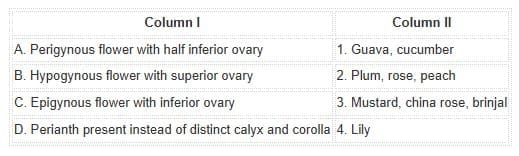
Match the following floral conditions with the correct plant examples:
Detailed Solution: Question 12

Perigynous = gynoecium at centre, other parts on rim of thalamus, half inferior ovary → plum, rose, peach (A-2). Hypogynous = gynoecium at highest position, superior ovary → mustard, china rose, brinjal (B-3). Epigynous = thalamus grows over and fuses with ovary, inferior ovary → guava, cucumber, sunflower (C-1). Perianth (undifferentiated calyx + corolla) → lily (D-4).

Test: Morphology of Flowering Plants - 1 - Question 13

Assertion (A): In a pinnately compound leaf, a bud is present in the axil of the petiole but NOT in the axil of individual leaflets.
Reason (R): Leaflets of a compound leaf are not true leaves; they lack axillary buds because only the whole compound leaf represents a single leaf unit attached at the node.

Detailed Solution: Question 13

This is a conceptually deep NEET question. A compound leaf as a whole has an axillary bud at the base of its petiole (where it meets the node), confirming it is a single leaf. Individual leaflets do NOT have axillary buds, which distinguishes them from branches bearing simple leaves. The reason correctly and completely explains why the assertion holds true.

Test: Morphology of Flowering Plants - 1 - Question 14

Assertion (A): The endosperm in a maize seed is separated from the embryo by the aleurone layer, and the radicle is enclosed in a coleorhiza.
Reason (R): Monocotyledonous seeds are generally endospermic because the single cotyledon (scutellum) absorbs nutrients from the endosperm during germination rather than storing them directly.

Detailed Solution: Question 14

Assertion A is fully correct — aleurone layer separates embryo from endosperm in maize, and the radicle is enclosed in coleorhiza (while the plumule is enclosed in coleoptile). Reason R is also biologically correct — the scutellum secretes enzymes and absorbs digested food from the endosperm during germination. However, R explains WHY monocot seeds are endospermic in general, not specifically why the structural features in A exist. Hence R does not directly explain A — they are two independent correct facts.

Test: Morphology of Flowering Plants - 1 - Question 15

Assertion (A): Sunflower and marigold show basal placentation while mustard shows parietal placentation.
Reason (R): In basal placentation, a single ovule is attached at the base of a unilocular ovary, whereas in parietal placentation, the ovary becomes falsely two-chambered due to formation of a false septum.

Detailed Solution: Question 15

Assertion A is correct — sunflower and marigold have basal placentation with a single ovule at the base; mustard has parietal placentation. Reason R is also factually correct regarding the structural descriptions of both placentation types. However, R describes the structural definitions rather than explaining WHY specific plants show those particular placentation types — so R is a correct independent statement but not a causal explanation of A.

142 videos|410 docs|135 tests
Information about Test: Morphology of Flowering Plants - 1 Page
In this test you can find the Exam questions for Test: Morphology of Flowering Plants - 1 solved & explained in the simplest way possible. Besides giving Questions and answers for Test: Morphology of Flowering Plants - 1, EduRev gives you an ample number of Online tests for practice
142 videos|410 docs|135 tests
Download as PDF