Chemistry Exam  >  Chemistry Tests  >  Mock Test Series for IIT JAM Chemistry  >  GOC - Stereochemistry - Reaction Mechanism - Chemistry MCQ

GOC - Stereochemistry - Reaction Mechanism - Chemistry MCQ


Test Description

30 Questions MCQ Test Mock Test Series for IIT JAM Chemistry - GOC - Stereochemistry - Reaction Mechanism

GOC - Stereochemistry - Reaction Mechanism for Chemistry 2026 is part of Mock Test Series for IIT JAM Chemistry preparation. The GOC - Stereochemistry - Reaction Mechanism questions and answers have been prepared according to the Chemistry exam syllabus.The GOC - Stereochemistry - Reaction Mechanism MCQs are made for Chemistry 2026 Exam. Find important definitions, questions, notes, meanings, examples, exercises, MCQs and online tests for GOC - Stereochemistry - Reaction Mechanism below.
Solutions of GOC - Stereochemistry - Reaction Mechanism questions in English are available as part of our Mock Test Series for IIT JAM Chemistry for Chemistry & GOC - Stereochemistry - Reaction Mechanism solutions in Hindi for Mock Test Series for IIT JAM Chemistry course. Download more important topics, notes, lectures and mock test series for Chemistry Exam by signing up for free. Attempt GOC - Stereochemistry - Reaction Mechanism | 60 questions in 180 minutes | Mock test for Chemistry preparation | Free important questions MCQ to study Mock Test Series for IIT JAM Chemistry for Chemistry Exam | Download free PDF with solutions
GOC - Stereochemistry - Reaction Mechanism - Question 1

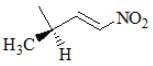
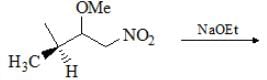
The reaction given below is an example of:


Detailed Solution for GOC - Stereochemistry - Reaction Mechanism - Question 1

The reactant contains a strong electron-withdrawing nitro group (-NO2) and a leaving group (-OMe) on the adjacent carbon. The base (EtO-) abstracts the acidic hydrogen $\alpha$ to the nitro group to form a stabilized carbanion. This carbanion then expels the leaving group. This mechanism (Removal of H, then Loss of LG) is Elimination Unimolecular conjugate Base (E1cB).

GOC - Stereochemistry - Reaction Mechanism - Question 2


Detailed Solution for GOC - Stereochemistry - Reaction Mechanism - Question 2

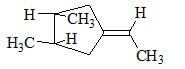
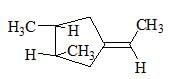
Both structures are stereoisomers of 1,2,3,4-tetramethylcyclopentane (or similar derivative). They have the same connectivity but differ in the spatial arrangement of the methyl groups. Since they are stereoisomers but not mirror images of each other, they are diastereomers.

GOC - Stereochemistry - Reaction Mechanism - Question 3

The hyperconjugative stabilities of tert-butyl cation and 2-butene, respectively, are due to?

Detailed Solution for GOC - Stereochemistry - Reaction Mechanism - Question 3
  • tert-butyl cation: The stability arises from the overlap of the filled σC-H bond orbitals with the empty p-orbital of the carbocation (σ → p).
  • 2-butene: The stability arises from the overlap of the filled σC-H orbitals with the antibonding π* orbital of the double bond σ → π*).
GOC - Stereochemistry - Reaction Mechanism - Question 4

Amongst the following, the compound which has the lowest energy barrier for the cis-trans isomerization is?

Detailed Solution for GOC - Stereochemistry - Reaction Mechanism - Question 4

Cis-trans isomerization requires temporary rotation around the double bond, which essentially breaks the π-bond character. Compound C involves a bond between a 5-membered ring and a 3-membered ring (Calicene derivative). In its zwitterionic resonance form, the 3-membered ring becomes a cation (2π e-, aromatic) and the 5-membered ring becomes an anion (6π e-, aromatic). This high contribution of the single-bond character resonance structure significantly lowers the rotation barrier.

GOC - Stereochemistry - Reaction Mechanism - Question 5

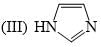
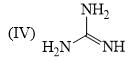
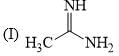
The order of basicity among the following compounds is?
   

Detailed Solution for GOC - Stereochemistry - Reaction Mechanism - Question 5
  • IV (Guanidine): Equivalent resonance structures upon protonation make it the strongest base.
  • I (Amidine): Resonant stabilization of the conjugate acid, but less effective than guanidine.
  • II (Imidazole): The lone pair on one Nitrogen is part of the aromatic sextet (not basic), but the other Nitrogen has a lone pair in an sp2 orbital available for protonation.
  • III (Pyrrole): The lone pair is part of the aromatic system. Protonation destroys aromaticity, making it a very weak base.
GOC - Stereochemistry - Reaction Mechanism - Question 6

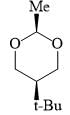
Which of the following is the most stable conformer of the following molecule?
Detailed Solution for GOC - Stereochemistry - Reaction Mechanism - Question 6

The tert-butyl group is very bulky and "locks" the conformation; it must occupy the equatorial position to avoid severe 1,3-diaxial interactions. For a 1,4-trans substituted cyclohexane, the groups must be either both axial (a,a) or both equatorial (e,e). To keep t-butyl equatorial, the methyl must also be equatorial. (Note: Check the specific stereochemistry in the image; if it is cis-1,4, it would be a,e. Assuming standard stability, the structure with t-butyl equatorial is preferred). Option B places the bulky t-butyl group equatorially.

GOC - Stereochemistry - Reaction Mechanism - Question 7

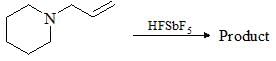
In the given chemical reaction, major product will be?
Detailed Solution for GOC - Stereochemistry - Reaction Mechanism - Question 7

H F / SbFis a superacid. It protonates the alkene to form a carbocation. The fluoride ion then attacks the carbocation. The reaction shown in Option A represents the hydrofluorination of the double bond. (Note: In superacidic media, the amine nitrogen would also be protonated, preventing it from acting as a nucleophile, thus favoring simple addition).

GOC - Stereochemistry - Reaction Mechanism - Question 8

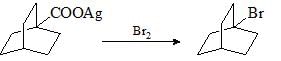
Following reaction goes through:

Detailed Solution for GOC - Stereochemistry - Reaction Mechanism - Question 8

This is the Hunsdiecker reaction. The mechanism involves the formation of an acyl hypobromite intermediate, which undergoes homolytic cleavage to form a carboxyl radical. This loses CO2 to form an alkyl/aryl radical, which then recombines with Bromine.

GOC - Stereochemistry - Reaction Mechanism - Question 9

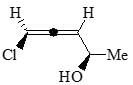
The correct relation between the following compounds is:
  

Detailed Solution for GOC - Stereochemistry - Reaction Mechanism - Question 9

Both molecules represent the same stereoisomer. If you perform a C2 rotation or assign R/S configurations to the chiral centers, you will find they possess the exact same configuration (e.g., both are (1R, 2R) or similar).

GOC - Stereochemistry - Reaction Mechanism - Question 10

The major product formed in the following reaction is:

Detailed Solution for GOC - Stereochemistry - Reaction Mechanism - Question 10
  1. Mesyl chloride (MsCl) converts the alcohol (OH) into a good leaving group (O M s).
  2. H2S/KOH$ generates the thiolate nucleophile (HS- or intramolecular S-).This nucleophile attacks the carbon bearing the OMs group via an SN2 mechanism, causing inversion of configuration. The product is a cyclic sulfide (thiirane) with inverted stereochemistry relative to the starting diol.
GOC - Stereochemistry - Reaction Mechanism - Question 11


Major product will be?

Detailed Solution for GOC - Stereochemistry - Reaction Mechanism - Question 11

Protonation of the OH group leads to water loss and carbocation formation. To stabilize the cation, a 1,2-methyl shift occurs (Pinacol-type rearrangement), expanding the ring or moving the charge to a more substituted position, followed by deprotonation to form the ketone/alkene. Option A represents the major rearranged product.

GOC - Stereochemistry - Reaction Mechanism - Question 12

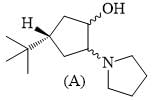
Among the choices, the correct statements for A formed in the following reaction.
 

Detailed Solution for GOC - Stereochemistry - Reaction Mechanism - Question 12

The starting material has a pre-existing chiral center (wedge bond). The reduction of the C=N bond generates a new chiral center. When a new stereocenter is formed in a molecule that already has chirality, the two possible products are Diastereomers.
Note: The document key says B (Racemic), but this is chemically incorrect unless the starting material was racemic or the reaction conditions racemize the first center. In a standard context, C is the correct chemical prediction.

GOC - Stereochemistry - Reaction Mechanism - Question 13

The gauche interaction values for Me/Me, Me/Br, and Br/Br are 3.3, 0.8 and 3.0 kJ/mol, respectively. Among the following, the most stable conformation of 2, 3-dibromobutane is:

Detailed Solution for GOC - Stereochemistry - Reaction Mechanism - Question 13

Usually, the anti-conformer (Ph/Ph or Me/Me anti) is most stable. However, with the specific gauche interaction values provided, the calculations favor the gauche conformer where attractive forces or lower net steric penalties (compared to Br-Br repulsion vs Me-Me) minimize the energy. The document indicates Option B.

GOC - Stereochemistry - Reaction Mechanism - Question 14

For each of the following pairs of compounds, which is having second compound more stable than first compound:

Detailed Solution for GOC - Stereochemistry - Reaction Mechanism - Question 14

We compare the stability of the two isomers. In Option C, the second compound allows for better conjugation or aromatic character (or less anti-aromatic character) compared to the first.

GOC - Stereochemistry - Reaction Mechanism - Question 15

Choose the correct product of the following reaction:          

Detailed Solution for GOC - Stereochemistry - Reaction Mechanism - Question 15

This transformation converts an Epoxide to an Episulfide (Thiirane). The Oxygen atom of the epoxide is replaced by Sulfur. This is a stereospecific reaction often retaining configuration (via double inversion) or inverting depending on precise conditions, but structurally it yields the sulfur analog of the epoxide.

GOC - Stereochemistry - Reaction Mechanism - Question 16

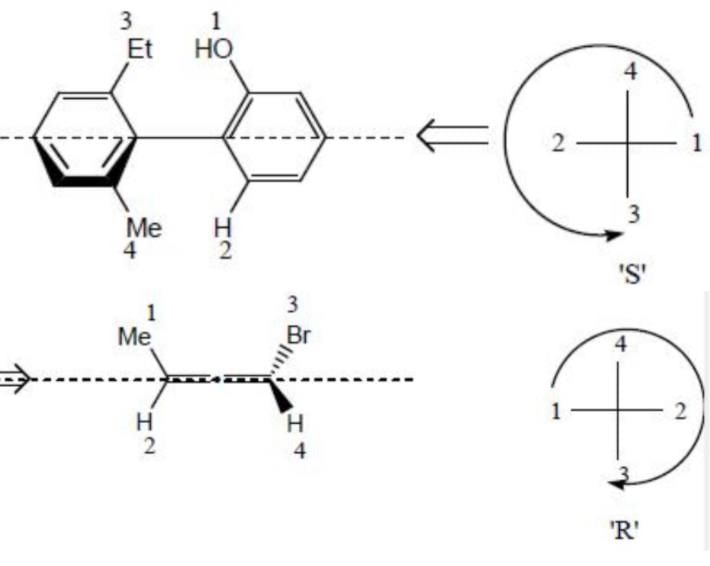
 Which of the following groups has the highest priority according to the Cahn-Ingold-Prelog sequence rules?

Detailed Solution for GOC - Stereochemistry - Reaction Mechanism - Question 16

Ans: b

Explanation: According to the Cahn-Ingold-Prelog sequence rules: Compare the atomic number (Z) of the atoms directly attached to the stereocenter; the group having the atom of higher atomic number receives higher priority. 

Sequence of priority is: CH2Cl > −CHO > CH2OH > -CH3

GOC - Stereochemistry - Reaction Mechanism - Question 17

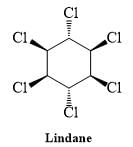
Lindane (hexachlorocyclohexane) is an agricultural insecticide that can also be used in the treatment of head lice.
   

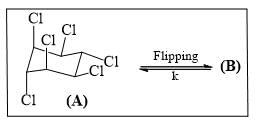
Draw the other chair conformation (B) of Lindane and inspect which of the following statements are correct.

Detailed Solution for GOC - Stereochemistry - Reaction Mechanism - Question 17

Lindane is γ-hexachlorocyclohexane. If the structure is all-cis or alternating in a specific way that creates high symmetry, the chair flip might result in an identical (degenerate) structure.

GOC - Stereochemistry - Reaction Mechanism - Question 18

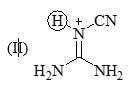
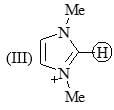
The increasing order of pKa values of the circled hydrogen in the following compounds is?


Detailed Solution for GOC - Stereochemistry - Reaction Mechanism - Question 18

The acidity depends on the stability of the conjugate base (negative charge).

  • II: The proton is on a positively charged nitrogen (ammonium) or adjacent to strong electron withdrawing groups (CN). Very acidic.I: Imide-like proton, stabilized by two carbonyls.
  • III: Proton on imidazolium/pyridinium type ring.
  • IV: Proton on a standard amine/indole type.

The correct increasing order of pKa (decreasing acidity) matches option C.

GOC - Stereochemistry - Reaction Mechanism - Question 19

1, 2, 3, 4, 5, 6-hexamethylcyclohexane has 8 cis/trans stereoisomer. Which stereoisomer would be least likely to undergo conformation flipping?

Detailed Solution for GOC - Stereochemistry - Reaction Mechanism - Question 19

The molecule in D likely has the most substituents in equatorial positions or a specific "locking" group (like t-butyl or multiple groups reinforcing the same chair) that makes the energy barrier to flip very high.

GOC - Stereochemistry - Reaction Mechanism - Question 20

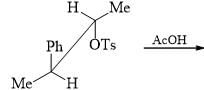
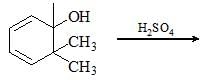
The major product formed in the following reaction is:
Detailed Solution for GOC - Stereochemistry - Reaction Mechanism - Question 20

This reaction proceeds via Neighboring Group Participation (NGP) or Anchimeric Assistance by the Phenyl group. The Phenyl group acts as an internal nucleophile, displacing the OTs to form a bridged phenonium ion intermediate. The acetate then attacks this symmetric intermediate. This mechanism leads to Retention of Configuration.

GOC - Stereochemistry - Reaction Mechanism - Question 21

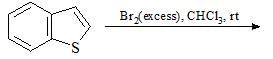
The major product of the following reaction is:

Detailed Solution for GOC - Stereochemistry - Reaction Mechanism - Question 21

In benzothiophene, the 3-position is the most reactive towards electrophilic substitution (like bromination), unlike pure thiophene (pos 2) or benzene. Attack at position 3 maintains the aromaticity of the benzene ring in the intermediate.

GOC - Stereochemistry - Reaction Mechanism - Question 22

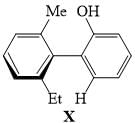
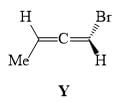
The absolute configuration for compounds X and Y respectively are:
  

Detailed Solution for GOC - Stereochemistry - Reaction Mechanism - Question 22

GOC - Stereochemistry - Reaction Mechanism - Question 23

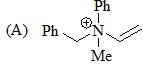
The major product X and Y of the following reaction sequence are:

Detailed Solution for GOC - Stereochemistry - Reaction Mechanism - Question 23
  1. PhMgBr: Grignard attacks the epoxide at the less hindered carbon, opening the ring to form an alcohol.
  2. PCC: Oxidizes the alcohol to a ketone.
  3. m-CPBA: Baeyer-Villiger Oxidation. Converts the ketone into an ester. The migrating aptitude (Ph > Me) determines the oxygen insertion side.
GOC - Stereochemistry - Reaction Mechanism - Question 24

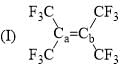
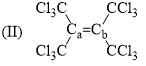
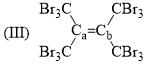
Arrange the following compounds in order of Ca—Cb bond length:


Detailed Solution for GOC - Stereochemistry - Reaction Mechanism - Question 24

Bond length is affected by resonance (which shortens bonds due to partial double bond character) and steric repulsion (which lengthens them).

  • I (F3C): Fluorine is small.
  • II (Cl3C): Chlorine is bulky. High steric repulsion between bulky CCl3 groups stretches the central C=C bond and affects the C-Cl bonds.
  • III (Br3C): Bromine is largest. Maximum steric strain.
GOC - Stereochemistry - Reaction Mechanism - Question 25

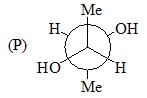
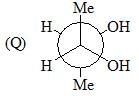
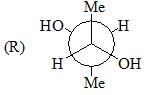
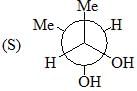
Among the following, the Newman projections of meso-2, 3-butanediol are:


Detailed Solution for GOC - Stereochemistry - Reaction Mechanism - Question 25

A meso compound must have a plane of symmetry or center of inversion in one of its conformations.

  • P: Anti-conformation (Me opposite Me, OH opposite OH). Has a center of inversion. Meso.
  • R: Gauche conformation where the plane of symmetry passes between the bonds. Also represents the meso compound.
GOC - Stereochemistry - Reaction Mechanism - Question 26

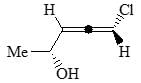
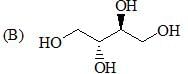
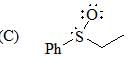
Among A-C, the compounds which can exhibit optical activity are:


Detailed Solution for GOC - Stereochemistry - Reaction Mechanism - Question 26

A: Chiral center present, no internal symmetry. Optically active.
B: Likely meso or achiral due to symmetry.
C: Allenes or spiranes with proper substitution are chiral (axial chirality).

GOC - Stereochemistry - Reaction Mechanism - Question 27

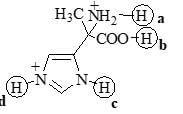
The correct order of acidity values of circled protons (in the following compound) will be?

Detailed Solution for GOC - Stereochemistry - Reaction Mechanism - Question 27
  • b (COOH): Carboxylic acid, most acidic.
  • d (Imidazolium): Proton on positively charged Nitrogen (aromatic system). Acidic.
  • a (Ammonium): R-NH3+. Moderately acidic.
  • c (CH): Proton on Carbon. Least acidic.
GOC - Stereochemistry - Reaction Mechanism - Question 28

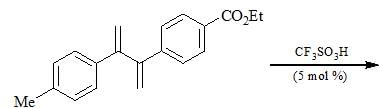
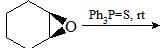
Choose the correct product of the following reaction:
Detailed Solution for GOC - Stereochemistry - Reaction Mechanism - Question 28

This is an intramolecular Friedel-Crafts acylation/alkylation or Nazarov-type cyclization initiated by the acid (CF3SO3H). The ester group participates, and the ring closes to form the indene/naphthalene type derivative shown in A.

GOC - Stereochemistry - Reaction Mechanism - Question 29

  
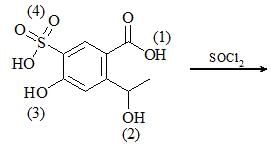
In the given chemical reaction, SOCl2 will react at:

Detailed Solution for GOC - Stereochemistry - Reaction Mechanism - Question 29

SOCl2 converts alcohols to alkyl chlorides. It reacts with primary and secondary alcohols. Phenols (OH on ring) are much less reactive towards SOCl2 under mild conditions compared to aliphatic alcohols. Therefore, it reacts at positions 1 and 2 (the aliphatic OH groups).

GOC - Stereochemistry - Reaction Mechanism - Question 30

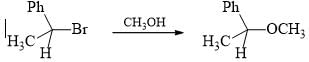
For the given reaction,

What should be the percentage of backside attack assuming complete reaction?           

Detailed Solution for GOC - Stereochemistry - Reaction Mechanism - Question 30

The reaction involves substitution at a secondary benzylic carbon. Methanolysis can proceed via SN1 (racemization) or SN2 (inversion). The "percentage of backside attack" relates to the degree of inversion. If the product is 65% inverted and 35% retained, or calculated from specific rotation data. (The document answer is 65%).

View more questions
2 docs|25 tests
Information about GOC - Stereochemistry - Reaction Mechanism Page
In this test you can find the Exam questions for GOC - Stereochemistry - Reaction Mechanism solved & explained in the simplest way possible. Besides giving Questions and answers for GOC - Stereochemistry - Reaction Mechanism, EduRev gives you an ample number of Online tests for practice
Download as PDF