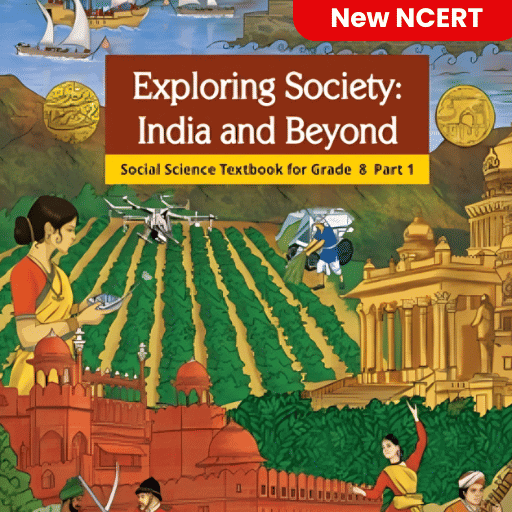
 | INFINITY COURSE Class 8 Social Science (Exploring Society) - NCERT Solutions, MCQs24,502 students learning this week · Last updated on Apr 07, 2026 |
Class 8 Social Science (Exploring Society) Study Material












Trending Courses for Class 8

What is Class 8 Social Science NCERT Curriculum?
Class 8 Social Science forms a crucial part of the CBSE curriculum, offering students a comprehensive understanding of history, geography, civics, and economics. The New NCERT Social Science Class 8 curriculum has been thoughtfully designed to develop critical thinking skills and foster awareness about our nation's past, present, and socio-economic structures. This integrated approach ensures that lakhs of students across India gain a holistic perspective on how societies function and evolve.
The NCERT Class 8 Social Science syllabus encompasses four major subjects: History (Itihas), Geography (Bhugol), Civics (Nagrik Shastra), and Economics (Arthashastra). Each subject builds upon foundational concepts while introducing students to contemporary issues relevant to India's development. Whether you're focusing on natural resources, political structures, or economic principles, this course equips you with knowledge that extends beyond textbooks.
Core Components of Class 8 SST
- History: Understanding India's political journey and historical transformations
- Geography: Exploring natural resources and environmental conservation
- Civics: Learning about India's democratic systems and electoral processes
- Economics: Grasping fundamental economic concepts and factors of production
Students appearing for Class 8 examinations benefit greatly from understanding the interconnections between these four disciplines, as modern problem-solving often requires multidisciplinary knowledge.
Best Study Materials for Class 8 Social Science Free Download
Securing good marks in Class 8 Social Science requires access to quality study materials that explain concepts clearly and comprehensively. Fortunately, excellent resources are available for free download, including chapter notes, solutions, and practice materials that align perfectly with the latest NCERT curriculum.
When preparing for Class 8 Social Science, having structured notes makes revision significantly easier. Our platform offers comprehensive chapter notes that break down complex topics into manageable segments. Additionally, you'll find worksheets with complete solutions that help you practice important questions and understand problem-solving approaches.
Essential Free Resources for Preparation
| Resource Type | Best For | Key Benefit |
|---|---|---|
| Chapter Notes | Quick revision and concept clarity | Organized summaries of all topics |
| Flashcards | Memorizing key terms and definitions | Portable, quick-reference format |
| Worksheets & Solutions | Practice and self-assessment | Real exam-style questions |
| Unit Tests | Chapter-wise evaluation | Identify weak areas early |
For visual learners, mindmaps for Class 8 Social Science provide excellent visual representations of complex topics, making it easier to retain information. You can also access PowerPoint presentations that present concepts in an engaging, structured manner.
Understanding Natural Resources and Their Use - Class 8 Geography
Natural resources form the foundation of any nation's economic development. In Class 8 Geography, students learn to identify, classify, and understand the sustainable use of these vital resources. The concept of Natural Resources and Their Use becomes increasingly important as India works toward sustainable development and environmental conservation.
Resources are classified into two main categories: renewable resources (water, forests, wildlife) and non-renewable resources (minerals, fossil fuels, metals). Understanding this distinction helps students appreciate why conservation and sustainable utilization are critical for future generations.
Key Topics in Natural Resources
- Classification of natural resources based on renewability
- Distribution of resources across different regions of India
- Mining and its environmental implications
- Water resources and irrigation systems
- Forest conservation and biodiversity preservation
- Sustainable resource management practices
To deepen your understanding of geography in Class 8 Social Science, our detailed resource on Natural Resources and Their Use provides comprehensive coverage with real-world examples from across India. This chapter emphasizes the importance of balancing resource utilization with environmental protection—a theme highly relevant to contemporary India.
Reshaping India's Political Map: Key Concepts for Class 8 Students
After independence, India underwent significant territorial and administrative reorganization. Learning about Reshaping India's Political Map helps students understand how modern Indian states were formed and why boundaries were redrawn. This chapter is essential for anyone studying Class 8 History and seeking to understand contemporary India's administrative structure.
The States Reorganization Commission led to the formation of states based on linguistic, cultural, and geographical considerations. Understanding this process demonstrates how India's federal structure evolved and why certain states share specific cultural or linguistic identities.
Important Aspects of India's Political Reorganization
- Pre-independence princely states and British provinces
- Formation of linguistic states post-1956
- Creation of new states in recent decades
- Role of the States Reorganization Commission
- Federal structure and state autonomy in India
The Rise of the Marathas - Class 8 History Chapter Explained
The Rise of the Marathas represents a pivotal period in Indian history. This chapter explores how the Maratha Empire emerged as a major power under Shivaji's leadership, establishing efficient administrative systems and challenging contemporary political structures. For Class 8 History students, understanding the Maratha period is crucial for grasping the complexity of pre-colonial India.
Shivaji's innovative military tactics, administrative reforms, and vision of a united nation laid the groundwork for Maratha expansion across the subcontinent. The chapter illustrates how decentralized governance and naval power became instrumental in establishing Maratha dominance during the 17th and 18th centuries.
Key Themes in Maratha History
- Shivaji's early life and rise to power
- Administrative structure of the Maratha Empire
- Military strategies and naval dominance
- Maratha expansion and territorial consolidation
- Impact on subsequent Indian political landscape
The Colonial Era in India: Complete Guide for Class 8
The Colonial Era in India marks one of the most transformative periods in our nation's history. This Class 8 History chapter examines how British colonial rule fundamentally altered Indian society, economy, and political structures. Understanding this era is essential for appreciating modern India's journey toward independence and democratic governance.
The British colonial period brought technological changes, administrative systems, and economic policies that had lasting effects on India. While some infrastructure developed, the colonial economy primarily served British interests, extracting resources and wealth from India. This chapter helps students recognize both the complexities and consequences of colonial rule.
Major Topics Covered
- Establishment of British East India Company
- Expansion of British control across India
- Economic policies and their impact on Indian agriculture
- Social and cultural changes during colonial rule
- Rise of Indian nationalism and independence movement
- Administrative systems introduced by the British
India's Electoral System and Universal Franchise - Class 8 Civics
India's democratic system stands as one of the world's largest and most inclusive. The concept of Universal Franchise and India's Electoral System ensures that every citizen, regardless of socioeconomic background, can participate in shaping their nation's future. For Class 8 Civics students, mastering this chapter means understanding the foundation of our democratic values.
Universal adult franchise, granting voting rights to all citizens above 18 years, represents India's commitment to equality and democratic participation. The Indian electoral system's design reflects careful thought about representation, federalism, and ensuring minority rights while respecting majority preferences.
Electoral System Components
- Universal adult franchise principles
- Constituency formation and delimitation
- Electoral commissions and their roles
- Voting procedures and ballot systems
- Election cycles and voting patterns
- Representation mechanisms for minorities
Parliamentary System in India: Legislature and Executive for Class 8
The Parliamentary System: Legislature and Executive forms the backbone of India's governmental structure. Understanding how these institutions function helps Class 8 Social Science students appreciate the checks and balances that keep our democracy functional. This chapter is critical for anyone seeking to understand modern India's governance mechanisms.
India's parliamentary system combines a bicameral legislature (Lok Sabha and Rajya Sabha) with an executive led by the Prime Minister. The President serves as the ceremonial head of state, while real executive power resides with the Council of Ministers. This separation of powers ensures accountability and prevents concentration of authority.
Structure of Indian Parliament
| Component | Function | Members |
|---|---|---|
| Lok Sabha | Lower house representing people directly | 543 elected members |
| Rajya Sabha | Upper house representing states | 245 members |
| President | Constitutional head of state | One elected member |
| Prime Minister | Executive head of government | Leads majority in Lok Sabha |
Factors of Production - Class 8 Economics Made Simple
Economics can seem complex, but Factors of Production introduces this vital concept in an accessible way for Class 8 students. Every economic activity involves four fundamental factors: land, labor, capital, and entrepreneurship. Understanding these factors helps students grasp how businesses operate and economies function.
Land represents natural resources; labor is human effort; capital includes machinery and tools; entrepreneurship is the vision that combines these elements. This framework applies whether you're analyzing a small village farm or India's manufacturing sector, making it foundational knowledge for Class 8 Economics students.
Factors of Production Explained
- Land: All natural resources including minerals, water, and soil
- Labor: Human effort and skills applied to production
- Capital: Tools, machinery, buildings, and financial resources
- Entrepreneurship: Innovation and management of production
Free Chapter Notes and Solutions for Class 8 Social Science
Effective preparation for Class 8 Social Science requires having reliable notes and solutions readily available. Whether you're revising before examinations or trying to clarify confusing concepts, quality study materials make a substantial difference. Our comprehensive collection includes detailed chapter notes covering all topics from the New NCERT curriculum.
These notes are organized logically, highlighting key concepts and important definitions. Each chapter note includes summary tables and quick-reference lists that make last-minute revision efficient. Combined with worksheet solutions, students gain exposure to various question formats and answer-writing techniques.
Class 8 Social Science Worksheets with Solutions PDF
Practice is indispensable for mastering Class 8 Social Science. Unit tests and worksheets provide opportunities to test your understanding chapter-by-chapter before tackling full-length examinations. Regular practice with these materials builds confidence and identifies areas needing additional focus.
Each worksheet mirrors the style and difficulty of actual board examinations, ensuring you're well-prepared for the real thing. Solutions provided with these worksheets explain not just answers but the reasoning behind them, developing deeper conceptual understanding rather than rote memorization.
How to Prepare for Class 8 Social Science Effectively
Strategic preparation transforms your Class 8 Social Science experience. Rather than passive reading, adopt an active learning approach combining multiple resources and techniques. Begin by understanding the overall structure through the CBSE Class 8 Syllabus, then tackle individual chapters systematically.
Preparation Strategy for Success
- Read NCERT textbooks first: Build foundational understanding before consulting additional materials
- Use visual aids: Mindmaps and PPTs help visualize complex relationships
- Create flashcards: Flashcards aid memorization of dates, definitions, and key terms
- Practice consistently: Solve worksheets and unit tests regularly
- Revise systematically: Review notes frequently rather than cramming before exams
- Discuss concepts: Talk through ideas with classmates or teachers to deepen understanding
Important Topics in Class 8 SST New NCERT Syllabus
The Class 8 Social Science latest syllabus contains numerous important topics spanning all four disciplines. Prioritizing your study based on weightage and conceptual importance helps you prepare efficiently. History chapters covering political reorganization and colonial era typically feature prominently, while Geography's focus on natural resources emphasizes environmental awareness crucial for modern India.
Civics sections on universal franchise and parliamentary systems develop democratic consciousness among students, while economics chapters on factors of production introduce entrepreneurial thinking. All these components together create a well-rounded social science education preparing students for higher classes and informed citizenship.
To ensure comprehensive preparation, systematically work through each topic using available resources: read chapter content, review notes, solve practice questions, and take unit tests. This multi-layered approach guarantees thorough understanding and better examination performance. Remember, consistent effort over time surpasses last-minute cramming every time, so start your preparation early and maintain steady progress throughout the academic year.
Social Science Class 8 - New NCERT CBSE Exam Pattern 2026-2027
Social Science Exploring Society: India and Beyond Class 8 Exam Pattern for Class 8
The exam pattern for Class 8 Social Science: Exploring Society: India and Beyond is designed to assess students' understanding of the subject matter comprehensively. Below is an overview of the key components of the exam pattern.
1. Exam Structure
- Types of Questions: The exam typically includes multiple choice questions, short answer questions, and long answer questions.
- Sections: The paper may be divided into different sections based on themes or chapters.
- Total Marks: The exam is usually out of 100 marks.
2. Distribution of Marks
- Multiple Choice Questions: 20 marks
- Short Answer Questions: 30 marks
- Long Answer Questions: 50 marks
3. Duration of Exam
- Time Allotted: Students generally have 2 to 3 hours to complete the exam.
4. Syllabus Coverage
- Chapters: The exam will cover all chapters included in the syllabus for the academic year.
- Key Themes: Important themes may include historical events, cultural aspects, geography, and contemporary issues.
5. Preparation Tips
- Revision: Regularly revise the chapters and focus on key concepts.
- Practice: Solve previous years' question papers and sample papers for better understanding.
- Group Study: Engage in group discussions to clarify doubts and enhance learning.
6. Evaluation Criteria
- Understanding: Students will be evaluated based on their understanding of the subject matter.
- Application: Ability to apply concepts to real-world scenarios will be assessed.
- Presentation: Clarity of writing and presentation will also be considered in long answer questions.
Understanding the exam pattern is essential for effective preparation and achieving success in Class 8 Social Science: Exploring Society: India and Beyond.


Social Science Class 8 - New NCERT Syllabus 2026-2027 PDF Download
Class 8 Social Science Syllabus
This syllabus outlines the key topics and concepts for Class 8 Social Science, focusing on "Exploring Society: India and Beyond." Each section delves into various aspects of Indian history, politics, and natural resources.
Class 8 Social Science: Exploring Society
This section introduces students to the rich tapestry of Indian society and its global connections.
- Understanding Society: Definitions, social structures, and cultural diversity.
- Global Interactions: India’s role in the world—trade, culture, and diplomacy.
- Societal Changes: How societal changes shape identity and community.
Class 8 Natural Resources and Their Use
This section highlights the various natural resources available in India and their significance.
- Types of Natural Resources: Renewable and non-renewable resources.
- Resource Management: Sustainable practices and conservation efforts.
- Human Impact: How human activities affect natural resources.
Class 8 Reshaping India’s Political Map
This section covers the historical and contemporary changes in India’s political landscape.
- Political Evolution: Key events that reshaped India’s political map.
- State Formation: The role of language, culture, and geography in state formation.
- Current Political Scenario: Understanding the current political divisions in India.
Class 8 The Rise of the Marathas
This section explores the emergence and expansion of the Maratha Empire in India.
- Historical Background: The socio-political conditions leading to the rise of the Marathas.
- Key Figures: Important leaders and their contributions.
- Maratha Administration: Governance and military strategies.
Class 8 The Colonial Era in India
This section examines the impact of colonial rule on India’s society, economy, and culture.
- Colonial Policies: Key policies and their effects on Indian society.
- Resistance and Rebellion: Major uprisings against colonial rule.
- Impact on Economy: Changes in agriculture, industry, and trade.
Class 8 Universal Franchise and India’s Electoral System
This section discusses the principles of universal franchise and the functioning of India’s electoral system.
- Understanding Universal Franchise: Importance and implications for democracy.
- Electoral Process: Steps involved in conducting elections in India.
- Role of the Election Commission: Ensuring free and fair elections.
Class 8 The Parliamentary System: Legislature and Executive
This section outlines the structure and functions of India’s parliamentary system.
- Legislature: Role of the Lok Sabha and Rajya Sabha.
- Executive: Responsibilities of the President, Prime Minister, and Council of Ministers.
- Checks and Balances: How the legislature and executive interact.
Class 8 Factors of Production
This section defines the factors of production and their relevance in economic activities.
- Types of Factors: Land, labor, capital, and entrepreneurship.
- Production Process: How these factors come together to create goods and services.
- Economic Implications: The role of production factors in economic growth.
By exploring these topics in Class 8 Social Science, students will gain a comprehensive understanding of India's society, history, and political systems, preparing them for more advanced studies in the future.
This course is helpful for the following exams: Class 8
How to Prepare Social Science Class 8 - New NCERT?
How to Prepare Social Science Exploring Society: India and Beyond Class 8 for Class 8?
Preparing for the Social Science Exploring Society: India and Beyond Class 8 course can be an enriching experience. Here are some effective strategies to help you excel in your studies.
1. Understand the Syllabus
Familiarize yourself with the syllabus of Social Science Exploring Society: India and Beyond Class 8. Knowing the topics covered will help you allocate time effectively and ensure that no important area is overlooked.
2. Create a Study Schedule
Organize a study timetable that includes dedicated time for Social Science Exploring Society: India and Beyond Class 8. Break down the chapters into manageable sections and set specific goals for each study session.
3. Use Comprehensive Study Materials
Leverage textbooks and additional resources that align with the Social Science Exploring Society: India and Beyond Class 8 syllabus. Ensure that you have access to the latest editions and supplementary materials for a well-rounded understanding.
4. Focus on Key Concepts
Identify and focus on the key concepts of Social Science Exploring Society: India and Beyond Class 8. Make notes of important definitions, dates, and events to reinforce your understanding.
5. Engage in Active Learning
Participate in discussions, group studies, and interactive sessions related to Social Science Exploring Society: India and Beyond Class 8. Engaging with peers can enhance your comprehension and retention of the material.
6. Practice with Sample Papers
Regularly practice with sample papers and previous years’ question papers for Social Science Exploring Society: India and Beyond Class 8. This will help you familiarize yourself with the exam format and types of questions you may encounter.
7. Revise Regularly
Make revision a regular part of your study routine for Social Science Exploring Society: India and Beyond Class 8. This will help reinforce your learning and improve recall during exams.
8. Seek Help When Needed
If you encounter difficulties in understanding certain topics in Social Science Exploring Society: India and Beyond Class 8, don’t hesitate to ask for help from teachers or classmates. Clarifying doubts early can prevent confusion later on.
9. Stay Updated on Current Affairs
Stay informed about current events and issues related to India and the world. Understanding the real-world applications of the concepts learned in Social Science Exploring Society: India and Beyond Class 8 will deepen your insight.
10. Prepare for Presentations and Projects
Be ready to engage in presentations or projects that may be part of the Social Science Exploring Society: India and Beyond Class 8 curriculum. These activities can enhance your understanding and provide practical experience in applying your knowledge.
By following these strategies, you can effectively prepare for Social Science Exploring Society: India and Beyond Class 8 and achieve academic success. Remember, consistent effort and a positive attitude are key to mastering the subject!
Importance of Social Science Class 8 - New NCERT
Importance of Social Science: Exploring Society: India and Beyond Class 8 Course
The "Exploring Society: India and Beyond" course for Class 8 offered by EduRev plays a crucial role in shaping the understanding of young minds about the world around them. Here are some key reasons highlighting the importance of this course:
1. Comprehensive Understanding of Society
This course provides students with a holistic view of social structures, cultures, and communities. It enables them to comprehend the complexities of society both within India and globally.
2. Fostering Critical Thinking
Through engaging lessons and discussions, students develop critical thinking skills. They learn to analyze social issues, explore different perspectives, and form well-rounded opinions.
3. Encouraging Cultural Awareness
By exploring various cultures, traditions, and histories, students gain respect and appreciation for diversity. This cultural awareness is essential in a globalized world.
4. Developing Civic Responsibility
The course emphasizes the importance of active citizenship. Students learn about their rights and responsibilities, fostering a sense of civic duty and encouraging them to participate in community activities.
5. Enhancing Research Skills
Students are encouraged to explore various topics through research projects and presentations. This enhances their ability to gather information, analyze data, and present findings effectively.
6. Real-World Applications
The content is designed to connect theoretical concepts with real-world scenarios. This makes learning relevant and allows students to see the impact of social science in everyday life.
7. Preparing for Future Studies
A solid foundation in social science at this level prepares students for higher studies. It equips them with the knowledge and skills necessary for advanced topics in social sciences.
8. Encouraging Empathy and Understanding
By studying different societies and their challenges, students develop empathy. They learn to understand and appreciate the struggles and triumphs of others, fostering a compassionate worldview.
In conclusion, the "Exploring Society: India and Beyond" course is not just an academic requirement; it is a vital component of a well-rounded education. It prepares students to become informed, responsible, and empathetic citizens in an increasingly interconnected world.
Social Science Class 8 - New NCERT FAQs
| 1. What are the main topics covered in Social Science Class 8 NCERT syllabus? |  |
| 2. How do I write a character sketch for history chapters in Class 8 Social Science? | |
| 3. What is the difference between natural resources and human resources in Class 8 geography? | |
| 4. What are the fundamental rights given by the Indian Constitution according to Class 8 civics? | |
| 5. How do I prepare for extract-based questions in Class 8 Social Science exams? | |
| 6. What is the French Revolution and why is it important for Class 8 history? | |
| 7. How do I understand the concept of democracy and rights in Class 8 civics? | |
| 8. What are the major industries and their locations in India according to Class 8 geography? | |
| 9. How do I write answers for question on social and political changes during medieval India in Class 8? | |
| 10. What is the role of natural vegetation and wildlife in maintaining ecological balance for Class 8 geography? | |
Best Social Science Class 8 - New NCERT NCERT Solutions and Study Materials
 | View your Course Analysis |  |
 | Create your own Test | |



|
 Videos
 Documents
 Tests
Tests Ratings
 | Explore Courses for Class 8 exam |  |


