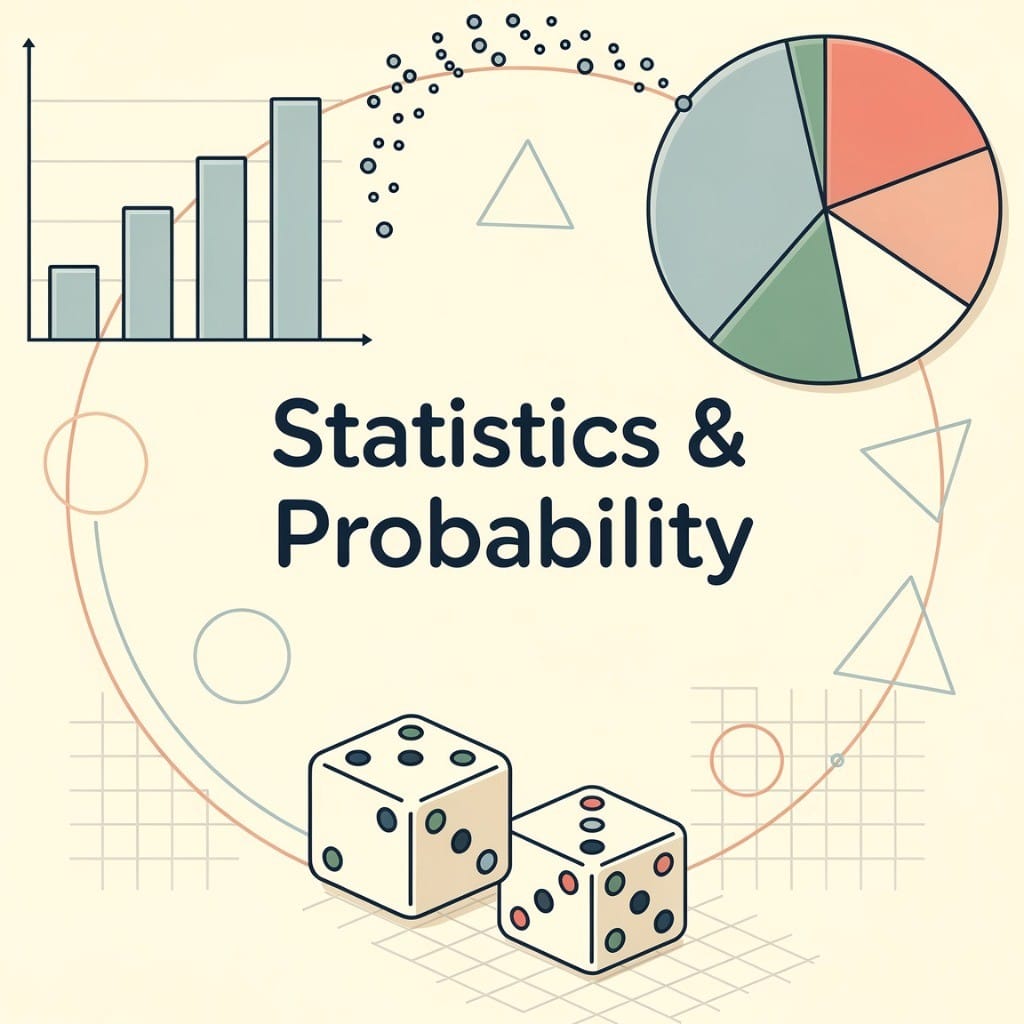
 | INFINITY COURSE Statistics & ProbabilityNclex Coaching Centre · Last updated on Apr 19, 2026 |
Statistics & Probability Study Material





Trending Courses for Grade 9

What is Statistics & Probability for Grade 9?
Statistics and Probability for Grade 9 is a foundational mathematics course designed to introduce students to data analysis, statistical reasoning, and probability theory. This comprehensive course builds critical thinking and analytical skills essential for advanced mathematics and real-world applications. If you're appearing for Grade 9 examinations in 2026, mastering this subject is crucial for securing good marks and developing problem-solving abilities that extend far beyond the classroom.
At its core, statistics and probability grade 9 teaches you how to collect, organize, display, and analyze data effectively. You'll learn to understand randomness, make predictions based on evidence, and evaluate statistical claims critically. These aren't just theoretical concepts-they're practical tools used in scientific research, business decisions, weather forecasting, and sports analytics.
The Importance of Learning Statistics Early
Understanding statistics for Grade 9 students at this stage builds confidence for higher mathematics and develops numeracy skills needed in everyday life. Whether you're reading news reports about surveys, understanding medical studies, or analyzing sports performance, statistical literacy matters. This course prepares you for competitive examinations and real-world scenarios where data interpretation is essential.
Key Topics Covered in Grade 9 Statistics and Probability
The Grade 9 Statistics and Probability syllabus encompasses several interconnected domains. Let's explore the main topics you'll encounter during your preparation.
Data Analysis and Representation
Your journey begins with understanding different types of data. You'll learn to distinguish between categorical data (like colors or categories) and quantitative data (numerical measurements). The course includes extensive coverage of modeling data distributions to understand how data behaves. You'll work with various visual representations including histograms, box plots, dot plots, and stem-and-leaf plots to communicate data effectively.
Probability and Counting
Understanding probability for Grade 9 involves learning how to calculate the likelihood of events occurring. You'll explore basic probability rules, independent and dependent events, conditional probability, and compound events. These foundational concepts prepare you for more advanced statistical inference later in your course.
Statistical Inference (Advanced Topics)
As you progress, Grade 9 Statistics and Probability topics expand to include sampling distributions, confidence intervals, hypothesis testing, and various inference techniques. These represent the most rigorous applications of statistics and require careful study.
modeling data distributions
Understanding Categorical and Quantitative Data Analysis
One of the first hurdles in mastering Grade 9 Statistics is distinguishing between categorical and quantitative data, then analyzing each appropriately. Categorical data represents qualities or categories (like hair color, student grades, or survey responses), while quantitative data represents measurable quantities (height, test scores, or temperature).
Analyzing Categorical Data
When you're analyzing categorical data, you'll use two-way tables to display relationships between two categorical variables. Frequency distributions help you understand how often each category appears. You'll also calculate marginal and conditional distributions-marginal distributions show totals for one variable, while conditional distributions show how one variable behaves when another is fixed.
Quantitative Data: Display and Summary
Quantitative data analysis begins with effective visualization. You'll master displaying and comparing quantitative data using various graphical methods. Understanding how to create and interpret box plots, histograms, and scatter plots is essential. Beyond visualization, summarizing quantitative data requires calculating measures of central tendency (mean, median, mode) and measures of spread (range, interquartile range, standard deviation, variance).
| Data Type | Examples | Analysis Methods |
|---|---|---|
| Categorical | Colors, Grades, Categories | Two-way tables, Frequency distributions |
| Quantitative | Heights, Test scores, Temperatures | Histograms, Box plots, Mean, Std Dev |
How to Master Probability Concepts in Grade 9
Mastering probability for Grade 9 requires understanding fundamental principles and building from basic concepts to more complex applications. Many students find probability challenging initially, but with systematic practice, you'll develop strong intuition for likelihood and randomness.
Foundation of Probability
Begin by understanding that probability measures the likelihood of events. The basic probability formula is: P(Event) = (Favorable Outcomes) / (Total Possible Outcomes). You'll explore independent events (where one doesn't affect another) and dependent events (where outcomes are related). Conditional probability answers questions like "Given that this happened, what's the probability of that happening?"
Study Design and Data Collection
Proper probability analysis depends on appropriate study design. You'll learn to design experiments and observational studies properly, understand sampling methods, and recognize sources of bias. Experimental design teaches you how to set up investigations that yield reliable probability estimates.
probability
Best Resources for Learning Grade 9 Statistics and Probability
Finding the right best Grade 9 Statistics and Probability resources dramatically improves your preparation. EduRev provides comprehensive, well-organized materials specifically designed for Grade 9 students mastering statistics and probability course 2026 content.
Types of Free Study Materials Available
- Chapter-wise notes covering all Grade 9 Statistics and Probability topics
- Interactive explanations of complex concepts with visual examples
- Step-by-step solution guides for worked problems
- Practice problem sets organized by difficulty level
- Grade 9 Statistics and Probability PDF download materials
- Video tutorials explaining how to solve probability problems Grade 9 style
- Grade 9 Statistics worksheets with answer keys
How to Use Free Resources Effectively
Access free Grade 9 Statistics notes on EduRev to build foundational understanding before attempting practice problems. Start with simpler concepts and progress systematically. Use Statistics and Probability notes PDF for offline study during your commute or travel. Review free statistics study materials regularly-consistency beats cramming when learning these interconnected concepts.
Step-by-Step Guide to Hypothesis Testing and Significance Tests
Understanding hypothesis testing Grade 9 level involves following a structured process. Hypothesis testing represents one of the most important applications of statistics for making evidence-based decisions.
The Hypothesis Testing Process
Begin by learning significance tests and hypothesis testing. The process involves five key steps:
- State the null hypothesis (H₀: no effect) and alternative hypothesis (H₁: some effect exists)
- Set the significance level (typically α = 0.05)
- Calculate the test statistic appropriate for your data
- Find the p-value (probability of observing your data if null hypothesis is true)
- Make a decision (reject or fail to reject the null hypothesis)
Two-Sample Comparisons
When comparing two groups, you'll use two-sample inference for the difference between groups. This could involve comparing test scores between two classes or analyzing whether a treatment differs from a control group. Two-sample t-tests are commonly used when comparing means of two groups.
Understanding Permutations and Combinations for Grade 9 Students
Permutations and combinations represent essential counting principles that form the foundation for calculating probabilities. Many students confuse these concepts, but understanding the distinction is crucial.
Counting Principles Explained
Counting, permutations, and combinations follow from the fundamental counting principle: if one event can occur in m ways and another in n ways, both can occur in m × n ways. How to calculate permutations and combinations-permutations count arrangements (order matters), while combinations count selections (order doesn't matter).
Practical Applications
Understanding permutations means calculating how many ways you can arrange objects. If you have 5 books and want to arrange 3 on a shelf, order matters-ABC differs from BAC. Combinations answer "how many ways to choose without regard to order?" Use these in probability calculations, password creation problems, and team selection scenarios.
| Concept | Formula | When to Use |
|---|---|---|
| Permutations | P(n,r) = n!/(n-r)! | When order matters (arrangements) |
| Combinations | C(n,r) = n!/(r!(n-r)!) | When order doesn't matter (selections) |
Exploring Bivariate Data and Correlation Analysis
Bivariate data analysis involves examining relationships between two variables simultaneously. This is where statistics becomes truly interesting as you discover connections in real-world data.
Scatter Plots and Relationships
When exploring bivariate numerical data, scatter plots reveal relationships visually. You'll learn to recognize positive relationships (both variables increase together), negative relationships (one increases as the other decreases), and no relationship. Scatter plots and correlation analysis help quantify these visual patterns. The correlation coefficient (r) measures relationship strength, ranging from -1 (perfect negative) to +1 (perfect positive).
Linear Regression Analysis
Regression analysis goes beyond correlation to make predictions. The line of best fit minimizes distances from data points, allowing you to predict one variable based on another. Understanding residuals-differences between actual and predicted values-reveals how well your model fits the data.
exploring bivariate numerical data
Complete Guide to Confidence Intervals and Sampling Distributions
Confidence intervals and sampling distributions represent crucial concepts in statistical inference. These tools let you make educated statements about entire populations based on sample data.
Sampling Distributions Fundamentals
Understanding sampling distributions requires recognizing that when you take repeated samples, the sample statistics themselves form a distribution. The Central Limit Theorem-one of statistics' most important principles-states that sample means approximately follow a normal distribution regardless of the original population's distribution (with sufficient sample size).
Building Confidence Intervals
Confidence intervals provide a range of plausible values for population parameters. A 95% confidence interval means that if you repeated your sampling procedure many times, approximately 95% of calculated intervals would contain the true population parameter. What are confidence intervals? They're statements like "we're 95% confident the true proportion falls between 0.45 and 0.55" based on your sample data.
Chi-Square Tests and Categorical Data Inference Explained
When analyzing relationships between categorical variables, chi-square tests provide the statistical method you need. These tests determine whether observed patterns differ significantly from what we'd expect by chance.
Types of Chi-Square Tests
Chi-square tests for categorical data inference include goodness of fit tests (comparing observed distribution to expected) and tests of independence (examining relationships between variables). The chi-square goodness of fit test answers: "Does this sample match the expected distribution?" Tests of independence answer: "Are these two categorical variables related?"
Interpreting Results
Chi-square analysis produces a test statistic compared to a critical value. When your calculated chi-square exceeds the critical value, you have evidence against the null hypothesis. Understanding p-values in this context helps you determine whether observed patterns are statistically significant or likely due to random chance.
How to Solve Random Variables Problems in Grade 9
Random variables convert uncertain situations into mathematical frameworks you can analyze. Whether discrete (taking specific values) or continuous (taking any value in a range), understanding random variables transforms probability from abstract to actionable.
Discrete vs Continuous Random Variables
Random variables represent numerical outcomes of random experiments. How to solve random variables problems involves understanding whether you're dealing with discrete outcomes (like dice rolls: 1, 2, 3, 4, 5, 6) or continuous outcomes (like measurement heights). Each type requires different approaches for calculating probabilities and expected values.
Expected Value and Variance
The expected value represents the average outcome if you repeated the experiment infinitely. Variance measures how spread out values are around the expected value. These concepts help predict long-term behavior of random processes-crucial for risk assessment in business and gambling scenarios.
Random variables
ANOVA (Analysis of Variance) Simplified for Students
ANOVA extends hypothesis testing beyond comparing two groups to comparing three or more simultaneously. This powerful technique answers whether differences between multiple groups are statistically significant or due to chance.
Understanding the F-Test
ANOVA analysis uses the F-statistic to compare variances between groups versus within groups. What is ANOVA in statistics? It's a method for testing whether group means significantly differ. The larger your F-statistic, the more evidence against the null hypothesis that all group means are equal.
Practical Applications
ANOVA for students is simplified when you recognize it answers practical questions: "Do different teaching methods produce different test score results?" or "Do different fertilizers affect plant growth differently?" The test's power lies in efficiently comparing multiple groups simultaneously rather than running separate tests that increase error likelihood.
Free Study Materials and Practice Problems for Grade 9 Statistics
Securing free Grade 9 Statistics resources ensures you can prepare comprehensively without financial barriers. Quality practice materials build confidence and expose you to problem variety essential for exam success.
Where to Find Materials
EduRev provides comprehensive free statistics study materials specifically designed for Grade 9. Access chapter-by-chapter notes, grade 9 probability practice problems organized by difficulty, and full Grade 9 Statistics worksheets with solutions. Download Grade 9 Statistics and Probability PDF files for offline study flexibility. Video tutorials walk through solving probability problems Grade 9 style, explaining reasoning alongside calculations.
Strategic Practice Approach
Begin with worked examples to understand methodology. Progress to guided problems with hints. Finally, attempt independent problems without assistance. This scaffolded approach builds competence systematically. Review mistakes carefully-they reveal knowledge gaps to address before examinations.
Tips for Excelling in Grade 9 Statistics and Probability
Preparing for Grade 9 examinations requires strategic planning beyond simply reading notes. These practical tips help you master the best way to learn Grade 9 Statistics and secure high marks.
Study Strategy Recommendations
- Build understanding from fundamentals-don't skip topics thinking you'll catch up later
- Create summary sheets for formulas, definitions, and key procedures
- Practice interpreting graphs and charts regularly for quick recognition during exams
- Work through problem solutions explaining your reasoning aloud-this deepens understanding
- Study statistics made easy by connecting concepts to real-world scenarios you encounter
- Form study groups to discuss challenging concepts from different perspectives
- Use calculator features effectively-learn to calculate mean, standard deviation, and statistical tests quickly
- Review previous examination papers and sample questions to understand expected answer formats
Common Mistakes to Avoid
Many students confuse permutations with combinations or misinterpret confidence intervals as probability statements about specific samples rather than long-run frequencies. Avoid mechanically applying formulas without understanding what you're calculating. Don't confuse correlation with causation-relationships don't prove one variable causes another. Finally, ensure you read questions carefully; distinguishing between asking for probability versus conditional probability, or independence versus dependence, determines whether your approach succeeds.
Mastering Grade 9 Statistics and Probability opens doors to advanced mathematics, scientific thinking, and practical problem-solving abilities. With systematic study, quality resources, and consistent practice on problems from simple to complex, you'll develop genuine statistical literacy. Start your preparation today using the comprehensive resources available-your future success depends on the foundation you build now. Good luck with your Grade 9 Statistics and Probability journey in 2026!
Statistics & Probability for Grade 9 Exam Pattern 2026-2027
Exam Pattern for Competitive Examinations
Understanding the exam pattern is crucial for effective preparation. Here's a detailed breakdown of what to expect in most competitive examinations:
1. Structure of the Exam
- Sections: Most exams are divided into various sections such as General Knowledge, Mathematics, English, and Reasoning.
- Question Types: Multiple-choice questions (MCQs), descriptive questions, and short-answer questions are commonly used.
2. Marking Scheme
- Positive Marking: Typically, candidates earn marks for every correct answer.
- Negative Marking: A penalty is often applied for incorrect answers, deducting a fraction of the total marks.
3. Duration of the Exam
- Time Allotted: The duration can range from 2 to 4 hours, depending on the exam.
- Time Management: It is essential to practice managing your time efficiently during the exam.
4. Total Number of Questions
- Varies by Exam: The number of questions can vary significantly, usually ranging from 50 to 200 questions.
- Practice Tests: Regular practice tests can help familiarize you with the question volume and format.
5. Syllabus Overview
- Core Subjects: Each exam has a defined syllabus covering specific subjects and topics.
- Weightage: Different sections may have varying weightage in terms of marks, so focus on high-weightage topics.
6. Preparation Strategies
- Study Material: Utilize quality study materials and resources like EduRev for comprehensive preparation.
- Mock Tests: Taking regular mock tests will help you gauge your preparation level and improve your speed.
By understanding the exam pattern, candidates can devise effective strategies to tackle their preparation efficiently. Always stay updated with any changes in the exam pattern and ensure you are well-prepared for each component of the exam.


Statistics & Probability Syllabus 2026-2027 PDF Download
Syllabus for Statistics & Probability
Introduction to Statistics & Probability
This syllabus covers essential concepts in Statistics & Probability, providing a comprehensive understanding of the tools and techniques necessary for data analysis.
1. Analyzing Categorical Data
- Understanding categorical variables
- Frequency tables and bar charts
- Contingency tables
- Chi-square tests for independence
2. Displaying and Comparing Quantitative Data
- Histograms and box plots
- Comparing distributions using visualizations
- Using dot plots and stem-and-leaf plots
3. Summarizing Quantitative Data
- Measures of central tendency (mean, median, mode)
- Measures of variability (range, variance, standard deviation)
- Interquartile range and outliers
4. Modeling Data Distributions
- Normal distribution properties
- Central Limit Theorem
- Other distributions (binomial, Poisson)
5. Exploring Bivariate Numerical Data
- Scatter plots and correlation
- Linear regression analysis
- Interpreting regression coefficients
6. Study Design
- Types of studies (observational vs. experimental)
- Sampling methods and biases
- Randomization and control groups
7. Probability
- Basic probability concepts
- Conditional probability
- Bayes' theorem
8. Counting, Permutations, and Combinations
- Fundamental counting principle
- Permutations and combinations
- Applications in probability
9. Random Variables
- Discrete vs. continuous random variables
- Probability distributions
- Expected value and variance of random variables
10. Sampling Distributions
- Distribution of sample means
- Standard error of the mean
- Law of large numbers
11. Confidence Intervals
- Constructing confidence intervals for means and proportions
- Interpreting confidence intervals
- Margin of error considerations
12. Significance Tests (Hypothesis Testing)
- Null and alternative hypotheses
- Type I and Type II errors
- P-values and significance levels
13. Two-Sample Inference For The Difference Between Groups
- Comparing means and proportions between two groups
- Independent vs. paired samples
- Performing t-tests and interpreting results
14. Inference For Categorical Data (Chi-Square Tests)
- Goodness of fit tests
- Understanding observed vs. expected frequencies
- Interpreting chi-square test results
15. Advanced Regression (Inference and Transforming)
- Multiple linear regression models
- Interactions and polynomial terms
- Model diagnostics and transformations
16. Analysis of Variance (ANOVA)
- One-way ANOVA concepts
- Comparing means across multiple groups
- Post-hoc tests and assumptions
Conclusion
This syllabus serves as a guide for mastering Statistics & Probability, equipping learners with essential skills for data analysis and interpretation. Emphasis is placed on practical applications and real-world examples.
This course is helpful for the following exams: Grade 9
How to Prepare Statistics & Probability for Grade 9?
How to Prepare for the EduRev Course
Preparing for your EduRev course effectively can enhance your learning experience and ensure you maximize your understanding of the material. Here's a comprehensive guide to help you get ready for your EduRev course.
1. Understand the Course Structure
Before diving into your EduRev course, take some time to familiarize yourself with its structure. This includes:
- Course Outline: Review the syllabus provided in the EduRev course to understand the topics that will be covered.
- Learning Objectives: Identify what you are expected to learn by the end of the course.
- Assessment Methods: Learn about the evaluation criteria, such as quizzes, assignments, and exams.
2. Gather Necessary Resources
To prepare effectively for your EduRev course, make sure you have the following resources at hand:
- Books and Materials: Check if there are recommended readings or materials and procure them ahead of time.
- Online Tools: Familiarize yourself with any online tools or platforms that may be used during the course.
- Study Aids: Consider utilizing study aids such as flashcards, summaries, and practice questions available on EduRev.
3. Create a Study Schedule
Having a solid study schedule can significantly improve your preparation for the EduRev course. Here's how to create one:
- Set Realistic Goals: Break down your study material into manageable sections and assign specific goals for each study session.
- Allocate Time Slots: Dedicate specific times each week to focus on your EduRev course content.
- Include Breaks: Don't forget to schedule breaks to avoid burnout and keep your mind fresh.
4. Engage with Fellow Learners
Connecting with other learners can enhance your understanding and make your preparation more effective:
- Join Study Groups: Create or join study groups related to your EduRev course to discuss concepts and clarify doubts.
- Participate in Discussions: Engage in forums or chat groups related to your EduRev course to share insights and resources.
- Seek Help: Don't hesitate to ask for help from peers or instructors if you find any topics challenging.
5. Practice Regularly
Regular practice is crucial for solidifying your understanding of the course material:
- Take Practice Quizzes: Use the practice quizzes available in your EduRev course to test your knowledge frequently.
- Review Past Questions: Look at previous years' questions to familiarize yourself with the exam format.
- Self-Assessment: Regularly assess your understanding and revisit topics that require more focus.
6. Stay Motivated
Maintaining motivation throughout your preparation is essential. Here are some tips:
- Reward Yourself: Plan small rewards for achieving study milestones in your EduRev course preparation.
- Visual Reminders: Use visual aids, like charts and mind maps, to keep your goals in sight.
- Reflect on Progress: Take time to reflect on what you've learned and how far you've come.
Conclusion
Preparing for your EduRev course requires a strategic approach. By understanding the course structure, gathering resources, creating a study schedule, engaging with peers, practicing regularly, and staying motivated, you can enhance your learning experience and achieve your academic goals. Remember, the key to success in your EduRev course is consistent effort and a positive mindset!
Importance of Statistics & Probability for Grade 9
Importance of Course for Personal and Professional Development
The modern educational landscape is rapidly evolving, and courses like the ones offered by EduRev play a crucial role in equipping individuals with the skills and knowledge necessary for success. Here are some key reasons why enrolling in a course is essential:
1. Skill Acquisition
Courses provide structured learning experiences that help individuals acquire new skills. Whether it's technical skills like coding or soft skills like communication, these courses are designed to enhance your capabilities.
2. Career Advancement
Completing a course can significantly boost your career prospects. Employers often look for candidates who are committed to their professional development. By showcasing your completed courses, you demonstrate your initiative and dedication.
3. Networking Opportunities
Many courses offer opportunities to connect with peers, instructors, and industry professionals. Building a network during your course can lead to valuable contacts and potential job leads in the future.
4. Flexibility and Accessibility
EduRev's courses are designed to be accessible and flexible, allowing you to learn at your own pace. This is particularly important for individuals balancing work, family, and educational commitments.
5. Updated Knowledge and Trends
Courses keep you informed about the latest trends and developments in your field. This is essential in today's fast-paced world where knowledge can quickly become outdated.
6. Confidence Building
As you gain new knowledge and skills, your confidence grows. This newfound confidence can impact various areas of your life, from job interviews to personal interactions.
7. Comprehensive Learning Resources
Courses often provide a wealth of resources, including videos, articles, and practice exercises. These comprehensive materials enhance your learning experience and allow for a deeper understanding of the subject matter.
8. Personal Growth
Beyond professional benefits, courses contribute to personal growth. Learning new concepts and skills fosters curiosity and a love for lifelong learning, enriching your life in many ways.
Conclusion
Investing in a course offered by EduRev is a strategic move towards personal and professional development. The skills, knowledge, and connections gained through these courses are invaluable assets in today's competitive environment.
Statistics & Probability for Grade 9 FAQs
 | View your Course Analysis |  |
 | Create your own Test | |



|
 Documents
 Ratings
 | Explore Courses for Grade 9 exam |  |


