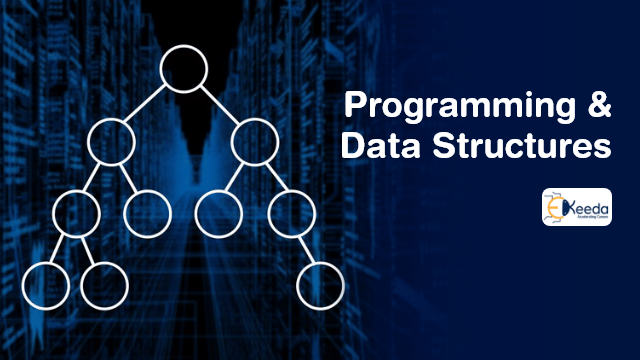
 PARTNER COURSE CSE Programming & Data Structures Algorithms & Trees 511 students learning this week · Last updated on Apr 14, 2026 | PARTNER COURSE CSE Programming & Data Structures Algorithms & Trees511 students learning this week · Last updated on Apr 14, 2026 |
The Programming and Data Structures Course for Computer Science Engineering (CSE) on EduRev is an essential course for those interested in computer pr ... view more ogramming. This course provides in-depth knowledge of programming concepts and data structures commonly used in software development. With this course, students will learn how to effectively write and execute programs, and design algorithms to solve complex problems. This course is a must for anyone looking to pursue a career in computer science or related fields.
CSE Programming & Data Structures Algorithms Study Material


Trending Courses for Computer Science Engineering (CSE)

Programming and Data Structures (Video Lectures) for Computer Science Engineering (CSE) Exam Pattern 2026-2027
Programming and Data Structures Exam Pattern for Computer Science Engineering (CSE)
Programming and Data Structures is an essential subject for Computer Science Engineering (CSE) students. This subject helps students learn programming languages and data structures, which are crucial in the field of computer science. The exam pattern for Programming and Data Structures in CSE is designed to test the students' knowledge of programming concepts and their ability to implement data structures in real-world scenarios.
Here is a breakdown of the exam pattern for Programming and Data Structures in CSE:
Exam Format:
The exam is usually conducted in two parts - theory and practical. The theory part consists of multiple-choice questions, and the practical part requires students to write programs and implement data structures.
Marking Scheme:
The marking scheme for the Programming and Data Structures exam varies from college to college. Generally, the theory part carries 50% of the marks, and the practical part carries the remaining 50%.
Topics Covered:
The Programming and Data Structures exam covers a wide range of topics, including programming concepts, data structures, algorithms, and problem-solving techniques.
Programming Concepts:
The exam tests students' knowledge of programming languages such as C, C++, Java, and Python. Students are expected to have a sound understanding of basic programming concepts such as loops, conditional statements, functions, and arrays.
Data Structures:
The exam also covers various data structures such as arrays, linked lists, stacks, queues, trees, and graphs. Students are required to understand the implementation of these data structures and their applications in real-world scenarios.
Algorithms:
The exam tests students' knowledge of various algorithms such as sorting, searching, and graph traversal. Students are expected to understand the complexity of these algorithms and their applications.
Problem-Solving Techniques:
The Programming and Data Structures exam also tests students' problem-solving skills. Students are required to solve real-world problems using programming and data structures concepts.
In conclusion, the Programming and Data Structures exam pattern for Computer Science Engineering (CSE) is designed to test students' knowledge of programming concepts and their ability to implement data structures. Students must prepare themselves by thoroughly studying the various programming languages, data structures, algorithms, and problem-solving techniques. With proper preparation and practice, students can excel in this subject and secure good grades.
Programming and Data Structures is an essential subject for Computer Science Engineering (CSE) students. This subject helps students learn programming languages and data structures, which are crucial in the field of computer science. The exam pattern for Programming and Data Structures in CSE is designed to test the students' knowledge of programming concepts and their ability to implement data structures in real-world scenarios.
Here is a breakdown of the exam pattern for Programming and Data Structures in CSE:
Exam Format:
The exam is usually conducted in two parts - theory and practical. The theory part consists of multiple-choice questions, and the practical part requires students to write programs and implement data structures.
Marking Scheme:
The marking scheme for the Programming and Data Structures exam varies from college to college. Generally, the theory part carries 50% of the marks, and the practical part carries the remaining 50%.
Topics Covered:
The Programming and Data Structures exam covers a wide range of topics, including programming concepts, data structures, algorithms, and problem-solving techniques.
Programming Concepts:
The exam tests students' knowledge of programming languages such as C, C++, Java, and Python. Students are expected to have a sound understanding of basic programming concepts such as loops, conditional statements, functions, and arrays.
Data Structures:
The exam also covers various data structures such as arrays, linked lists, stacks, queues, trees, and graphs. Students are required to understand the implementation of these data structures and their applications in real-world scenarios.
Algorithms:
The exam tests students' knowledge of various algorithms such as sorting, searching, and graph traversal. Students are expected to understand the complexity of these algorithms and their applications.
Problem-Solving Techniques:
The Programming and Data Structures exam also tests students' problem-solving skills. Students are required to solve real-world problems using programming and data structures concepts.
In conclusion, the Programming and Data Structures exam pattern for Computer Science Engineering (CSE) is designed to test students' knowledge of programming concepts and their ability to implement data structures. Students must prepare themselves by thoroughly studying the various programming languages, data structures, algorithms, and problem-solving techniques. With proper preparation and practice, students can excel in this subject and secure good grades.


Programming and Data Structures (Video Lectures) Syllabus 2026-2027 PDF Download
Computer Science Engineering (CSE) Syllabus:
Programming and Data Structures:
- Introduction to programming concepts and basics
- Data types, variables, and arrays
- Operators and expressions
- Control structures and loops
- Functions and recursion
- Pointers and dynamic memory allocation
Input/output and Math Operators in C:
- Input/output functions in C
- Mathematical operators and functions in C
- Working with strings and characters
Control Structures in C:
- Conditional statements and switch cases
- Looping structures and iterations
- Break and continue statements
Functions in C:
- Functions and their types in C
- Passing arguments in functions and return values
- Recursion and its applications
Pointers in C:
- Introduction to pointers and their uses
- Pointer arithmetic and dynamic memory allocation
- Pointers and arrays
Character Handling In C:
- Working with characters and strings
- Character arrays and pointers
- String functions in C
Structures In C:
- Introduction to structures and their uses
- Defining and declaring structures
- Nesting and accessing structures
Link List:
- Introduction to linked lists and their types
- Creating and manipulating linked lists
- Searching and sorting in linked lists
Stack and Queue:
- Introduction to stacks and queues and their uses
- Implementing stacks and queues using arrays and linked lists
- Applications of stacks and queues
Binary Tree:
- Introduction to binary trees and their properties
- Traversal techniques in binary trees
- Implementing binary trees using arrays and linked lists
Multiway Tree:
- Introduction to multiway trees and their uses
- Traversal techniques in multiway trees
- Implementing multiway trees using arrays and linked lists
AVL Tree:
- Introduction to AVL trees and their properties
- Insertion and deletion in AVL trees
- Rotations and balancing techniques in AVL trees
Expression Evaluation:
- Introduction to infix, postfix, and prefix notations
- Converting infix to postfix and prefix notations
- Evaluating postfix and prefix expressions
Binary Heap:
- Introduction to binary heap and its properties
- Min and max heap and their operations
- Heap sort algorithm
Graph Data Structure:
- Introduction to graphs and their properties
- Types of graphs and their representations
- Graph traversal techniques
- Shortest path algorithms in graphs
This course is helpful for the following exams: Computer Science Engineering (CSE)
How to Prepare Programming and Data Structures (Video Lectures) for Computer Science Engineering (CSE)?
Preparing for Programming and Data Structures is crucial for any Computer Science Engineering (CSE) student. It forms the foundation of the entire course and helps in building a strong base for advanced programming concepts. Here are a few tips on how to prepare for Programming and Data Structures for CSE:
1. Understand the Basics: Before diving into complex programming concepts, it is crucial to have a strong understanding of the basics. Start with learning programming languages like C or Python, which are widely used in the industry. Get familiar with the syntax, data types, loops, and conditional statements.
2. Practice: Practice is the key to mastering programming and data structures. Dedicate time every day to practice coding problems and implementing data structures like arrays, linked lists, stacks, and queues. Start with simple problems and gradually move on to advanced ones. EduRev offers a wide range of practice problems and coding challenges to help you prepare.
3. Read and Learn: Read textbooks and online resources to gain a deeper understanding of programming concepts and data structures. There are many free online resources available, including online courses, tutorials, and documentation.
4. Attend Lectures: Attend lectures and classes regularly to get a better understanding of the concepts. Take notes and ask questions to clarify your doubts. EduRev offers comprehensive lectures and recorded videos from top educators to help you prepare for Programming and Data Structures.
5. Collaborate: Collaborate with fellow students and participate in online coding communities to learn from others. Discuss coding problems and work on projects together. EduRev offers a platform to connect with like-minded students and educators from around the world.
In conclusion, preparing for Programming and Data Structures is essential for any CSE student. With consistent practice, dedication, and the right resources like EduRev, you can master these concepts and excel in your career as a computer scientist.
1. Understand the Basics: Before diving into complex programming concepts, it is crucial to have a strong understanding of the basics. Start with learning programming languages like C or Python, which are widely used in the industry. Get familiar with the syntax, data types, loops, and conditional statements.
2. Practice: Practice is the key to mastering programming and data structures. Dedicate time every day to practice coding problems and implementing data structures like arrays, linked lists, stacks, and queues. Start with simple problems and gradually move on to advanced ones. EduRev offers a wide range of practice problems and coding challenges to help you prepare.
3. Read and Learn: Read textbooks and online resources to gain a deeper understanding of programming concepts and data structures. There are many free online resources available, including online courses, tutorials, and documentation.
4. Attend Lectures: Attend lectures and classes regularly to get a better understanding of the concepts. Take notes and ask questions to clarify your doubts. EduRev offers comprehensive lectures and recorded videos from top educators to help you prepare for Programming and Data Structures.
5. Collaborate: Collaborate with fellow students and participate in online coding communities to learn from others. Discuss coding problems and work on projects together. EduRev offers a platform to connect with like-minded students and educators from around the world.
In conclusion, preparing for Programming and Data Structures is essential for any CSE student. With consistent practice, dedication, and the right resources like EduRev, you can master these concepts and excel in your career as a computer scientist.
Importance of Programming and Data Structures (Video Lectures) for Computer Science Engineering (CSE)
Importance of Programming and Data Structures Course for Computer Science Engineering (CSE)
Programming and Data Structures are the backbone of Computer Science Engineering (CSE). It is a crucial course that every CSE student must take to become a proficient programmer. The course teaches students how to write efficient algorithms and data structures to solve complex problems.
Key Pointers:
- Programming and Data Structures Course is essential for CSE students as it enables them to write efficient and optimized code.
- The course helps students to understand the fundamental concepts of data structures, algorithms, and programming languages.
- It enables students to write code that can handle large data sets, complex computations, and real-world problems.
- The course teaches students how to design and implement algorithms and data structures that can solve a wide range of problems.
- It also helps students to develop problem-solving skills, logical thinking, and critical analysis.
Headers:
1. Understanding Data Structures: The course teaches students about different data structures like arrays, linked lists, trees, graphs, and hash tables. It helps students to understand the working of these data structures and how to use them to solve complex problems.
2. Developing Efficient Algorithms: The course helps students to develop efficient algorithms that can solve complex problems in an optimal way. It teaches students how to analyze the time and space complexity of algorithms and how to choose the best algorithm for a given problem.
3. Implementing Programming Concepts: The course teaches students about programming concepts like loops, conditional statements, functions, and recursion. It enables students to write optimized code that can handle large data sets and complex computations.
4. Enhancing Problem-Solving Skills: The course helps students to develop problem-solving skills, logical thinking, and critical analysis. It enables them to approach a problem systematically and find the best possible solution.
5. Preparing for the Industry: The Programming and Data Structures course is an essential part of CSE curriculum as it prepares students for the industry. It teaches them the skills required to write efficient and optimized code, which is a crucial requirement for any software development job.
In conclusion, the Programming and Data Structures Course is an essential course for every CSE student. It teaches students the fundamental concepts of programming and data structures, enabling them to write efficient and optimized code that can solve complex problems. It also develops problem-solving skills, logical thinking, and critical analysis, preparing students for the industry.
Programming and Data Structures are the backbone of Computer Science Engineering (CSE). It is a crucial course that every CSE student must take to become a proficient programmer. The course teaches students how to write efficient algorithms and data structures to solve complex problems.
Key Pointers:
- Programming and Data Structures Course is essential for CSE students as it enables them to write efficient and optimized code.
- The course helps students to understand the fundamental concepts of data structures, algorithms, and programming languages.
- It enables students to write code that can handle large data sets, complex computations, and real-world problems.
- The course teaches students how to design and implement algorithms and data structures that can solve a wide range of problems.
- It also helps students to develop problem-solving skills, logical thinking, and critical analysis.
Headers:
1. Understanding Data Structures: The course teaches students about different data structures like arrays, linked lists, trees, graphs, and hash tables. It helps students to understand the working of these data structures and how to use them to solve complex problems.
2. Developing Efficient Algorithms: The course helps students to develop efficient algorithms that can solve complex problems in an optimal way. It teaches students how to analyze the time and space complexity of algorithms and how to choose the best algorithm for a given problem.
3. Implementing Programming Concepts: The course teaches students about programming concepts like loops, conditional statements, functions, and recursion. It enables students to write optimized code that can handle large data sets and complex computations.
4. Enhancing Problem-Solving Skills: The course helps students to develop problem-solving skills, logical thinking, and critical analysis. It enables them to approach a problem systematically and find the best possible solution.
5. Preparing for the Industry: The Programming and Data Structures course is an essential part of CSE curriculum as it prepares students for the industry. It teaches them the skills required to write efficient and optimized code, which is a crucial requirement for any software development job.
In conclusion, the Programming and Data Structures Course is an essential course for every CSE student. It teaches students the fundamental concepts of programming and data structures, enabling them to write efficient and optimized code that can solve complex problems. It also develops problem-solving skills, logical thinking, and critical analysis, preparing students for the industry.
Programming and Data Structures (Video Lectures) for Computer Science Engineering (CSE) FAQs
| 1. What are the basic data structures used in programming and how do they work? |  |
Ans. Basic data structures include arrays, linked lists, stacks, and queues. Arrays store elements in contiguous memory locations for fast access. Linked lists use pointers to connect nodes dynamically. Stacks follow Last-In-First-Out (LIFO) principles, while queues operate on First-In-First-Out (FIFO) logic. Each structure optimises different operations like insertion, deletion, and traversal based on specific use cases.
| 2. How do I understand algorithm complexity and time complexity analysis for CSE exams? | |
Ans. Algorithm complexity measures efficiency using Big O notation, which describes how runtime grows with input size. Time complexity analysis evaluates worst-case, average-case, and best-case scenarios. O(1) is constant, O(n) is linear, O(n²) is quadratic, and O(log n) is logarithmic. Asymptotic analysis helps compare algorithms and predict performance on large datasets, essential for optimisation questions in competitive exams.
| 3. What is the difference between a stack and a queue in data structures? | |
Ans. Stacks operate on Last-In-First-Out (LIFO) principle-last element added is first removed, like a plate stack. Queues follow First-In-First-Out (FIFO)-first element added is first removed, like a queue line. Stacks use push and pop operations; queues use enqueue and dequeue. Applications differ: stacks handle undo functionality and expression evaluation, while queues manage scheduling and breadth-first search traversals.
| 4. How do I solve problems using recursion and tree traversal techniques? | |
Ans. Recursion involves functions calling themselves with base and recursive cases to solve problems. Tree traversal includes inorder, preorder, and postorder for binary trees, plus level-order traversal. Depth-First Search (DFS) explores deeply before backtracking; Breadth-First Search (BFS) explores level-by-level. Understanding recursive call stacks and parent-child relationships helps solve tree problems efficiently in programming assessments.
| 5. What topics in sorting algorithms should I focus on for computer science engineering exams? | |
Ans. Key sorting algorithms include bubble sort, selection sort, insertion sort, merge sort, quick sort, and heap sort. Focus on time complexity: bubble sort is O(n²), merge sort and quick sort average O(n log n), heap sort is O(n log n). Understand space complexity and stability-which algorithms maintain relative order of equal elements. Practice implementation and analysing algorithm efficiency comparisons.
| 6. How do binary search trees and balanced trees work in data structure problems? | |
Ans. Binary Search Trees (BSTs) maintain sorted data where left children are smaller and right children are larger than parent nodes. Balanced trees like AVL trees and Red-Black trees self-balance during insertion and deletion, preventing skewed structures. BSTs enable efficient searching, insertion, and deletion in O(log n) time when balanced. Balancing operations involve rotations to maintain optimal height and performance.
| 7. What is the best way to approach graph problems using adjacency lists and matrices? | |
Ans. Graphs represent networks using adjacency lists (linked list representation) or adjacency matrices (2D array representation). Adjacency lists are space-efficient for sparse graphs; matrices suit dense graphs with quick edge lookups. Choose representations based on graph density and required operations. Apply graph traversal algorithms like DFS and BFS, then solve shortest path, connectivity, and cycle detection problems accordingly.
| 8. How do I master hash tables and collision handling techniques for programming exams? | |
Ans. Hash tables use hash functions to map keys to array indices for O(1) average-case lookup. Collisions occur when multiple keys hash to the same index. Resolve collisions using chaining (linked lists at each index) or open addressing (probing techniques like linear and quadratic probing). Load factor and hash function quality determine performance. Understanding these optimises dictionary and caching implementations.
| 9. What dynamic programming concepts should I prepare for CSE competitive exams? | |
Ans. Dynamic programming solves optimisation problems by breaking them into overlapping subproblems and storing results to avoid recomputation. Key problems include longest common subsequence, knapsack problem, and coin change. Master memoisation (top-down) and tabulation (bottom-up) approaches. Identify optimal substructure properties and recurrence relations. Practice analysing space-time trade-offs; DP typically trades memory for reduced time complexity.
| 10. How should I revise linked list operations and pointer manipulation for data structures? | |
Ans. Linked lists use pointers to connect nodes dynamically, requiring careful pointer manipulation. Master operations: traversal, insertion (beginning, middle, end), deletion, reversal, and detection of cycles using Floyd's algorithm. Practice implementing singly and doubly linked lists. Use visual diagrams to trace pointer changes during operations. EduRev provides detailed video lectures and practice problems covering linked list concepts comprehensively for exam preparation.
Course Description
Programming and Data Structures (Video Lectures) | Notes, Videos, MCQs & PPTs for Computer Science Engineering (CSE) 2026-2027 is part of Computer Science Engineering (CSE) preparation. The notes and questions for Programming and Data Structures (Video Lectures) | Notes, Videos, MCQs & PPTs have been prepared according to the Computer Science Engineering (CSE) exam syllabus. Information about Programming and Data Structures (Video Lectures) | Notes, Videos, MCQs & PPTs covers all important topics for Computer Science Engineering (CSE) 2026-2027 Exam. Find important definitions, questions, notes,examples, exercises test series, mock tests and Previous year questions (PYQs) below for Programming and Data Structures (Video Lectures) | Notes, Videos, MCQs & PPTs.
Preparation for Programming and Data Structures (Video Lectures) | Notes, Videos, MCQs & PPTs in English is available as part of our Computer Science Engineering (CSE) preparation & Programming and Data Structures (Video Lectures) | Notes, Videos, MCQs & PPTs in Hindi for Computer Science Engineering (CSE) courses. Download more important topics related with Programming and Data Structures (Video Lectures) | Notes, Videos, MCQs & PPTs, notes, lectures and mock test series for Computer Science Engineering (CSE) Exam by signing up for free.
Course Speciality
Programming and Data Structures Online course is designed by expert faculty that will simplify concepts and make learning easy for you. This course is available at budget-friendly prices for GATE aspirants and covers all the important topics required for GATE 2022 preparation. Students can attain more knowledge in less time and perform better with our exclusive online courses.
Programming & Data Structures (Video Lectures) | Notes, Videos, MCQs & PPTs course on EduRev: tutorials, coding exercises & practical projects. Joined by 5k+ students.
Course Options
 | View your Course Analysis |  |
 | Create your own Test | |



Related Exams

THIS COURSE INCLUDES:
 Videos
 Top teachers of India
Add To My Courses
 | Explore Courses for Computer Science Engineering (CSE) exam |  |
Signup for Free!
Signup to see your scores go up within 7 days! Learn & Practice with 1000+ FREE Notes, Videos & Tests.
Course Speciality
Programming and Data Structures Online course is designed by expert faculty that will simplify concepts and make learning easy for you. This course is available at budget-friendly prices for GATE aspirants and covers all the important topics required for GATE 2022 preparation. Students can attain more knowledge in less time and perform better with our exclusive online courses.
Programming & Data Structures (Video Lectures) | Notes, Videos, MCQs & PPTs course on EduRev: tutorials, coding exercises & practical projects. Joined by 5k+ students.


