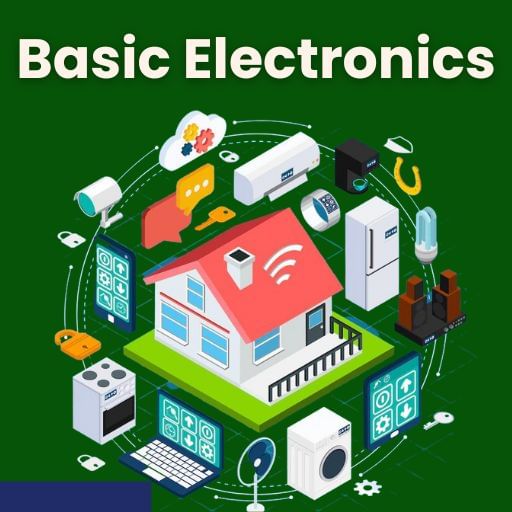
 | INFINITY COURSE SSS 2 Basic Electronics: Components & Systems Prep165 students learning this week · Last updated on Apr 14, 2026 |
SSS 2 Basic Electronics: Components Study Material



Trending Courses for SSS 2

What is Basic Electronics for SSS 2?
Basic Electronics for SSS 2 is a comprehensive foundational course designed for Senior Secondary School 2 students across Nigeria and West African countries. This course introduces learners to essential electronic principles, components, circuits, and their practical applications in modern technology. Whether you're appearing for SSS 2 examinations or simply interested in building a strong electronics foundation, this course serves as your gateway to understanding how electronic devices work.
The Basic Electronics SSS 2 curriculum covers a wide spectrum of topics ranging from alternating current circuits to microprocessors, making it an ideal starting point for anyone interested in electrical engineering, telecommunications, or computer hardware careers. Students securing good marks in Basic Electronics for SSS 2 often find themselves better prepared for advanced technical courses and competitive examinations.
Understanding the fundamentals of electronics in SSS 2 is crucial because these concepts form the backbone of all modern technology, from smartphones to power systems. The course emphasizes both theoretical knowledge and practical skills, ensuring you develop a well-rounded understanding of electronics.
Understanding Alternating Current Circuits in Basic Electronics
Alternating Current (AC) circuits represent one of the most important topics in Basic Electronics SSS 2. Unlike direct current, AC continuously changes direction, and understanding this concept is essential for every electronics student. AC circuits are present everywhere-in your home's electrical supply, in radio transmission, and in countless industrial applications.
In AC circuits, you'll encounter several key concepts including waveforms, frequency, amplitude, and phase relationships. The frequency of AC circuits in most parts of Nigeria is typically 50 Hz, which means the current completes 50 complete cycles per second. Mastering Alternating Current Circuits will give you the foundation needed to understand more complex electronics concepts.
Core Concepts in AC Circuit Analysis
- Impedance and Reactance: Understanding how capacitors and inductors resist current flow in AC circuits
- RMS Values: Learning to work with root mean square measurements rather than peak values
- Phase Angles: Recognizing how voltage and current can be out of phase in circuits with reactive components
- AC Circuit Calculations: Applying mathematical methods to solve complex circuit problems
Alternating Current Circuits
Power in AC Circuits: Calculations and Key Concepts
Power in AC circuits is more complex than in DC circuits because you need to consider real power, reactive power, and apparent power. This distinction is crucial for SSS 2 students who want to understand energy consumption and efficiency in electronic systems.
Real power (measured in watts) represents the actual energy consumed by resistive components, while reactive power (measured in VAR) is associated with energy stored and returned by inductors and capacitors. The power factor-the ratio of real power to apparent power-determines how efficiently an electrical system operates.
To excel in Power in AC Circuits calculations, you must master the mathematical relationships between voltage, current, and impedance. Our detailed study materials break down these concepts into manageable sections, making them easier to grasp.
Key Power Relationships
| Power Type | Symbol | Unit | Formula |
|---|---|---|---|
| Real Power | P | Watts (W) | P = VI cos(φ) |
| Reactive Power | Q | VAR | Q = VI sin(φ) |
| Apparent Power | S | VA | S = VI |
Power in AC Circuits
Transistors Explained: Types, Working Principles and Applications
Transistors are semiconductor devices that form the foundation of modern electronics. In your Basic Electronics SSS 2 course, you'll encounter two main types: Bipolar Junction Transistors (BJTs) and Field Effect Transistors (FETs). These tiny components can amplify signals or act as electronic switches, making them indispensable in circuit design.
Understanding how transistors work is essential for grasping modern electronics. A transistor essentially uses a small current or voltage to control a larger current, enabling amplification and switching operations. Whether you're studying transistor basics for beginners or preparing for advanced applications, starting with the fundamentals is crucial.
Explore the complete guide on Transistors to understand configurations like common emitter, common base, and common collector arrangements. Each configuration has unique characteristics suitable for different applications.
Types and Applications of Transistors
- BJTs: Excellent for amplification and switching applications in audio equipment and digital circuits
- FETs: Preferred for high-input impedance applications and low-power consumption scenarios
- Biasing: Proper transistor biasing ensures stable operation and prevents distortion
- Amplification: Transistors form the basis of amplifier circuits used in audio and radio systems
Transistors
Integrated Circuits and Microprocessors: A Comprehensive Guide for SSS 2 Students
Integrated Circuits (ICs) represent the next level of sophistication in electronics. Rather than assembling individual transistors and resistors, ICs pack thousands or millions of components onto a single semiconductor chip. Understanding how integrated circuits work is vital for modern electronics education.
The IC and microprocessors SSS 2 syllabus covers analog ICs (like operational amplifiers), digital ICs (like logic gates and microcontrollers), and mixed-signal ICs that combine both. Microprocessors, the brains of computers, are specialized ICs that execute instructions and control overall system operation.
Check out our comprehensive resource on Integrated Circuits (IC) and Microprocessors for detailed explanations of IC fabrication basics, architecture, and real-world applications. Learning about microprocessor basics will prepare you for advanced computing courses.
IC Classifications and Applications
- Analog ICs: Op-amps, comparators, and signal processors for continuous signal handling
- Digital ICs: Logic gates, counters, and memory devices for discrete signal processing
- Microprocessor Fundamentals: Understanding CPU architecture and instruction execution
- Practical Applications: Consumer electronics, industrial control, and communication systems
Power Supply Unit: Components, Functions and Circuit Design
Every electronic device requires a reliable power supply unit (PSU) to convert AC mains voltage into the stable DC voltage needed by circuit components. In your Basic Electronics course, you'll learn how power supplies work and why they're critical for device operation.
A typical power supply unit design includes a transformer for voltage conversion, a rectifier for AC-to-DC conversion, a filter circuit to smooth the output, and a voltage regulator to maintain constant voltage despite load variations. Understanding power supply circuits helps you troubleshoot common device failures and design robust electronic systems.
Our detailed guide on Power Supply Unit explains both linear and switching power supplies, their advantages, limitations, and practical circuit implementations. Modern power supplies have become increasingly efficient, and knowing their design principles is valuable for anyone in electronics.
Radio Transmission and Reception Systems for Secondary School Students
Radio technology has shaped modern communication for over a century. In Basic Electronics for SSS 2, learning about radio transmission and reception systems connects theoretical concepts to real-world applications that students encounter daily.
Radio systems rely on modulating information signals onto high-frequency carrier waves. The two primary modulation techniques are Amplitude Modulation (AM) and Frequency Modulation (FM). Understanding radio systems explained with practical examples helps students grasp how their favorite FM stations broadcast music and news.
Dive deeper into Radio Transmission and Reception to learn about transmitter components, receiver architecture, antenna systems, and signal propagation. Radio fundamentals form the basis for understanding modern wireless communication technologies.
Radio Transmission and Reception
How to Master Measuring Instruments in Electronics
Proficiency with electronic measuring tools is a practical skill that separates competent electronics technicians from novices. In SSS 2 Basic Electronics, learning to use measuring instruments properly ensures accurate circuit analysis and safe troubleshooting.
The most fundamental measuring instrument is the multimeter, which measures voltage, current, and resistance. Beyond multimeters, oscilloscopes display signal waveforms, signal generators create test signals, and frequency counters measure signal frequencies. Each instrument serves specific purposes in circuit analysis and troubleshooting.
Master the practical aspects through our guide on Measuring Instruments. Proper measurement technique prevents equipment damage and ensures reliable results. Understanding how to use measuring instruments in electronics is essential for laboratory work and practical assessments.
Essential Electronic Measuring Tools
| Instrument | Primary Function | Key Measurements |
|---|---|---|
| Multimeter | General-purpose measurement | Voltage, Current, Resistance |
| Oscilloscope | Signal waveform observation | Frequency, Amplitude, Phase |
| Signal Generator | Test signal creation | Various frequencies and waveforms |
Transducers and Sensors: Types and Practical Applications
Transducers and sensors convert physical quantities-temperature, pressure, light, or motion-into electrical signals that circuits can process. These devices are everywhere: thermostats measure temperature, microphones convert sound to electrical signals, and pressure sensors monitor hydraulic systems.
In Basic Electronics SSS 2, understanding transducer principles helps you appreciate how electronic systems sense and respond to the physical world. Different sensor types excel in different applications based on their operating principles and output characteristics.
Explore Transducers and Sensors to learn about temperature sensors, pressure transducers, light sensors, and motion detectors. Each sensor type has unique characteristics that make it suitable for specific applications in industrial automation, consumer electronics, and medical devices.
Transducers and Sensors
Essential Hand Tools for Electronics Students
Working with electronic circuits requires proper hand tools for assembly, modification, and repair. SSS 2 Basic Electronics students must become proficient with soldering irons, wire strippers, cutters, pliers, and screwdrivers. Proper tool usage ensures quality circuit construction and personal safety.
Soldering represents the most critical hand skill-creating reliable electrical connections between components. Without proper soldering technique, even well-designed circuits fail due to poor connections. Learning to use hand tools correctly from the beginning prevents bad habits and ensures professional-quality work.
Check our comprehensive resource on Hand Tools for detailed guidance on tool selection, safe handling practices, and proper technique. Safety should always be your priority when working with electronic components and tools.
Television Receiver Technology and Working Principles
Television technology represents a fascinating application of electronics, combining signal processing, display technology, and audio systems. Learning about television receiver technology helps SSS 2 students understand how complete electronic systems integrate multiple components.
Traditional TV receivers employ complex signal processing chains to separate video and audio information, amplify signals, and drive display devices. Modern televisions use flat-panel displays and digital processing, but understanding fundamental principles remains essential.
Learn the complete picture by reviewing our guide on Television Receiver technology. Understanding TV working principles demonstrates how individual electronic components combine into sophisticated systems that deliver entertainment and information.
Acoustic Transducers
Acoustic transducers-microphones and speakers-enable sound conversion to and from electrical signals. Microphones capture sound waves and convert them to electrical signals for recording or transmission, while speakers perform the reverse function.
Beyond simple speakers and microphones, piezoelectric transducers and ultrasonic devices extend acoustic applications into medical imaging, industrial sensing, and consumer electronics. Understanding acoustic transducers expands your appreciation for electronics in everyday life.
Gain deeper insights through our detailed explanation of Acoustic Transducers, including sound wave conversion principles, different microphone and speaker types, and applications in audio systems and beyond.
Acoustic Transducers
Best Study Resources for Basic Electronics SSS 2
Succeeding in Basic Electronics SSS 2 requires comprehensive study materials that break complex concepts into understandable segments. Finding the best Basic Electronics books and resources ensures you build strong foundational knowledge.
The most effective approach combines multiple learning methods: textbook study for theoretical foundations, video tutorials for visual explanations, practice problems for skill development, and laboratory work for practical experience. Free Basic Electronics notes SSS 2 and downloadable study guides provide convenient access to essential information.
EduRev offers extensive Basic Electronics study materials including comprehensive notes, chapter-wise explanations, and practice resources specifically designed for SSS 2 students. Whether you're seeking a Basic Electronics study guide or detailed PDF materials, having well-organized resources accelerates your learning journey.
Effective Study Strategies
- Start with fundamentals before progressing to complex topics
- Combine theoretical learning with practical laboratory work
- Practice calculations and problem-solving regularly
- Review and revise concepts at regular intervals
- Seek clarification on difficult topics immediately
Basic Electronics for SSS 2 Exam Pattern 2026-2027
Exam Pattern for SSS 2
Electronic devices and circuits play a crucial role in our daily lives, from the smartphones we use to the computers we rely on. Understanding the basics of electronics is essential for anyone interested in pursuing a career in technology or engineering. For students in SSS 2, it is important to have a solid foundation in the subject as it sets the stage for advanced studies.
Exam Pattern:
The SSS 2 exam for Basic Electronics is designed to assess students' understanding of the fundamental concepts and principles of electronics. The exam pattern typically consists of a combination of theoretical and practical questions. Here are some key pointers to keep in mind:
1. Theoretical Questions: The exam will include questions that test students' knowledge of basic electronic components, such as resistors, capacitors, and transistors. Students will be expected to understand their functions, symbols, and properties.
2. Circuit Analysis: Students will be asked to analyze simple electronic circuits and solve problems related to voltage, current, and resistance. They should be able to apply Ohm's Law and Kirchhoff's Laws to calculate values and make appropriate measurements.
3. Digital Electronics: The exam may include questions on digital logic circuits, such as logic gates, flip-flops, and binary arithmetic. Students should have a clear understanding of Boolean algebra and be able to design and analyze simple digital circuits.
4. Practical Skills: Students may be required to demonstrate their practical skills by performing experiments or troubleshooting faulty circuits. They should be familiar with the use of basic electronic instruments, such as multimeters and oscilloscopes.
5. Problem Solving: The exam will assess students' ability to apply their knowledge and problem-solving skills to real-life scenarios. They may be presented with circuit diagrams or practical situations and asked to identify faults, design circuits, or calculate values.
Preparing for the SSS 2 exam in Basic Electronics requires a combination of theoretical understanding and practical application. Students should review their textbooks, lecture notes, and practice solving sample questions to familiarize themselves with the exam pattern. Additionally, hands-on experience with electronic components and circuits through practical experiments can greatly enhance their understanding and performance in the exam.
By mastering the basics of electronics in SSS 2, students can lay a strong foundation for further studies in the field and unlock a wide range of career opportunities in technology and engineering.


Basic Electronics for SSS 2 Syllabus 2026-2027 PDF Download
- Introduction to basic electronic components such as resistors, capacitors, inductors, and diodes
- Understanding electronic circuits and their behavior
- Analyzing and solving basic electronic circuit problems using Ohm's Law and Kirchhoff's Laws
- Introduction to circuit analysis techniques such as nodal analysis and mesh analysis
- Introduction to circuit design and prototyping
- Hands-on activities and experiments to reinforce theoretical concepts
SSS 2 Alternating Current Circuits
- Understanding the behavior of alternating current (AC) circuits
- Analyzing and solving AC circuit problems using phasor representation
- Introduction to AC circuit analysis techniques such as impedance and admittance
- Introduction to AC circuit components such as inductors and capacitors
- Introduction to AC power and power factor
- Hands-on activities and experiments to understand AC circuit behavior
SSS 2 Power in AC Circuits
- Understanding power in AC circuits
- Calculating real power, reactive power, and apparent power
- Understanding power factor and its significance
- Introduction to power factor correction techniques
- Hands-on activities and experiments to measure and calculate power in AC circuits
SSS 2 Transistors
- Introduction to transistors and their applications
- Understanding the behavior of bipolar junction transistors (BJTs) and field-effect transistors (FETs)
- Analyzing and designing transistor amplifiers and switching circuits
- Hands-on activities and experiments to understand transistor behavior and circuit design
SSS 2 Integrated Circuits (IC) and Microprocessors
- Introduction to integrated circuits (ICs) and their applications
- Understanding the behavior and operation of ICs
- Introduction to microprocessors and their architecture
- Programming microprocessors using assembly language or high-level languages
- Hands-on activities and experiments to work with ICs and microprocessors
SSS 2 Power Supply Unit
- Understanding the operation and components of power supply units (PSUs)
- Analyzing and designing basic power supply circuits
- Introduction to voltage regulation and filtering techniques
- Hands-on activities and experiments to build and test power supply circuits
SSS 2 Radio Transmission and Reception
- Understanding the principles of radio transmission and reception
- Introduction to modulation techniques such as amplitude modulation (AM) and frequency modulation (FM)
- Analyzing and designing basic radio transmitter and receiver circuits
- Hands-on activities and experiments to build and test radio circuits
SSS 2 Television Receiver
- Understanding the operation and components of a television receiver
- Introduction to television broadcasting and signal processing
- Analyzing and designing basic television receiver circuits
- Hands-on activities and experiments to build and test television receiver circuits
SSS 2 Hand Tools
- Introduction to common hand tools used in electronics
- Understanding the proper use and maintenance of hand tools
- Hands-on activities and projects to develop skills in using hand tools
SSS 2 Measuring Instruments
- Introduction to common measuring instruments used in electronics
- Understanding the principles and operation of measuring instruments
- Hands-on activities and experiments to develop skills in using measuring instruments
SSS 2 Transducers and Sensors
- Understanding the principles and operation of transducers and sensors
- Introduction to various types of transducers and sensors used in electronics
- Analyzing and designing circuits involving transducers and sensors
- Hands-on activities and experiments to work with transducers and sensors
SSS 2 Acoustic Transducers
- Understanding the principles and operation of acoustic transducers
- Introduction to various types of acoustic transducers such as microphones and speakers
- Analyzing and designing circuits involving acoustic transducers
- Hands-on activities and experiments to work with acoustic transducers
This syllabus is intended to provide a comprehensive understanding of basic electronics and its applications to SSS 2 students. The syllabus includes theoretical concepts, circuit analysis techniques, circuit design principles, and practical hands-on activities to develop practical skills. Students will learn to analyze and solve electronic circuit problems, design and build circuits, work with measuring instruments, and understand the operation of various electronic devices.
This course is helpful for the following exams: SSS 2
How to Prepare Basic Electronics for SSS 2?
If you are an SSS 2 student and taking the Basic Electronics course offered by EduRev, it is essential to prepare effectively to excel in your studies. Here are some key points to help you prepare for the Basic Electronics course:
1. Understand the Course Structure:
- Familiarize yourself with the course syllabus and curriculum.
- Identify the key topics and concepts that will be covered.
- Pay attention to the weightage of each topic in the exam.
2. Organize your Study Materials:
- Gather all the necessary study materials, including textbooks, notes, and reference books.
- Use EduRev's resources, such as lecture notes and practice questions, to supplement your learning.
3. Create a Study Schedule:
- Develop a study schedule that allows you to allocate sufficient time to each topic.
- Set realistic goals and deadlines for completing each section of the course.
4. Review the Basics:
- Before diving into more complex topics, make sure you have a strong foundation in the basic principles of electronics.
- Revise topics such as Ohm's Law, circuit analysis, and electronic components.
5. Take Notes:
- During lectures or while studying, take detailed notes to help you remember important concepts.
- Highlight key points and formulas for quick revision.
6. Practice with Past Papers:
- Solve past examination papers and sample questions to familiarize yourself with the exam format and types of questions asked.
- Analyze your performance and identify areas for improvement.
7. Seek Clarification:
- If you have any doubts or difficulties understanding a particular topic, don't hesitate to seek help from your teacher or classmates.
- Participate in discussions or study groups to enhance your understanding of challenging concepts.
8. Engage in Practical Learning:
- Basic Electronics involves practical applications. Make sure to participate in laboratory sessions and hands-on experiments.
- Understand the functionality of electronic components by building simple circuits.
9. Test Yourself:
- Regularly test your knowledge through quizzes and self-assessment exercises.
- Evaluate your progress and focus on areas that require further attention.
10. Stay Motivated:
- Set short-term goals and reward yourself upon achieving them.
- Stay motivated by visualizing your success and the benefits of mastering Basic Electronics.
Remember, consistent and dedicated preparation is key to excel in the Basic Electronics course. Use EduRev's resources effectively and stay focused on your goals to succeed in your SSS 2 examinations.
Importance of Basic Electronics for SSS 2
Importance of Basic Electronics for SSS 2 Course for SSS 2
Basic Electronics is a fundamental subject that holds great importance for students pursuing the SSS 2 course. This course, offered by EduRev, provides valuable knowledge and skills that are highly relevant in today's technological world. Understanding the significance of Basic Electronics is crucial for students in order to excel in their academic and professional pursuits.
1. Foundation for Advanced Studies:
Basic Electronics serves as a foundation for various advanced studies, including engineering, technology, and computer science. It provides students with a solid understanding of the fundamental concepts and principles that are utilized in more complex electronic systems. This knowledge is essential for students aiming to pursue higher education or careers in these fields.
2. Practical Applications:
The concepts learned in Basic Electronics have practical applications in numerous areas of everyday life. Whether it's operating household appliances, using electronic devices, or understanding the functioning of modern technologies, a solid understanding of Basic Electronics is essential. It enables students to navigate and adapt to the rapidly evolving world of technology.
3. Career Opportunities:
Proficiency in Basic Electronics opens up a plethora of career opportunities for students. The demand for professionals with a strong background in electronics is constantly increasing. Industries such as telecommunications, robotics, aerospace, and renewable energy rely heavily on individuals who possess a deep understanding of Basic Electronics. By mastering this subject, students enhance their employability and have a competitive edge in the job market.
4. Problem-Solving Skills:
Through the study of Basic Electronics, students develop critical thinking and problem-solving skills. Electronic circuits often require troubleshooting and analysis to identify and fix issues. By learning how to analyze and troubleshoot these circuits, students enhance their logical reasoning and problem-solving abilities, which are valuable in various aspects of life.
5. Self-Reliance and Innovation:
Basic Electronics empowers students to be self-reliant and innovative. The ability to design, build, and repair electronic circuits fosters a sense of independence and creativity. Students can apply their knowledge to create innovative electronic projects or prototypes, which not only enhances their learning experience but also nurtures their entrepreneurial spirit.
In conclusion, Basic Electronics plays a vital role in the SSS 2 course offered by EduRev. It equips students with a strong foundation, practical skills, and problem-solving abilities. Moreover, it opens up a wide range of career opportunities and cultivates self-reliance and innovation. By mastering Basic Electronics, students gain a valuable skillset that will benefit them throughout their academic and professional journey.
Basic Electronics for SSS 2 FAQs
| 1. What are the main components of a basic electric circuit for SSS 2? |  |
| 2. How do you calculate electrical resistance using Ohm's Law in SSS 2 electronics? | |
| 3. What is the difference between series and parallel circuits in basic electronics? | |
| 4. Why does a conductor allow electric current to flow better than an insulator? | |
| 5. What are the different types of electric cells and how do they differ? | |
| 6. How does the heating effect of electric current work in domestic appliances? | |
| 7. What is electromagnetic induction and why is it important in SSS 2 physics? | |
| 8. How do you distinguish between alternating current (AC) and direct current (DC)? | |
| 9. What causes electrical energy loss in transmission lines and how is it reduced? | |
| 10. What are the safety precautions every student should follow when handling electrical equipment? | |
 | View your Course Analysis |  |
 | Create your own Test | |



|
 Video
Video Documents
 Tests
Tests Ratings
 | Explore Courses for SSS 2 exam |  |


