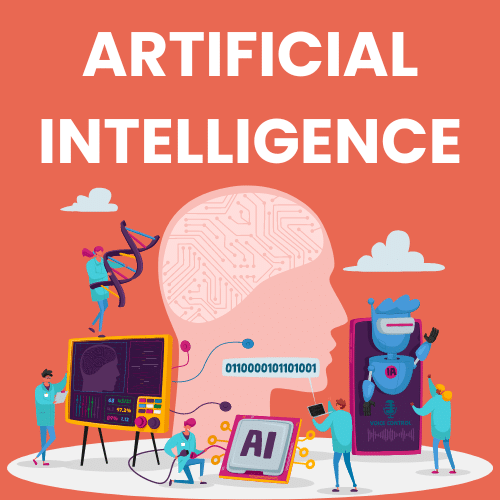
 | INFINITY COURSE Artificial Intelligence for Class 9 – Basics & Applications32,144 students learning this week · Last updated on Apr 07, 2026 |
Artificial Intelligence for Class 9 – Study Material





Trending Courses for Class 9

What is Artificial Intelligence (AI) for Class 9?
Artificial Intelligence for Class 9 is an introductory course designed to familiarize young learners with the fundamental concepts of AI technology. This CBSE skill subject offers students their first structured exposure to one of the most transformative technologies of our time. Rather than diving into complex algorithms, the Class 9 AI course focuses on building conceptual understanding and practical problem-solving skills that form the foundation for advanced studies.
The curriculum introduces students to how machines can learn from data, make decisions, and solve real-world problems. It's not just theoretical—students engage with hands-on projects that help them understand AI applications in everyday life, from voice assistants like Alexa to recommendation systems on YouTube. This practical approach makes AI accessible and relevant for 14-year-old learners.
Core Focus Areas of Class 9 Artificial Intelligence
The Class 9 AI syllabus is structured around seven main pillars that work together to create a comprehensive learning experience. Each component builds upon the others, creating a logical progression from basics to more complex ideas.
- Computational Thinking: Developing logical problem-solving approaches
- Python Programming: Learning to code, the language of AI development
- Data Literacy: Understanding how data drives AI systems
- Mathematical Foundations: Statistics and probability essential for AI
- AI Project Development: Following systematic approaches to build AI solutions
- Ethical Considerations: Understanding responsible AI use
- Employability Skills: Soft skills needed for AI-related careers
Why Learn Artificial Intelligence in Class 9?
Choosing to study AI in Class 9 is a forward-thinking decision that positions students ahead in today's competitive landscape. With AI reshaping industries across India and globally, early exposure gives students a significant advantage. Learning AI now helps students understand technology they'll encounter throughout their lives and potentially pursue rewarding careers in this rapidly growing field.
Beyond career prospects, studying AI develops critical thinking skills that are valuable in any field. Students learn to ask important questions about technology: How does this system work? What data is it using? Could it be biased? These are skills that matter whether students become engineers, doctors, entrepreneurs, or teachers.
Career and Academic Benefits
| Benefit Area | How AI Class 9 Helps |
|---|---|
| Tech Industry Ready | Foundational knowledge for computer science, data science, and AI engineering roles |
| Higher Studies | Prepares for advanced courses in engineering, computer science, and specialized AI programs |
| 21st Century Skills | Develops computational thinking, problem-solving, and digital literacy |
| Versatile Knowledge | Applicable across healthcare, finance, agriculture, education, and more |
AI Syllabus for Class 9: Complete Course Overview
The Class 9 Artificial Intelligence syllabus is carefully designed to provide a balanced introduction without overwhelming students. The course structure progresses logically from foundational concepts to practical application. Understanding the complete CBSE AI Class 9 course structure helps you prepare systematically and ensures you don't miss any important topics.
Major Topics and Chapters
The curriculum encompasses several interconnected areas that together create a comprehensive understanding of AI:
- Employability Skills: Develop workplace communication, teamwork, and professional readiness through AI-focused activities. Explore this important topic in our comprehensive guide to Employability Skills.
- AI Reflection and Ethics: Examine responsible AI development, bias in AI systems, privacy concerns, and the societal impact of artificial intelligence. Our detailed AI Reflection and Ethics chapter covers these crucial considerations for young learners.
- AI Project Cycle: Learn the systematic approach to developing AI solutions—from identifying problems to evaluating solutions. Get hands-on with our detailed AI Project Cycle guide that walks through each stage.
- Data Literacy: Master working with data, understanding data types, collection methods, and basic analysis techniques. Check out our Data Literacy chapter for comprehensive coverage.
- Python Programming: Build foundational coding skills using Python, the industry-standard language for AI development. Our Python programming guide makes coding accessible for beginners.
Understanding the AI Project Cycle for Class 9 Students
The AI project cycle is the beating heart of practical AI education in Class 9. It provides a structured methodology for approaching any AI problem, from simple to complex. Understanding this cycle transforms students from passive learners into active problem-solvers who can tackle real-world challenges using AI principles.
The cycle typically includes five essential stages: problem definition, data acquisition, data exploration, model development, and evaluation. Each stage builds upon the previous one, creating a logical flow that ensures thorough problem-solving. Rather than jumping straight to coding, students learn to think systematically about what they're trying to achieve and why.
Stages of the AI Project Cycle
- Problem Scoping: Clearly defining what problem you're solving and why it matters
- Data Acquisition: Gathering relevant data from appropriate sources
- Data Exploration: Understanding patterns, trends, and characteristics in your data
- Model Development: Building and training AI systems to solve your problem
- Evaluation: Testing your solution and measuring how well it works
Master this framework with our detailed AI Project Cycle resource, which includes real-world examples and hands-on practice.
Python Programming for AI: Beginner's Guide for Class 9
Python programming for AI is one of the most practical and valuable skills in the Class 9 curriculum. Python has become the go-to language for AI and machine learning development because it's powerful yet readable, making it perfect for beginners. Learning Python basics in Class 9 gives you skills that are immediately useful and highly marketable.
The Class 9 Python curriculum focuses on foundational concepts rather than advanced techniques. Students learn variables, data types, control structures (loops and conditionals), and basic functions. These fundamentals are building blocks for everything you'll do with AI, whether you're processing data, building models, or creating applications.
Essential Python Concepts for AI
- Variables and data types (integers, floats, strings, lists)
- Control structures (if-else statements, for loops, while loops)
- Functions and code organization
- Working with libraries and modules
- Basic file handling and input/output operations
Start your Python learning journey with our comprehensive Python programming guide for Class 9, featuring beginner-friendly explanations and practical examples.
Introduction to Generative AI for Class 9
Generative AI represents one of the most exciting recent developments in artificial intelligence, and it's now part of the Class 9 curriculum starting from 2024-25. Generative AI systems like ChatGPT, DALL-E, and similar tools can create text, images, and other content based on patterns they've learned. Understanding generative AI basics helps you appreciate the cutting-edge technology shaping modern applications.
Unlike traditional AI systems that predict or classify existing patterns, generative AI can produce entirely new content. This opens possibilities in creative writing, image generation, code generation, and much more. For Class 9 students, understanding generative AI provides insight into where technology is heading.
Key Concepts in Generative AI
- How generative models learn from training data
- Differences between generative and discriminative AI
- Practical applications of generative AI in everyday tools
- Ethical considerations specific to generative AI
- How large language models work conceptually
Dive deep into this emerging field with our comprehensive Introduction to Generative AI chapter, designed specifically for Class 9 learners.
Data Literacy and AI: Essential Concepts for Class 9
Data literacy—the ability to understand, create, communicate, and work with data—is fundamental to AI. Nearly every AI system operates on data, making data literacy non-negotiable for anyone wanting to understand AI. In Class 9, data literacy skills help you appreciate how information drives decision-making in AI systems.
Data literacy goes beyond numbers. It's about asking critical questions: Where does this data come from? Is it reliable? Could it be biased? How is it being used? These questions matter whether you're evaluating AI systems or building your own projects.
Core Data Literacy Topics
| Topic | Why It Matters for AI |
|---|---|
| Data Types and Formats | Understanding what kinds of data AI systems can process |
| Data Collection Methods | Learning how training data is gathered and its impact on AI systems |
| Data Visualization | Communicating patterns and insights from data clearly |
| Data Quality and Bias | Recognizing problems in data that affect AI performance |
Strengthen your data foundation with our detailed Data Literacy chapter, featuring practical examples and exercises.
Math for AI: Statistics and Probability for Class 9
Mathematics—particularly statistics and probability—forms the theoretical backbone of AI. Don't worry though: the Class 9 AI curriculum covers math concepts at an appropriate level without requiring advanced calculus. Understanding these mathematical foundations helps you grasp how AI systems actually work beneath the surface.
Statistics helps you summarize and understand data patterns, while probability helps you make decisions under uncertainty—both crucial for AI. These aren't abstract concepts; they're tools that AI engineers use daily to build better systems.
Essential Math Topics for AI
- Measures of Central Tendency: Mean, median, and mode for summarizing data
- Data Spread and Distribution: Understanding variation in data sets
- Probability Basics: Calculating likelihood of events
- Statistical Analysis: Drawing conclusions from data
- Correlation and Relationships: Finding patterns between variables
Master these essential mathematical concepts with our comprehensive Math for AI chapter covering statistics and probability fundamentals.
AI Ethics and Reflection: Important Considerations for Young Learners
Learning about AI ethics in Class 9 prepares you to think critically about technology's impact on society. As AI becomes more powerful and prevalent, understanding ethical implications isn't optional—it's essential. The Class 9 curriculum deliberately includes this topic because future AI developers need to build systems responsibly.
AI ethics addresses real concerns: Can AI systems be biased? How should personal data be protected? Who's responsible when AI makes a wrong decision? These questions matter to everyone, not just engineers. Exploring them now develops your judgment about technology.
Examine these crucial considerations deeply through our detailed AI Ethics and Reflection chapter, which explores bias, fairness, privacy, and responsible AI development.
Employability Skills Through AI Education in Class 9
Beyond technical knowledge, the Class 9 AI course develops employability skills that make you attractive to employers and educational institutions. These soft skills—communication, collaboration, problem-solving, and adaptability—are increasingly important in the technology industry.
Working on AI projects in Class 9 naturally develops these skills. You'll collaborate with teammates, present ideas, troubleshoot problems, and adapt to challenges. These experiences build confidence and competence that extend far beyond AI.
Build these critical workplace skills with our comprehensive Employability Skills guide, focusing on how AI education develops professional readiness.
Best Study Material and Resources for Class 9 AI Course
Having quality study material makes your Class 9 AI preparation significantly more effective. The right resources help concepts click, practice strengthens understanding, and organized study plans keep you on track. On EduRev, you'll find comprehensive resources specifically designed for Class 9 AI learners.
Essential Resources for Success
- Practice Questions: Test your understanding and identify weak areas with our comprehensive Practice Questions collection
- Flashcards: Reinforce key concepts and terminology using our AI Flashcards for quick review
- Mind Maps: Visualize how concepts connect with our Mind Maps, perfect for understanding relationships between topics
These study materials complement each other perfectly. Use mind maps to understand the big picture, flashcards for quick memorization, and practice questions to test your knowledge. Together, they create a comprehensive learning system that caters to different learning styles.
How to Prepare for Class 9 Artificial Intelligence Course
Effective preparation transforms your Class 9 AI experience from overwhelming to manageable and enjoyable. A strategic approach helps you learn more, retain better, and actually understand concepts rather than just memorizing facts.
Preparation Strategy for Success
- Start with Conceptual Understanding: Before diving into coding or math, grasp fundamental AI concepts and how they relate to real-world applications
- Practice Consistently: Regular coding practice and problem-solving builds skills incrementally and builds confidence
- Work on Projects: Hands-on AI projects reinforce learning and show how concepts connect in practice
- Review and Revise: Regular revision prevents concepts from slipping away and helps identify gaps early
- Engage Actively: Ask questions, discuss with peers, and seek clarification rather than passively reading material
Your preparation journey with Class 9 AI study material is an investment in your future. Whether you continue with advanced AI studies or apply AI concepts in other fields, the foundation you build now matters. Start with the chapters that interest you most, maintain consistency, and celebrate small wins along the way. The world needs thoughtful, capable people who understand artificial intelligence—that could be you.
Artificial Intelligence (AI) for Class 9 CBSE Exam Pattern 2026-2027
Introduction:
Artificial Intelligence (AI) is a rapidly growing field that involves the development of intelligent machines that can think and learn like humans. In the Class 9 curriculum, students are introduced to the basics of AI and its applications.
Exam Pattern:
1. Objective Type Questions: The AI exam for Class 9 typically consists of multiple-choice questions that test the students' understanding of key concepts related to AI.
2. Short Answer Questions: Students may also be required to answer short answer questions that require them to explain concepts, algorithms, and applications of AI in detail.
3. Practical Exam: In some cases, students may have to demonstrate their understanding of AI by solving practical problems or coding tasks related to AI algorithms.
4. Project Work: Class 9 students may also be required to work on AI projects that involve designing and implementing AI solutions for real-world problems.
5. Revision and Practice: It is essential for students to revise the AI concepts thoroughly and practice solving sample papers and mock tests to prepare effectively for the exam.
Conclusion:
The AI exam for Class 9 is designed to test students' knowledge and understanding of artificial intelligence concepts and their applications. By following a structured study plan and practicing regularly, students can excel in the AI exam and build a strong foundation in this emerging field.


Artificial Intelligence (AI) for Class 9 Syllabus 2026-2027 PDF Download
Class 9 Artificial Intelligence (AI) for Class 9
- Introduction to AI: Understanding the basics of Artificial Intelligence, its applications, and impact on society.
- AI Project Cycle: Learning the steps involved in planning, designing, implementing, and evaluating an AI project.
- Neural Network: Exploring the concept of neural networks, their structure, and working principles.
- Python: Introduction to Python programming language for AI development.
- Practice Questions: Solving practice questions to reinforce learning and improve problem-solving skills.
Class 9 Employability Skills
- Communication Skills: Enhancing verbal and written communication skills for effective interaction in professional environments.
- Teamwork: Understanding the importance of teamwork and collaboration in achieving common goals.
- Problem-Solving: Developing critical thinking and problem-solving skills to tackle real-world challenges.
- Time Management: Learning to prioritize tasks, set goals, and manage time efficiently.
- Resume Building: Creating a professional resume highlighting skills, experience, and achievements.
Class 9 Introduction To AI
- History of AI: Tracing the evolution of Artificial Intelligence from its origins to present-day applications.
- Types of AI: Exploring different types of AI systems, such as narrow AI and general AI.
- Ethical Considerations: Discussing ethical issues and concerns related to AI development and implementation.
- Future of AI: Predicting the future trends and advancements in the field of Artificial Intelligence.
Class 9 AI Project Cycle
- Planning: Defining project objectives, scope, and timeline.
- Design: Creating a detailed plan for implementing AI algorithms and technologies.
- Implementation: Developing and testing the AI project according to the design specifications.
- Evaluation: Assessing the performance and effectiveness of the AI project through testing and feedback.
Class 9 Neural Network
- Structure: Understanding the structure of neural networks, including neurons, layers, and connections.
- Activation Functions: Exploring different activation functions used in neural networks, such as sigmoid and ReLU.
- Training: Learning the process of training a neural network using algorithms like backpropagation.
- Applications: Studying real-world applications of neural networks in areas like image recognition and natural language processing.
Class 9 Python
- Basics: Introduction to Python syntax, variables, data types, and control structures.
- Functions: Defining and calling functions in Python for code reusability and organization.
- Libraries: Exploring popular Python libraries for AI development, such as NumPy and TensorFlow.
- Projects: Working on Python projects to apply programming concepts in AI development.
Class 9 Practice Questions
- Multiple Choice: Solving multiple-choice questions to test knowledge and understanding of AI concepts.
- Programming Exercises: Completing programming exercises in Python to practice coding skills.
- Case Studies: Analyzing case studies to apply AI concepts in real-world scenarios.
- Mock Tests: Taking mock tests to assess readiness for exams and competitions.
This course is helpful for the following exams: Class 9
How to Prepare Artificial Intelligence (AI) for Class 9?
How to Prepare Artificial Intelligence (AI) for Class 9 for Class 9?
Introduction:
Artificial Intelligence (AI) is a rapidly growing field that is becoming increasingly important in today's world. As a Class 9 student, it is crucial to start building your knowledge and skills in AI early on. EduRev offers a comprehensive course in AI specifically designed for Class 9 students.
Key Points to Prepare for AI in Class 9:
1. Understand the Basics: Start by understanding the basic concepts of AI, including machine learning, neural networks, and deep learning.
2. Practice Coding: Develop your coding skills in languages such as Python, which is commonly used in AI applications.
3. Explore AI Tools: Familiarize yourself with AI tools and platforms like TensorFlow and Keras to gain hands-on experience.
4. Stay Updated: Keep yourself updated with the latest trends and developments in the field of AI through online resources, books, and courses.
5. Participate in Projects: Engage in AI projects to apply your knowledge and skills in real-world scenarios.
6. Join AI Communities: Connect with other AI enthusiasts and professionals to share ideas and learn from each other.
Benefits of EduRev AI Course for Class 9:
1. Structured Curriculum: The AI course by EduRev is designed specifically for Class 9 students, ensuring a structured learning path.
2. Interactive Learning: Engage in interactive lessons, quizzes, and assignments to enhance your understanding of AI concepts.
3. Expert Guidance: Benefit from expert guidance and support from experienced instructors throughout the course.
4. Hands-on Experience: Gain practical experience through projects and practical exercises to apply your knowledge in real-world scenarios.
5. Certification: Receive a certificate upon completion of the AI course, showcasing your proficiency in the field.
In conclusion, preparing for Artificial Intelligence (AI) in Class 9 is essential to stay ahead in the rapidly evolving field of technology. By enrolling in the EduRev AI course, you can build a strong foundation in AI and set yourself up for success in the future. Start your AI journey today with EduRev!
Importance of Artificial Intelligence (AI) for Class 9
Importance of Artificial Intelligence (AI) for Class 9 Course for Class 9
Artificial Intelligence (AI) is a rapidly growing field that is revolutionizing various aspects of our lives. Integrating AI into the Class 9 curriculum can provide numerous benefits to students, helping them develop essential skills for the future.
Key Pointers:
- Enhanced Learning Opportunities: AI can personalize learning experiences for students, catering to their individual needs and learning styles. This can lead to improved academic performance and overall engagement in the classroom.
- Preparation for the Future: As AI continues to advance, it is becoming increasingly important for students to have a basic understanding of this technology. By incorporating AI into the Class 9 curriculum, students can develop skills that will be valuable in their future careers.
- Problem-Solving Skills: AI encourages critical thinking and problem-solving skills, as students learn to analyze data, make decisions, and create solutions using AI algorithms. These skills are essential in today's fast-paced and technology-driven world.
- Exposure to Emerging Technologies: By studying AI in Class 9, students can gain exposure to emerging technologies and trends in the field. This can spark interest in pursuing further education or careers in AI-related fields.
- Collaboration and Teamwork: AI projects often require collaboration and teamwork, as students work together to design and implement AI solutions. This can help students develop communication and collaboration skills that are essential in the workplace.
Overall, integrating Artificial Intelligence into the Class 9 curriculum can provide students with valuable skills and knowledge that will benefit them in their academic and professional lives. By understanding the importance of AI, students can stay ahead of the curve and prepare for the future of technology.
Artificial Intelligence (AI) for Class 9 FAQs
| 1. What is artificial intelligence and how does it work in Class 9 level? |  |
| 2. What are the different types of AI applications explained in Class 9 curriculum? | |
| 3. How do machine learning algorithms help AI systems learn from data? | |
| 4. What is the difference between artificial intelligence and machine learning for Class 9 students? | |
| 5. What are neural networks and how do they relate to human brain functioning? | |
| 6. How does natural language processing enable AI to understand human language? | |
| 7. What ethical concerns and limitations of AI should Class 9 students understand? | |
| 8. How do supervised and unsupervised learning differ in AI training methods? | |
| 9. What role does big data play in developing effective AI systems? | |
| 10. How can Class 9 students learn AI concepts through hands-on projects and real-world examples? | |
Best Artificial Intelligence (AI) for Class 9 NCERT Solutions and Study Materials
 | View your Course Analysis |  |
 | Create your own Test | |



|
 Videos
 Documents
 Ratings
 | Explore Courses for Class 9 exam |  |


