 |  Isomerism 50 Flashcards |  Start |
 | Isomerism refers to compounds that have the same molecular formula but ___ properties. |  Card: 1 / 50 |
| Different | Card: 2 / 50 |
| True or False: Structural isomerism involves molecules with the same connectivity of atoms. | Card: 3 / 50 |
| False. Structural isomerism involves different arrangements of atoms. | Card: 4 / 50 |
| What are the two main classifications of isomerism? | Card: 5 / 50 |
| Structural isomerism and Stereoisomerism | Card: 6 / 50 |
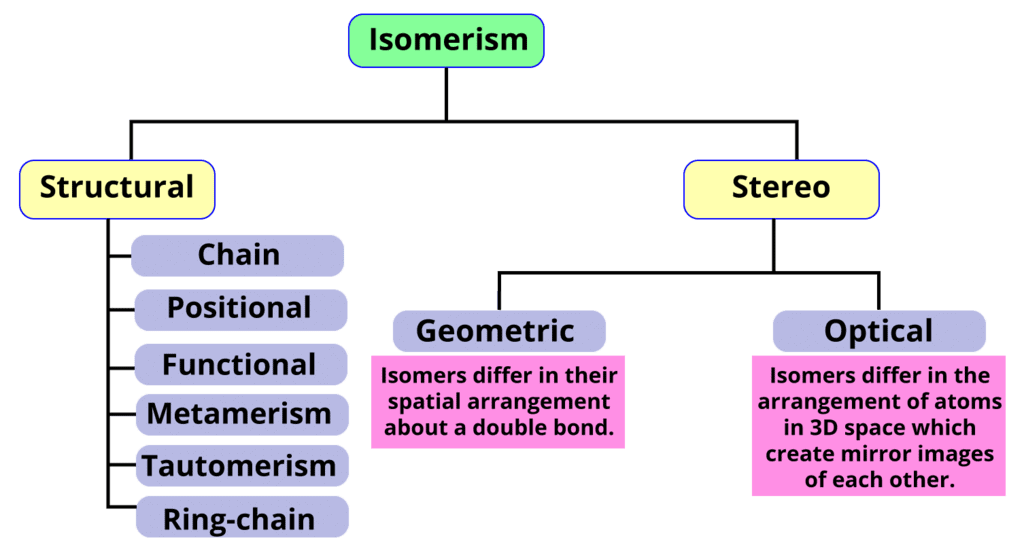
| What are structural isomers and how do they differ from one another? | Card: 7 / 50 |
| Structural isomers differ in atom connectivity.
| Card: 8 / 50 |
| Fill in the blank: Tautomeric isomers exist in equilibrium due to the migration of a ___ or a ___ between different forms. | Card: 9 / 50 |
| Hydrogen atom or a proton | Card: 10 / 50 |
| Chain isomerism involves compounds with the same molecular formula but differing in ___. | Card: 11 / 50 |
| The length of the principal chain | Card: 12 / 50 |
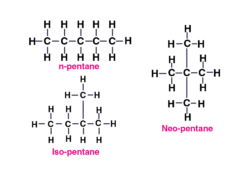
| Identify the structural isomers of C5H12 and explain their formation. | Card: 13 / 50 |
| C5H12 has three isomers: n-pentane, isopentane, and neopentane, formed by varying the arrangement of carbon chains. | Card: 14 / 50 |
| Position isomers differ from chain isomers in that they have the same molecular formula but differ in the position of ___ and ___ within the molecule. | Card: 15 / 50 |
| Functional groups and multiple bonds | Card: 16 / 50 |
| True or False: The compounds 1-chloropropane and 2-chloropropane are examples of chain isomers. | Card: 17 / 50 |
| False. They are position isomers. 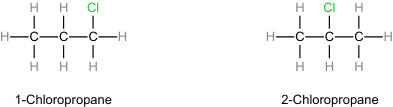 | Card: 18 / 50 |
| What is the significance of total unsaturation in determining the structural isomers of a compound such as C₄H₆? | Card: 19 / 50 |
| Total unsaturation affects structural isomers.
| Card: 20 / 50 |
| Fill in the blank: The total number of structural isomers, both cyclic and acyclic, for C₄H₆ is ___. | Card: 21 / 50 |
| 9 | Card: 22 / 50 |
| What are functional isomers, and provide an example of two functional isomers? | Card: 23 / 50 |
| Functional isomers differ in functional groups.
| Card: 24 / 50 |
| True or False: Primary, secondary, and tertiary amines can have the same molecular formula but different structural formulas. | Card: 25 / 50 |
|  Unlock all Flashcards with EduRev Infinity Plan Starting from @ ₹99 only | |
| True. Primary, secondary, and tertiary amines can indeed have the same molecular formula but differ in their structural arrangements. | Card: 26 / 50 |
| What types of amides can be formed from the molecular formula C3H7NO, and how many structural isomers are possible for each type? | Card: 27 / 50 |
| From C3H7NO, one primary amide, two secondary amides (total 4 structural isomers), and one tertiary amide can be formed. | Card: 28 / 50 |
| True or False: Tertiary amides can form hydrogen bonds. | Card: 29 / 50 |
| False. Tertiary amides cannot form hydrogen bonds due to the lack of a hydrogen atom attached to the nitrogen. | Card: 30 / 50 |
| What is the total number of structural isomers for the compound with the formula C6H12? | Card: 31 / 50 |
| There are a total of 13 structural isomers for the compound with the formula C6H12. | Card: 32 / 50 |
| True or False: A cumulated diene can be formed from a compound with the formula C5H8. | Card: 33 / 50 |
| False. No cumulated diene can be formed from a compound with the formula C5H8. | Card: 34 / 50 |
| Metamerism is a type of isomerism characterized by compounds that have the same molecular formula but differ in the nature of the ___ groups attached to a polyvalent atom. | Card: 35 / 50 |
| Alkyl | Card: 36 / 50 |
| True or False: Tautomerism involves compounds that have the same molecular formula and arise from the oscillation of an atom, usually ___ . | Card: 37 / 50 |
| True; typically, this atom is hydrogen. | Card: 38 / 50 |
| What role does intramolecular hydrogen bonding play in the stability of certain compounds? | Card: 39 / 50 |
| Intramolecular hydrogen bonding leads to the formation of a stable six-membered ring, which significantly enhances the stability of the compound. | Card: 40 / 50 |
| Enol content in a compound is influenced by the stability of which intermediate? | Card: 41 / 50 |
| Enol content depends on carbanion stability.
| Card: 42 / 50 |
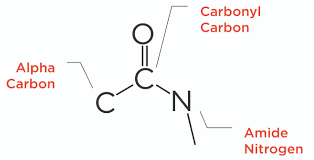
| Amides and amines differ primarily in their functional groups, where amides contain a ___ group attached to a nitrogen atom. | Card: 43 / 50 |
| Carbonyl (C=O) | Card: 44 / 50 |
| True or False: Azo compounds are typically more stable than hydrazones due to the presence of extended conjugation within their structure. | Card: 45 / 50 |
| True | Card: 46 / 50 |
| Fill in the blank: Ring-chain isomers are always ___ isomers. | Card: 47 / 50 |
| Functional | Card: 48 / 50 |
| What distinguishes alkenes from cycloalkanes in terms of their structural representation? | Card: 49 / 50 |
| Alkenes have a double bond between carbon atoms, while cycloalkanes consist of carbon atoms arranged in a ring structure without any double bonds. | Card: 50 / 50 |
| Completed! Keep practicing to master all of them. |  Restart |


