CBSE Class 6 > Class 6 Notes > Maths Olympiad > Learning Poster: Lines and Angles
Learning Poster: Lines and Angles

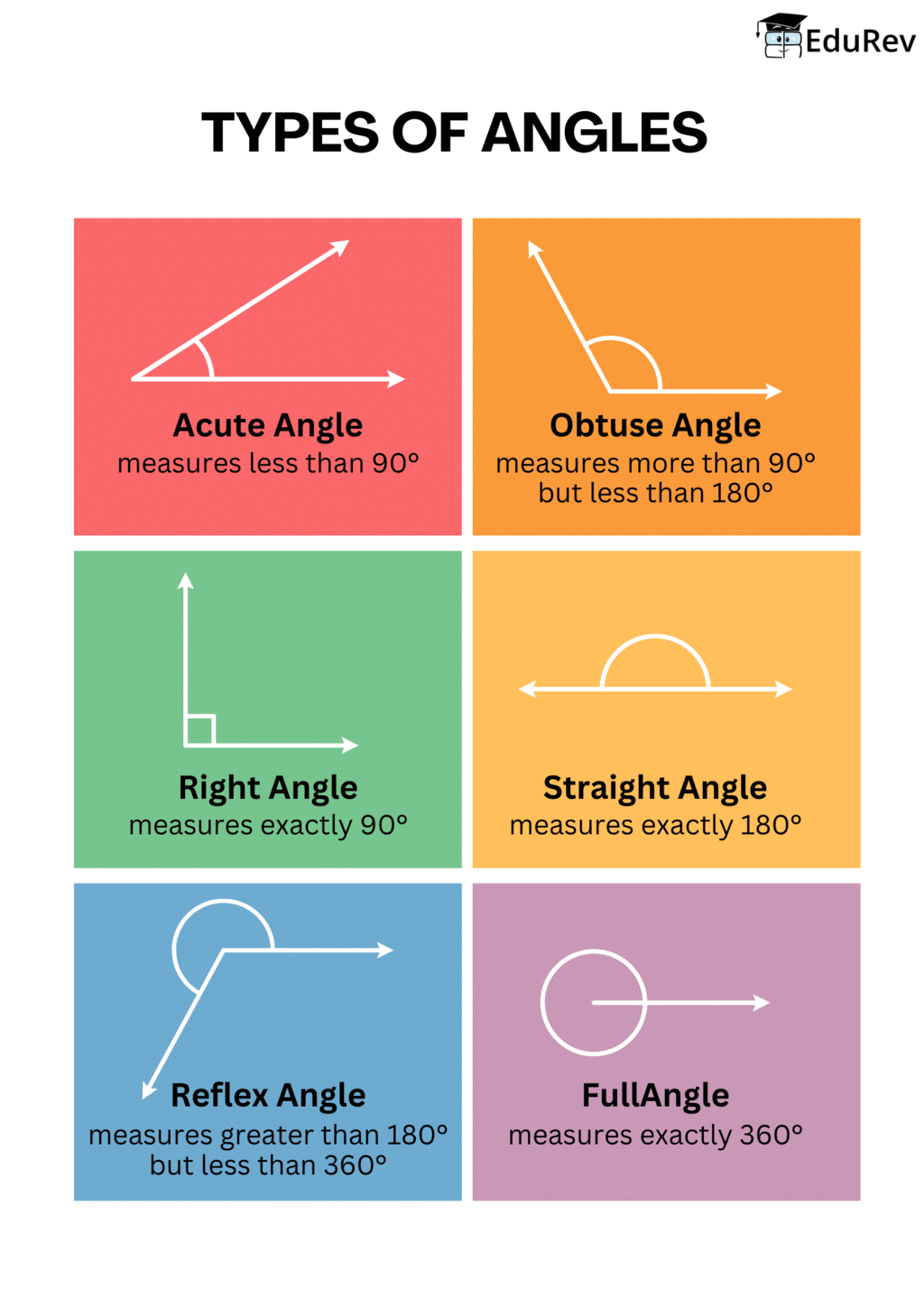
The document Learning Poster: Lines and Angles is a part of the Class 6 Course Maths Olympiad Class 6.
All you need of Class 6 at this link: Class 6
FAQs on Learning Poster: Lines and Angles
| 1. What are lines and angles in geometry? |  |
Ans. Lines are straight one-dimensional figures that extend infinitely in both directions. They have no thickness and are defined by two points. Angles are formed when two lines meet at a point, and they are measured in degrees. The size of an angle indicates how far the lines are inclined to each other.
| 2. How do you classify angles based on their measures? | |
Ans. Angles can be classified into several categories based on their measures: - Acute angles are less than 90 degrees. - Right angles are exactly 90 degrees. - Obtuse angles are greater than 90 degrees but less than 180 degrees. - Straight angles are exactly 180 degrees. - Reflex angles are greater than 180 degrees but less than 360 degrees.
| 3. What is the relationship between parallel lines and angles? | |
Ans. When two parallel lines are intersected by a transversal, several angles are formed. The corresponding angles are equal, alternate interior angles are equal, and the sum of the interior angles on the same side of the transversal is 180 degrees. This property helps in solving many geometric problems.
| 4. How can we measure angles accurately? | |
Ans. Angles can be measured using a protractor. To use a protractor, the midpoint of the protractor (the small hole) is placed at the vertex of the angle. One line of the angle is aligned with the zero line of the protractor, and the degree measure of the other line is read from the scale on the protractor.
| 5. Why is it important to learn about lines and angles in Class 6? | |
Ans. Learning about lines and angles in Class 6 is foundational for understanding more complex geometric concepts later on. It helps develop critical thinking and problem-solving skills, as students learn to analyze shapes, solve geometric problems, and understand spatial relationships, which are essential in various real-life applications.
About this Document

3.1K Views

4.70/5 Rating

Apr 29, 2026 Last updated
Document Description: Learning Poster: Lines and Angles for Class 6 2026 is part of Maths Olympiad Class 6 preparation. The notes and questions for Learning Poster: Lines and Angles have been prepared according to the Class 6 exam syllabus. Information about Learning Poster: Lines and Angles covers topics like and Learning Poster: Lines and Angles Example, for Class 6 2026 Exam. Find important definitions, questions, notes, meanings, examples, exercises and tests below for Learning Poster: Lines and Angles.
Introduction of Learning Poster: Lines and Angles in English is available as part of our Maths Olympiad Class 6 for Class 6 & Learning Poster: Lines and Angles in Hindi for Maths Olympiad Class 6 course. Download more important topics related with notes, lectures and mock test series for Class 6 Exam by signing up for free. Class 6: Learning Poster: Lines and Angles
Description
Learning Poster: Lines & Angles of Maths Olympiad Class 6 covers all the important topics, helping you prepare for the Class 6 exam on EduRev. Start for free!
Information about Learning Poster: Lines and Angles
In this doc you can find the meaning of Learning Poster: Lines and Angles defined & explained in the simplest way possible. Besides explaining types of Learning Poster: Lines and Angles theory, EduRev gives you an ample number of questions to practice Learning Poster: Lines and Angles tests, examples and also practice Class 6 tests



Related Searches
Learning Poster: Lines and Angles, shortcuts and tricks, Semester Notes, Objective type Questions, Important questions, Learning Poster: Lines and Angles, Extra Questions, pdf , mock tests for examination, video lectures, Learning Poster: Lines and Angles, Free, ppt, study material, Sample Paper, MCQs, practice quizzes, Exam, Summary, Previous Year Questions with Solutions, past year papers, Viva Questions;