Examples: Analytical Paragraph


To write an analytical paragraph, you need to analyse and interpret information with the help of visuals like graphs, tables, and charts. The goal of writing an analytical paragraph is to present information clearly and in an organised way, while also drawing smart conclusions.
The EduRev's English Grammar Advanced Course for Class 10 provides this document containing a range of practice questions with model answers to help you improve your skill in writing analytical paragraphs.
Answer the following questions in 100-120 words:
Question 1
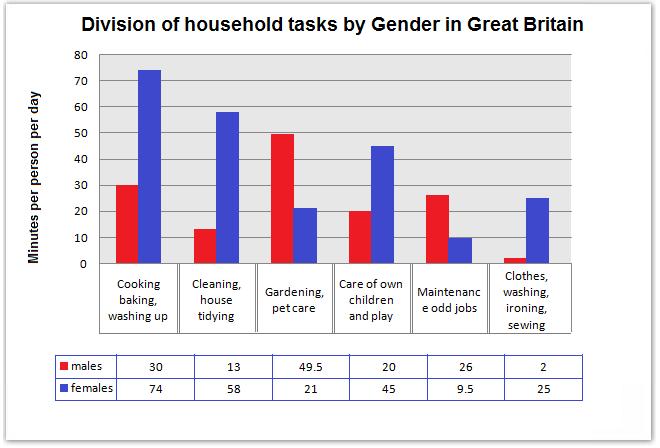
Q.1. The given chart shows the division of household tasks by gender in Great Britain. Write an analytical paragraph describing the chart in not more than 100-120 words.
Model Answer:
The chart compares the average daily time spent by males and females on various household tasks in Great Britain. Overall, women spend considerably more time on routine domestic chores such as cooking, cleaning, laundry and child care, while men devote more time to gardening, pet care and odd jobs. On average, women spend over 200 minutes per day on household activities, whereas men spend roughly 140 minutes. Cooking and cleaning are the largest components of women's domestic workload, while gardening and maintenance occupy the greatest share of men's time. These differences indicate a clear gender division of labour within households: women undertake most day-to-day domestic care, and men focus more on outdoor or occasional maintenance tasks.
Question 2
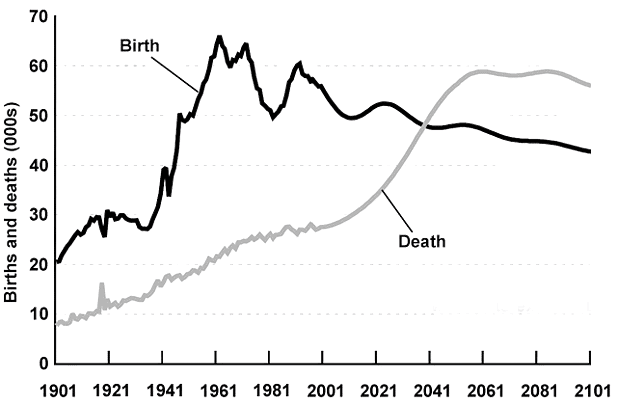
Q.2. The given line graph provides information about changes in birth and death in New Zealand between 1901 and 2101. Write an analytical paragraph to summarise information and make comparisons where relevant in about 100-120 words.
Model Answer:
The line graph traces birth and death rates per 1,000 people in New Zealand from 1901 and projects them up to 2101. In 1901, the birth rate was a little above 20, while the death rate was under 10 per 1,000. The birth rate rose sharply to reach its highest point in the mid-20th century (around the 1960s) before gradually declining to about 50 per 1,000 at present. Deaths show a steadier upward trend, reaching approximately 30 per 1,000 today. Projections indicate deaths will continue to rise and overtake births by about 2041, peaking close to 60 per 1,000 in later decades and settling near 55 by 2101, while births are expected to decline further and stabilise around 45 per 1,000. The graph, therefore, suggests a demographic transition towards higher mortality relative to fertility in the long term.
Question 3
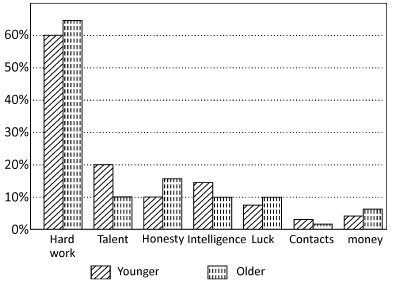
Q.3. Harish has to write a paragraph on the qualities required for success. He notices the chart given below on the paper and decides to use it as the basis of his writing. Using the chart and your own ideas write a paragraph in 100-120 words.
"The most important thing in life"
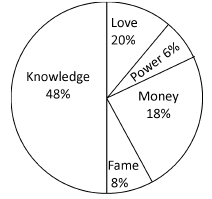
Most important factor for sources
Model Answer:
The Qualities Required for Success
Success depends on several factors, but certain personal qualities are consistently important. The chart highlights values such as knowledge, love, money, fame and power; among these, knowledge is fundamental because it equips a person with skills and understanding needed for achievement. Equally important are hard work, talent, integrity and perseverance, which turn opportunities into lasting success. Money, fame and power may open doors, but without effort and honesty, they cannot secure long-term accomplishment. Love and supportive relationships provide motivation and emotional strength. Luck can influence outcomes, yet success is chiefly the result of sustained effort, the right abilities, and ethical behaviour.
Also Check at EduRev
Question 4
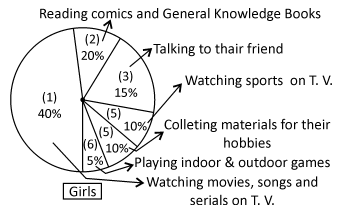
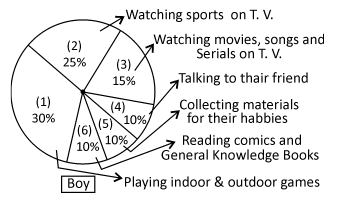
Q.4. A survey was conducted to find out how teenagers spend their free time. Using the data given in the pie chart, together with your own ideas, write a small paragraph in 100-120 words on the topic, "How do teenagers spend their free time?"
Model Answer:
The pie chart shows clear differences in how teenage boys and girls spend leisure time. Watching television, films and serials occupies a large portion for girls (40%) but far fewer boys (15%). Reading general knowledge or books is more popular with girls, while boys are more drawn to watching sports on TV (25% of boys versus 10% of girls). Socialising by talking with friends is also higher among girls (15%) compared to boys (5%). When it comes to hobbies and collecting materials, boys show slightly more interest (10%) than girls (5%). Playing indoor and outdoor games is the largest leisure activity for boys (30%), whereas only a small percentage of girls spend their spare time on games. Overall, girls tend to prefer passive leisure and study-related activities, while boys favour active play and sports.
Question 5
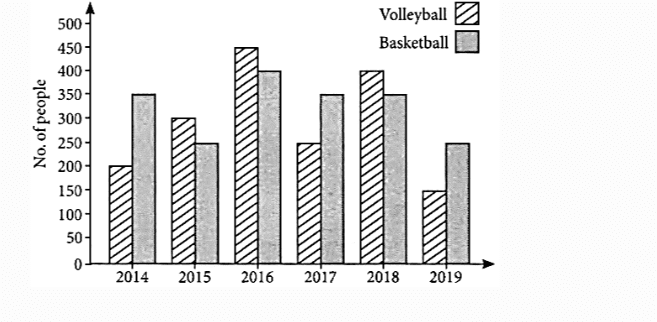
Q.5 The given double bar graph shows the preferences of children in a school in playing different games over the span of six years. Write an analytical paragraph about the given information.
Model Answer:
The double bar graph illustrates changes in children's preferences for various games over six years. Volleyball experienced a pronounced rise in popularity, peaking in 2016, but this surge was not sustained and interest declined by 2019. Basketball maintained a fairly steady level of popularity across the period, with only small fluctuations and a slight increase around 2016. The contrast suggests volleyball attracted a temporary wave of interest, while basketball showed a consistent, enduring appeal among the pupils. Such patterns may reflect changing coaching, school facilities or trends among students, with short-term spikes for some sports and steady preference for others.
Frequently Asked Questions (FAQs) Related to Analytical Paragraph
Q.1. What is an analytical paragraph?
An analytical paragraph is a focused piece of writing that examines a topic or set of data in detail. It breaks the topic into parts, analyses each part using evidence or examples, and draws logical conclusions based on that analysis.
Q.2. What is the purpose of an analytical paragraph?
The purpose is to interpret information clearly, explain relationships or trends, and justify conclusions using evidence. It helps the reader understand the significance of the data or idea being analysed.
Q.3. What are the key components of an analytical paragraph?
- Topic sentence that states the main point;
- Evidence or data drawn from the visual or text;
- Explanation that interprets the evidence;
- Concluding sentence that summarises the analysis and may offer an implication or comparison.
Q.4. How do you write an analytical paragraph?
Begin with a clear topic sentence identifying what you will analyse. Present the most relevant data or features next, then explain their significance and relationships. Use comparisons where helpful, and end with a concise conclusion that ties the analysis together.
Q.5. What are some tips for writing an effective analytical paragraph?
Focus on one main idea; use specific evidence from the visual; explain how the evidence supports your point; organise sentences logically; and write a clear concluding sentence. Keep language precise and avoid irrelevant details.
EduRev is a helpful resource if you want structured practice and model answers to improve your analytical writing skills.
FAQs on Examples: Analytical Paragraph
| 1. What is an analytical paragraph and how is it structured? |  |
| 2. How can I effectively analyze a piece of literature in an analytical paragraph? | |
| 3. What are some common mistakes to avoid when writing an analytical paragraph? | |
| 4. Can an analytical paragraph include personal opinions, or should it be strictly objective? | |
| 5. How long should an analytical paragraph be for academic writing? | |





