LR Exam  >  LR Notes  >  Calendars - Important Formulas; Logical Reasoning

Calendars - Important Formulas; Logical Reasoning

Important Formulas - Calendar


1. Odd Days

Number of days more than the complete weeks are called odd days in a given period.


2. Leap Year

A leap year has 366 days.

In a leap year, the month of February has 29 days.

Every year divisible by 4 is a leap year, if it is not a century.

Examples: 
1952, 2008, 1680 etc. are leap years. 
1991, 2003 etc. are not leap years

Every 4th century is a leap year and no other century is a leap year.

Examples: 
400, 800, 1200 etc. are leap years. 
100, 200, 1900 etc. are not leap years


3. Ordinary Year

The year which is not a leap year is an ordinary year.

An ordinary year has 365 days


4. Counting odd days and calculating day of any particular date

1 ordinary year ≡ 365 days ≡ (52 weeks + 1 day)
Hence number of odd days in 1 ordinary year= 1.

1 leap year ≡ 366 days ≡ (52 weeks + 2 days)
Hence number of odd days in 1 leap year= 2.

100 years ≡ (76 ordinary years + 24 leap years )
≡ (76 x 1 + 24 x 2) odd days 
≡ 124 odd days. 
≡ (17 weeks + 5 days) 
≡  5 odd days. 

Hence number of odd days in 100 years = 5.

Number of odd days in 200 years = (5 x 2) = 10 ≡ 3 odd days

Number of odd days in 300 years = (5 x 3) = 15 ≡ 1 odd days

Number of odd days in 400 years = (5 x 4 + 1) = 21 ≡ 0 odd days

Similarly, the number of odd days in all 4th centuries (400, 800, 1200 etc.) = 0

Mapping of the number of odd day to the day of the week
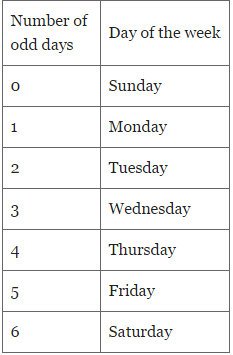
 

Calendars - Important Formulas; Logical Reasoning


5. Additional Notes

Last day of a century cannot be Tuesday or Thursday or Saturday.

For the calendars of two different years to be the same, the following conditions must be satisfied.

(1) Both years must be of the same type. i.e., both years must be ordinary years or both years must be leap years.

(2) 1st January of both the years must be the same day of the week.

The document Calendars - Important Formulas; Logical Reasoning is a part of LR category.
All you need of LR at this link: LR

FAQs on Calendars - Important Formulas; Logical Reasoning

1. What are some important formulas related to calendars?
Ans. Some important formulas related to calendars include: - Finding the number of days in a given year: A common formula is 365 + leap year adjustments. Leap year adjustments are made by adding 1 day if the year is divisible by 4 but not divisible by 100, or if it is divisible by 400. - Calculating the day of the week for a given date: There are various formulas like Zeller's Congruence or Tomohiko Sakamoto's Algorithm that can be used to determine the day of the week for a specific date. - Determining the number of weeks in a given month: This can be calculated by finding the total number of days in the month and dividing it by 7. - Calculating the difference between two dates: This can be done by counting the number of days between the two dates, taking into account leap years and the number of days in each month.
2. How can logical reasoning be applied to calendars?
Ans. Logical reasoning can be applied to calendars in various ways, such as: - Identifying patterns: Logical reasoning can help in identifying patterns in calendars, such as recurring events or specific arrangements of dates. This can be useful for planning and organizing schedules. - Solving calendar puzzles: Logical reasoning skills can be employed to solve puzzles or riddles related to calendars, such as finding the missing date or determining the day of the week for a given date. - Analyzing calendar data: Logical reasoning can aid in analyzing calendar data, such as identifying trends or correlations between dates and events. This can be helpful for businesses, researchers, or event planners. - Making logical deductions: By applying logical reasoning, one can make deductions or predictions based on calendar information. For example, determining the next occurrence of an event based on its previous pattern.
3. How can calendars help in time management?
Ans. Calendars play a crucial role in time management by providing a visual representation of dates, events, and commitments. Here are some ways calendars can help in time management: - Scheduling: Calendars allow individuals to schedule and allocate specific time slots for tasks, appointments, meetings, or events. This helps in organizing and prioritizing activities efficiently. - Avoiding conflicts: By having a clear overview of all commitments, calendars help in avoiding scheduling conflicts. They enable individuals to see if there are any overlapping appointments or if there is sufficient time for each task. - Setting reminders: Calendars often come with reminder features that notify individuals of upcoming events or deadlines. This helps in staying on track and not missing important tasks or appointments. - Long-term planning: Calendars provide a broader perspective, allowing individuals to plan long-term goals, projects, or vacations. This ensures that there is enough time allocated for these activities and helps in achieving a balanced schedule.
4. How can one calculate the age using a calendar?
Ans. Calculating age using a calendar involves considering the birth date and the current date. Here's how it can be done: - Determine the birth date: Note down the day, month, and year of the individual's birth. - Determine the current date: Note down the day, month, and year of the present day. - Calculate the age: Subtract the birth year from the current year. If the birth month is greater than the current month, subtract 1 from the age. If the birth month is the same as the current month but the birth day is greater than the current day, subtract 1 from the age. The resulting number is the person's age. It's important to note that this calculation assumes that the current month and day have already occurred in the current year.
5. How can one determine the day of the week for a specific date using a calendar?
Ans. There are various methods to determine the day of the week for a specific date using a calendar. One commonly used method is Zeller's Congruence. Here's how it works: - Assign values to each element: Assign a value to the year, month, and day of the date. For example, January and February are considered as months 13 and 14 of the previous year, while March is considered as month 3 of the current year. - Calculate the day: Use the formula [(day + ((13 * (month + 1)) / 5) + year + (year / 4) - (year / 100) + (year / 400)) % 7]. The resulting value corresponds to a day of the week, with 0 representing Saturday, 1 representing Sunday, and so on. This method can be used to determine the day of the week for any given date, allowing for better planning and scheduling.
Download as PDF

Top Courses for LR

Related Searches
Calendars - Important Formulas; Logical Reasoning, shortcuts and tricks, pdf , Summary, Extra Questions, past year papers, Calendars - Important Formulas; Logical Reasoning, Free, Semester Notes, video lectures, Objective type Questions, practice quizzes, MCQs, Calendars - Important Formulas; Logical Reasoning, ppt, Exam, Viva Questions, Sample Paper, Important questions, Previous Year Questions with Solutions, mock tests for examination, study material;
