Components of Economic Environment, Business Environment

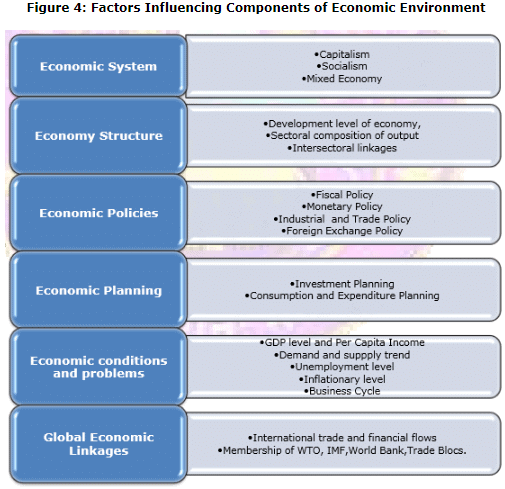
The major components of the economic environment which have their impact on the business activities are:

1. The Nature of Economic System- An economic system of a nation is defined as a continuous process of setting up of institutional arrangements by which a nation can satisfy unlimited and multiple wants of its people to the maximum with the optimal allocation and utilization of its limited resources by taking its production, distribution and consumption decisions. Every business has to take its decisions regarding its operations and activities within the framework of its country‟s economic system to make optimum utilization of its available resources. So business activities cannot be analyzed properly without reference to the economic system within which they are being carried out. The nature of economic system obtained within a country is a critical element of the economic environment of business of that country as it has a significant impact on the nature of economic environment. The nature of economic system can be described in terms of the system of consumption, production, distribution and exchange transaction. From the standpoint of these factors, the economic system can be broadly classified as capitalist, socialist or mixed.
a) Capitalist Economy- It is a type of economic system where means of production are owned and controlled by individuals and private institutions with the objective of earning profits. The decisions regarding production, distribution and consumption are made by forces of demand and supply without much intervention by the state. USA, Canada, Mexico, Germany, Sweden, etc. are the examples of Capitalist Economy.
b) Socialist Economy- It is another type of economic system where the means of production are owned and controlled by the state. Here, central planning plays an important role in the matters related with production, distribution and consumption. Denmark, Finland, Norway, New Zealand, etc. are the examples of Socialist Economy.
c) Mixed Economy- It refers to an economic system which combines both capitalism and socialism. Here, means of production are owned and controlled by both the state as well as private players. The forces of demand and supply and central planning plays an equal important role in the matters related with production, distribution and consumption. Mixed economy has emerged as the dominant economic system in several countries like Australia, Iceland, United Kingdom, Japan, Italy including India.
2. The Structure of the Economy- The structure of the economy include factors such as contribution of different sectors like primary sector (mostly agriculture), Secondary sector (industrial) and tertiary (secondary) sectors, large, medium, small and tiny sectors to the economy, and their linkages, integration with the world economy.
3. Economic Policies- The anatomy and functioning of the economic system is often influenced by the national economic policies at work. The effectiveness of economic policy on the other hand depends on what assumptions are made about the system and how policy is assumed to operate. Every economic policy has the fundamental objective of promotion of growth with stability. The government of a country frames economic policies in the form of industrial policy, fiscal policy, monetary policy, industry policy, foreign exchange policy, foreign investment policy, EXIM policy etc. which can directly influence all business activities and operations. Every business firm is supposed to perform and take their decisions within the policy framework and respond to the changes therein as changes in these policies may have positive or negative effect on a business unit. For example the government may grant subsidies to one business or it may increase the rate of custom or excise duty on certain commodities or tax rate may be increased like introduction of value added tax for some commodities make that commodities more expensive or put extra burden on either suppliers or consumers. If the government has adopted liberal foreign investment policy then it will lead to more inflow of foreign capital in the country resulting in more industrialization and growth in the country.
(i) Fiscal Policy- It is commonly looked upon as comprising variations in government tax and expenditure programme. The pattern of government expenditure affects the development of various regions, sectors and industries. On the other hand government often uses tax incentives or disincentives to encourage or discourage certain activities.
(ii) Monetary Policy-The specific objectives of monetary policy are: (1) To provide necessary finance to various investors through commercial banks and cooperative banks for economic development; (2) To control the inflationary pressures generated in the economy with its instruments like bank rate, open market operations, cash reserve ratio etc.; (3) To maintain full or near full employment.
(iii) Industrial Policy- Industrial Policy define the scope and role of different sectors like private, public, joint and cooperative, or large, medium, small and tiny. Industrial policy influences various business decisions like the location of industries, choice of technology, scale of operations etc.
(iv) Trade Policy- Trade policy is often integrated with the industrial policy. The trade policy also influence the fortune of the business like restrictive import policy may greatly help the domestic industries, while a liberalization of the import policy may create difficulty for such industries. Like the government of India has approved the most awaited policy measures of permitting FDI in multi brand product retail trading MBPRT upto 51 percent, further simplified 100% FDI in single brand product retail trading (SBPRT) to welcome international brand to innovate in retail market of India in 2012, providing benefits of foreign investment in supply chain infrastructure, improvement in supply chain efficiencies, attaining remunerative prices for farmers, reduction in food inflation and creation of employment opportunities.
(v) Foreign Exchange Policy- The foreign exchange policy influenced the crossborder movement of capital and technology. The liberalization of foreign exchange policy all around the world has encouraged the cross border movement of capital and technology. The increase in the rate of foreign investment, mainly, the Foreign Direct Investment (FDI) and Foreign Portfolio Investment (FPI) is significantly dependent on the economic environment of the economy.
4. Economic Planning- The management of national economy must begin with national level economic planning within the framework provided by the general economic policy of the government. An economic planning is a mechanism for allocation of available resources and encourages efficient decision making process in an economy to achieve pre determined objectives of plans like increasing growth rate, reducing inflation, creating employment , obtaining self sufficiency etc. A government plays an important role as it has the authority of drafting and implementing financial plans keeping in mind the interest of various business industries and social welfare. Every economic unit has to plan its economic activity. Economic activity without a plan is like the movement of a ship without a destination. So an individual household plans; an individual firm plans; a region or state plans; an economy plans and sometimes different economies of world together also plans.
5. Economic Factors and problems - The economic factors involve a number of factors like economic conditions, gross domestic product, per capita income, capital formation, foreign exchange reserves, growth of foreign trade etc that have strong influence on the operations and growth of business organizations. Any improvement or change in above factors can influence the size of markets in which business units are operating. General economic conditions affect the business. Economic policies and planning make sense only in the context of economic problems. It is the nature of economic problems which provides a meaningful direction to the objectives, instruments and mechanism of various economic plans and policies. Every economy passes through the phases of boom and recession. A boom is characterized by high level of output, employment and rising demand and prices. Recession is exactly the opposite of boom. The common economic problems are inflation and unemployment.
6. Global Economic Linkages- The role of international economic environment is increasing day by day as the integration of different economies of the world leads to emergence of global economy. A business enterprise which is involved in foreign trade is going to be influenced by economic environment of its own country‟s as well as of the country with which it has international business relations. The greater interaction and interdependence between different countries create free flow of goods and services, labor, technology and capital across national boundaries. The magnitude and nature of cross border trade flows and financial flows influences the economic environment of the country. The membership of WTO, IMF, World Bank also influences an economic environment of the country as they frame and issue various rules and guidelines for these international trades.
FAQs on Components of Economic Environment, Business Environment
| 1. What exactly are the main components of economic environment in business studies? |  |
| 2. How do inflation and deflation affect my business differently? | |
| 3. What's the difference between fiscal policy and monetary policy in the economic environment? | |
| 4. Why do exchange rates matter so much for businesses involved in international trade? | |
| 5. How does unemployment rate in the economic environment influence business strategies? | |