Finger Counting

What is Finger Abacus?
Finger abacus is a method of calculating that resembles the counting process of an abacus/soroban. It's also called chisanbop.
In this method, the practitioner uses their fingers as the beads and reads them in different values.
What are the Values of Fingers in Finger Abacus?
As this is a counting method based on fingers, it's extremely important to know which finger represents what value.
Let's begin with the values of closed fists: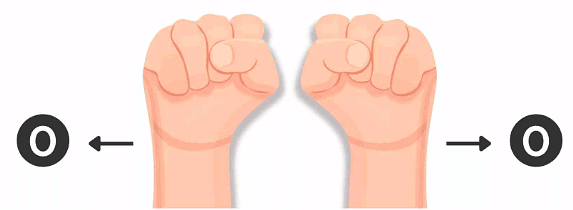
A closed fist in finger abacus always represents 0.
The fingers of right hand and left hand stand for different values. Take a look at the picture below:
As you can see in the fingers of left hand and the finger of right hand have a huge difference in the values they represent. If you find it hard to memorize it from the above picture, I recommend to note the values down by making a table (as shown below).
First, let's check out the table for right-hand fingers:
Now, let's look at the table representing values of the fingers in our left hand:
Finger Abacus Vs. Soroban
What is Soroban?
Soroban is a type of abacus that originated in Japan. It has vertical rods intersected by a horizontal rod. Each rod has five beads on the lower deck and one bead on the upper deck.
How is Finger Abacus similar to Soroban?
The counting process on your fingers is similar to soroban. Each hand represents as one rod in a soroban.
So, while counting, the thumb acts like the lonely bead on the upper deck, and the remaining 4 fingers resemble the four beads on the lower deck of the rod.
Finger Counting
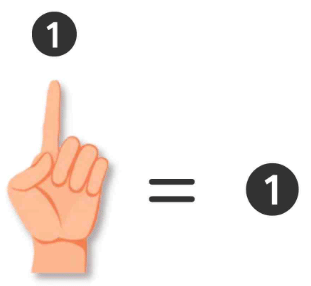
Index finger representing 1 in finger abacus.
In the above picture, you can see the index finger of the right hand. The value of the index finger of the right hand is 1. So, the count is 1.
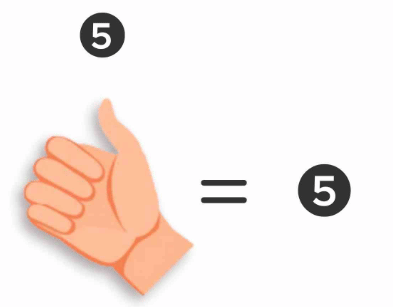
The value of the thumb of the right hand is 5. So, in the above picture, the count is 5.
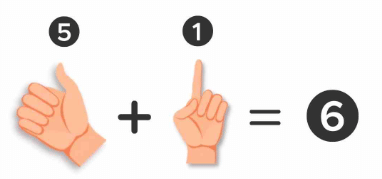 In the above picture, we have a thumb and a finger of the right hand. As the values of the thumb and a finger of the right hand are 5 and 1, respectively, so the count is:
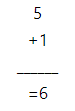 Let's take a look at another example:
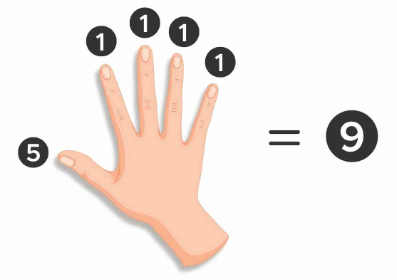 In the above picture, we have a thumb, an index finger, a middle finger, a ring finger, and a pinky. As per the values, the count is: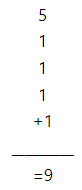
FAQs on Finger Counting
| 1. How do I use my fingers to count numbers in Class 1 Abacus? |  |
| 2. What's the easiest way to teach finger counting to young students? | |
| 3. Why do we learn finger counting before using the abacus? | |
| 4. Can finger counting help my child understand addition and subtraction faster? | |
| 5. How does finger counting connect to the abacus learning method in CBSE Class 1? | |