Introduction - Double Entry System

Double entry System
Meaning of double entry system:
As per this system every business transactions affects two accounts in opposite directions i.e. if one account will debited, the other will be credited.
Principles of double entry system:
1. Every business transaction affects two accounts.
2. Records both the personal and impersonal aspect.
3. Recording is made as per specified rules.
4. Preparation of Trial balance.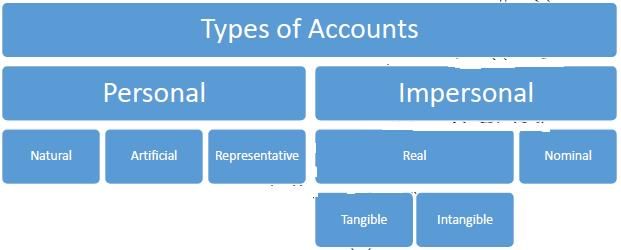
1. Personal accounts:
- The accounts which relates to the individual, firm, Company or an institution is called as personal
- Ex: mohan a/c, dps a/c, capital a/c or drawings a/c
- Rule: Debit the receiver, credit the giver.
Types of personal accounts
a. Natural personal account:
Accounts of natural persons, means accounts of
b. Artificial personal account:
These are the accounts on the name of the firms or institutions, they do not have any physical existence but they act like the human beings. Ex: dps a/c, reliance a/c, icici bank a/c.
c. Representative personal account:
When an account represents a particular person or a group of persons it is called as representative personal account. Ex: outstanding salaries (represents those group of persons to whom salary is due and not paid).
2. Real account:
- The accounts of all the assets or those things which are valuable to the business are called as real account.
- Rule: Debit what comes in, credit what goes out.
Types of Real account
a. Tangible Real account:
It includes all the tangible assets (assets which can be seen, felt, touch and seen.) Ex: land, plant.
b. In-Tangible Real account:
It includes all the intangible assets (assets which cannot be seen, felt, touch and seen.) Ex: goodwill, pate.
3. Nominal accounts:
- It includes all the expenses, losses and incomes & gains. Ex: interest, salary, commission received and bad debts.
- Rule: Debit all the expenses& losses, credit all incomes & gains
-Whenever any word(prefix or suffix) is fixed with the nominal account it becomes a personal account.
| Nominal account | Personal account |
| 1. Rent account | Outstanding rent, prepaid rent. |
| 2. Salary account | Outstanding Salary, prepaid Salary |
| 3. Commission account | Outstanding Commission, unearned commission or accrued commission |
| 4. Interest account | Interest Outstanding, Interest accrued |
Stages of double entry system:
1. Recording in the books of original entry(journal or subsidiary books)
2. Classification into ledger.
3. Summary (preparation of trial balance, financial statements{trading and profit and loss account})
Advantages of double entry system:
1. Scientific system.
2. Complete record of every business transactions
3. Preparation of trial balance.
4.Preparation of trading and profit and loss a/c.
5. Lesser possibility of fraud.
6. Legal approval.
Disadvantages of double entry system:
1. Expensive(as a number of books are maintained )
2. It is difficult to apply the rules of debit and credit.
3. Affected by errors: error of omission, commission and principles.
1. Classify the following Accounts into Personal, Real or Nominal Accounts :
1. Capital; _________________________________
2. Drawings; _________________________________
3. Cash paid; _________________________________
4. Cash received; _________________________________
5. Commission paid-. _________________________________
6. Commission received; _________________________________
7. Purchases A/c; _________________________________
8. Sales A/c; _________________________________
9. Furniture A/c; _________________________________
10. Cash A/c: _________________________________
11. Bank A/c; _________________________________
12. Bank Overdraft A/c; _________________________________
13. Debtors A./c; _________________________________
14. Creditors A/c: _________________________________
15, Travelling Expenses; _________________________________
16. Goodwill; _________________________________
17. Patents; _________________________________
18. Salary A/c; _________________________________
19. Salary, _________________________________
20. Outstanding Insurance A/c; _________________________________
21. Insurance Prepaid A/c; _________________________________
22. Bad Debts written off; _________________________________
23. Bad Debts recovered. _________________________________
Q2. Classify the following accounts into Personal, Real or Nominal accounts : -
I. Machinery VII. Drawings
II. Capital VIII. Salary
III. Stock IX. Outstanding Salary
IV. Bad Debts X. Insurance
V. Goodwill XI. Prepaid Insurance
VI. Sales XII. Interest Received
[Ans:]
Personal Accounts II, VII, IX, XI
Real Accounts I, III, V
Nominal Accounts IV, VI, VIII, X, XII. ]
Q3. State to which class of accounts does each of the following relate:-
I. Cash V. Creditors
II. Bank VI. Commission Received
III. Trade Marks VII. Accrued Commission
IV. Debtors VIII. Commission Received in Advance
[Ans:]
Personal Accounts II, IV, V, VII, VIII.
Real Accounts I,III.
Nominal Accounts VI. ]
Q4. Classify the following accounts under personal, real or nominal accounts:
(i) Commission paid
(ii) Commission received
(iii) Commission Accrued
(iv) Prepaid salaries
(v) Leasehold property A/c
(vi) Discount allowed
(vii) Carriage inwards A/c
(viii) Discount allowed
(ix) Drawings A/c
(x) Rent Received in advance
(xi) Debtors
(xii) Sales A/c
(xiii) Rent paid in advance
(xiv) Bank overdraft
[Ans:]
Personal accounts : (iii), (iv), (viii), (ix), (xi), (xiii), (xiv)
Real Accounts : (v)
Nominal Accounts : (i), (ii), (vi), (vii), (xii)]
FAQs on Introduction - Double Entry System
| 1. What is the double entry system and why do we need it in accounting? |  |
| 2. How do debits and credits work differently in the double entry bookkeeping method? | |
| 3. What's the difference between single entry and double entry accounting systems? | |
| 4. Can I understand the golden rules of accounting without knowing the double entry system first? | |
| 5. Why do trial balance and final accounts depend on the double entry system? | |


