Laxmikanth Summary: Role of Regional Parties


Introduction
Regional parties in India are political organisations whose main base of support is confined to one or a few states or distinct regions. They represent regional interests, give voice to local identities and grievances, and influence national politics by shaping coalition formations and centre-state relations. Understanding regional parties is essential for analysing Indian federalism, electoral politics, and the working of parliamentary democracy.
Features
- Limited geographic scope: Their organisational presence and electoral support are concentrated primarily within a state or a specific region rather than across the entire country.
- Cultural, linguistic or ethnic identification: Many regional parties articulate the aspirations of a particular religious, linguistic, ethnic or cultural group and mobilise support around that identity.
- Focus on local issues: They prioritise state- and region-specific concerns - such as land, language, employment, local governance and resource allocation - over pan-India issues.
- State-level political focus: The immediate objective is often to capture political power in the state assembly or influence state government policy and administration.
- Advocacy for regional autonomy: They frequently demand greater fiscal, administrative or political autonomy for their state within the framework of the Indian Union.
Classification of Regional Parties
Regional parties in India can be classified on the basis of origin, ideology and organisational character. Major categories include the following.
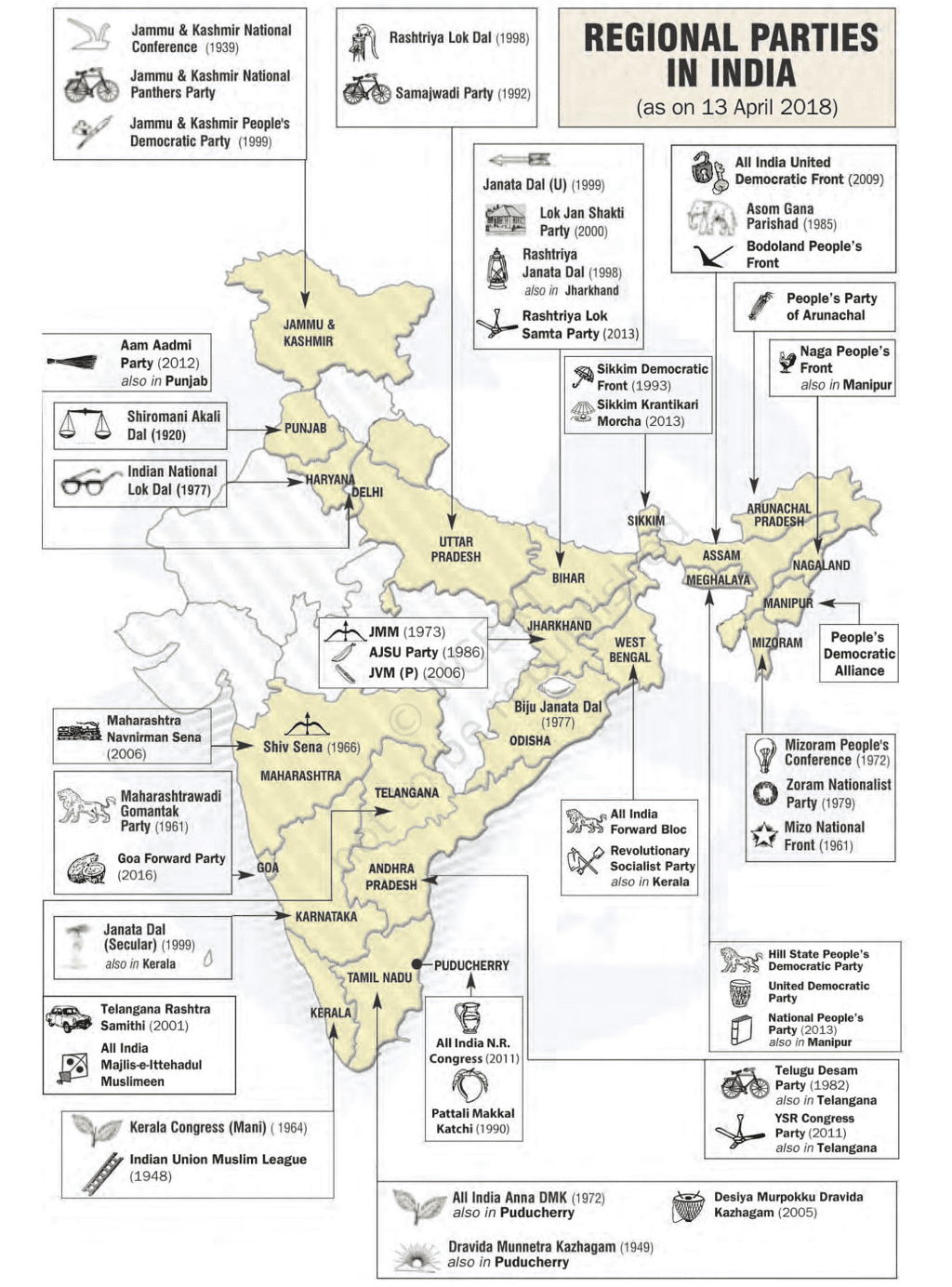
- Cultural or ethnic parties: Parties that draw support from distinct linguistic, religious or ethnic identities. Examples: Shiromani Akali Dal, Jammu & Kashmir National Conference, Dravida Munnetra Kazhagam (DMK), Telugu Desam Party (TDP), Shiv Sena, Asom Gana Parishad (AGP).
- Nationwide but limited-influence parties: Parties that address national issues but have limited electoral presence concentrated in a few states. Examples: Samajwadi Party, Nationalist Congress Party (NCP).
- Splinters from national parties: Regional parties that emerged as offshoots after splits in larger national parties. Examples: Biju Janata Dal (BJD), Rashtriya Janata Dal (RJD), All India Trinamool Congress (TMC), YSR Congress.
- Personalised parties: Parties organised around a dominant leader or family rather than a durable ideology; often highly dependent on the leader's charisma and control of patronage.
Reasons for the Rise of Regional Parties
The ascent of regional parties since the 1960s-1990s reflects structural, social and political developments in India. Key causes include the following.
- Linguistic reorganisation of states: Reorganisation increased political space for state-based parties that could mobilise on language and regional identity.
- Unaddressed regional grievances: Perceived neglect by national parties on issues such as economic development, resource distribution and local infrastructure led to demand for regional representation.
- Socio-economic inequalities: Uneven development and distributive conflicts produced constituencies looking for parties that prioritise local welfare and protection of regional interests.
- Collapse or decline of single-party dominance: The weakening of a once dominant national party created opportunities for regional leaders to consolidate local support.
- Charismatic and regional leadership: Strong regional leaders able to mobilise caste, community and sub-regional loyalties gave organisational shape to regional parties.
- Identity politics: The politicisation of caste, religion and ethnicity increased the salience of parties that could champion specific social groups.
- Political decentralisation and federal contestation: Greater demands for fiscal devolution and administrative autonomy encouraged party formation around state interests.
Role and Functions of Regional Parties
Regional parties perform multiple functions in India's political system. Their roles affect governance, representation, federal relations and the broader party system.
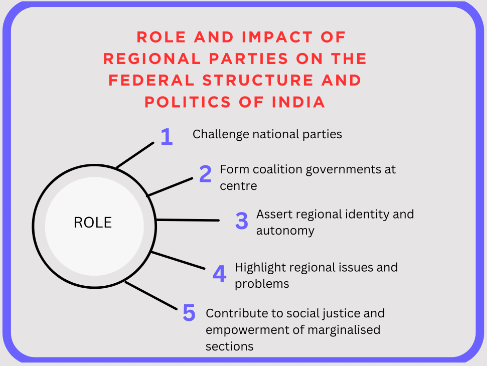
- State governance and administration: By forming governments in states, they provide region-specific policies and implementation tailored to local needs.
- Challenge to one-party dominance: They have reduced the dominance of a single national party, enhancing competitive politics and enabling alternative political choices for voters.
- Influence on centre-state relations: Regional parties shape the centre's behaviour on federal issues - for example, demands for devolution, special status or prioritisation of state interests in central schemes.
- Enhancing grassroots political participation: Their organisation often deepens mass mobilisation and political participation at the local and village levels.
- Raising regional issues: They bring local problems (such as irrigation, industry closure, language rights or land disputes) to national attention, influencing policy priorities.
- Acting as a check on central power: In coalition situations, regional parties can restrain arbitrary central action and compel central governments to negotiate and accommodate state concerns.
- Contribution to parliamentary democracy: By representing diverse interests and sometimes serving as state governments and national coalition partners, they add pluralism and representation to parliamentary democracy.
Dysfunctions and Criticisms
- Parochialism: A tendency to prioritise narrow regional interests over national considerations can complicate policy-making on issues that require a pan-India perspective.
- Identity and vote-bank politics: Some regional parties mobilise support primarily through caste, communal or regional appeals, which can deepen social divisions.
- Inter-state conflicts: Regional assertiveness may contribute to disputes over river waters, territorial boundaries and resource sharing between states.
- Clientelism and corruption: Concentration of power in state-level patronage networks has at times been associated with nepotism, misuse of office and administrative capture.
- Populist fiscal policies: Pressure to deliver short-term, highly visible welfare measures to secure votes can undermine fiscal discipline and long-term development.
- Coalition bargaining pressures: In coalition governments, small but strategically placed regional parties can exert disproportionate influence, leading to policy compromises that favour narrow interests.
Impact on National Politics and Coalition Era
Since the decline of single-party dominance, regional parties have become kingmakers in national politics. Their support has been crucial for the formation and survival of coalition governments at the centre. This has several consequences:
- Policy negotiations: Regional parties negotiate policy concessions and resource transfers for their states in return for coalition support.
- Decentralising pressure: Coalitions with regional partners often result in greater emphasis on devolution of funds and administrative powers.
- Fragmentation and stability trade-offs: While coalitions broaden representation, they may also face stability challenges because of diverse and sometimes conflicting regional demands.
Examples and Illustrations
- West Bengal: The rise of All India Trinamool Congress (TMC) transformed state politics by displacing a long-standing left front and influencing national coalitions.
- Odisha: Biju Janata Dal (BJD) emerged from national party splits to become the dominant state party, emphasising regional development priorities.
- Tamil Nadu: Parties such as DMK and AIADMK built politics around language, cultural identity and welfare policies and have shaped national alliances.
Conclusion
Regional parties are permanent and influential actors in contemporary Indian politics. They strengthen representation by voicing local concerns and enhancing participation, but they also present challenges for national cohesion, inter-state cooperation and policy stability. A balanced assessment recognises both their contributions to pluralism and the need to manage their excesses through institutional mechanisms - for example, strong state institutions, transparent governance, careful coalition management and policies that address regional disparities.
FAQs on Laxmikanth Summary: Role of Regional Parties
| 1. What are the main features of regional parties in Indian politics? |  |
| 2. How are regional parties classified in Indian politics? | |
| 3. What has been the rise of regional parties in Indian politics? | |
| 4. What role do regional parties play in Indian politics? | |
| 5. What are the common dysfunctions associated with regional parties in Indian politics? | |





