Laxmikanth Summary: Special Officer for Linguistic Minorities


Introduction
The constitutional office of a Special Officer for Linguistic Minorities was not part of the original text of the Constitution of India. The States Reorganisation Commission (1953-55) recommended creation of such an office to safeguard the rights of linguistic minorities following the reorganisation of states on linguistic lines. The recommendation led to insertion of Article 350-B into Part XVII of the Constitution by the Seventh Constitutional Amendment Act, 1956. The office is commonly referred to as the Commissioner for Linguistic Minorities (CLM) and functions under the administrative control of the Ministry of Minority Affairs.
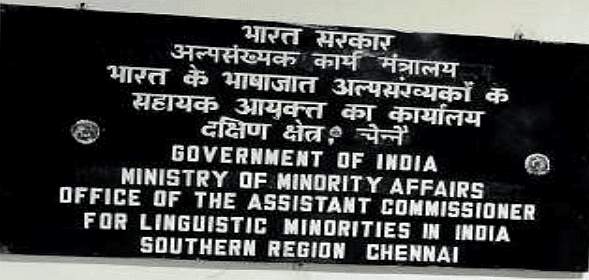 Office of Assistant Commissioner
Constitutional Provisions
- The original Constitution did not provide for a Special Officer for linguistic minorities; the need for such an office was identified by the States Reorganisation Commission (1953-55).
- The Seventh Constitutional Amendment (1956) introduced Article 350-B in Part XVII of the Constitution to provide for a Special Officer for linguistic minorities.
- Article 350-B provides that a Special Officer for Linguistic Minorities shall be appointed by the President of India.
- The Special Officer is mandated to investigate all matters relating to safeguards for linguistic minorities provided under the Constitution and laws.
- The Special Officer must report to the President on such matters at intervals the President may direct.
- The President is required to lay these reports before both Houses of Parliament and to forward copies to the concerned State Governments.
- The Constitution does not specify the qualifications, tenure, salary, allowances, service conditions or the procedure for removal of the Special Officer; these matters are left to executive rules and administrative arrangements.
- Article 350-A, which is also in Part XVII, requires that states shall endeavour to provide adequate facilities for instruction in the mother-tongue at the primary stage of education to children belonging to linguistic minority groups - the Special Officer monitors implementation of such safeguards among others.
Note: The Special Officer's role is essentially supervisory and recommendatory: the office enquires, reports and recommends measures to protect minority linguistic rights but does not possess judicial or binding executive powers to enforce decisions.
Commissioner for Linguistic Minorities (CLM)
The office created under Article 350-B is commonly known as the Commissioner for Linguistic Minorities (CLM). The office was set up soon after the constitutional provision and functions as the nodal central agency to monitor implementation of safeguards for linguistic minorities.
- The CLM's headquarters is in New Delhi.
- The CLM maintains three regional offices located at Belgaum (Karnataka), Chennai (Tamil Nadu) and Kolkata (West Bengal).
- Each regional office is headed by an Assistant Commissioner.
- The headquarters is supported by officers including a Deputy Commissioner and Assistant Commissioner(s).
- The CLM liaises with State Governments and Union Territories through nodal officers appointed by those governments to facilitate coordination and follow-up.
- Administratively, the CLM functions under the Ministry of Minority Affairs and forwards annual reports and other communications to the President through the Union Minister for Minority Affairs.
Role
- The CLM examines and takes up with appropriate authorities all matters concerning the protection and enforcement of constitutional and nationally agreed safeguards for linguistic minorities.
- The CLM receives representations from individuals, associations, institutions and organisations representing linguistic minority communities and takes action to examine grievances.
- The CLM conducts field visits to localities where linguistic minorities are concentrated and to educational institutions to assess actual conditions and implementation of safeguards.
- During visits the CLM holds discussions with key public functionaries, including Chief Ministers, Governors, Lieutenant Governors, Chief Secretaries, and Principal Secretaries (Education), to understand problems and seek remedial measures.
- The CLM organises meetings, conferences and seminars, circulates questionnaires and undertakes reviews to monitor implementation and recommend corrective action.
Vision and Mission
- Vision: To strengthen systems and processes that ensure the effective realisation of constitutional rights of linguistic minorities, thereby enabling speakers of minority languages to participate fully in inclusive and integrated development.
- Mission: To ensure that all States and Union Territories implement constitutional safeguards and nationally agreed measures for linguistic minorities effectively, and to facilitate equal opportunities for inclusive development of these communities.
Functions and Objectives
Functions
- To enquire into all matters relating to safeguards provided for linguistic minorities and to investigate complaints pertaining to their effective implementation.
- To submit reports to the President of India on the status of implementation of constitutional and statutory safeguards for linguistic minorities, at such intervals as may be specified.
- To monitor implementation through methods such as distribution of questionnaires, field visits, inspections of educational institutions, conferences, seminars, meetings and periodic reviews.
- To advise and recommend measures to the Central and State Governments for improving implementation and resolving persisting problems.
- To coordinate with State/UT nodal officers and relevant departments to ensure timely follow-up on recommendations and corrective steps.
Objectives
- To secure equal opportunities for linguistic minorities so that they can partake in national development without discrimination.
- To create awareness among linguistic minority communities about the constitutional protections and practical measures available to them.
- To ensure effective implementation of the safeguards guaranteed by the Constitution and policies agreed by States and Union Territories.
- To address grievances and process requests relating to linguistic minority safeguards and to facilitate speedy redressal through coordination with appropriate authorities.
Try yourself: What is the primary objective of the CLM?
Concluding Note
The office of the Commissioner for Linguistic Minorities is a constitutional mechanism aimed at protecting the linguistic rights of minority groups across India. While the office primarily enquires, reports and recommends, its work is important for drawing attention to gaps in implementation, influencing policy and ensuring sustained dialogue between minority communities and government authorities. For examinations and public administration, it is essential to remember the key legal basis - Article 350-B (inserted by the Seventh Amendment, 1956), the supervisory and recommendatory character of the office, and the administrative link to the Ministry of Minority Affairs.
FAQs on Laxmikanth Summary: Special Officer for Linguistic Minorities
| 1. What are the constitutional provisions related to linguistic minorities in India? |  |
| 2. What is the role of the Special Officer for Linguistic Minorities? | |
| 3. What is the vision and mission of the Special Officer for Linguistic Minorities? | |
| 4. What are the functions of the Special Officer for Linguistic Minorities? | |
| 5. What are the objectives of the Special Officer for Linguistic Minorities? | |





