UPSC Exam > UPSC Notes > Medicine Line
Medicine Line

 1700s
1700s
- 1775 - During the Revolutionary War, the American colonists hoped Quebec and Nova Scotia would be their allies against the British. The soon-to-be U.S. got impatient, though, and took matters into its own hands, invading its neighbor to the north and taking Montreal in the first big military maneuver of the war. A month later, they were pushed back in a major defeat known as the Battle of Quebec.
- 1783 - After the war, a victorious U.S. demanded that Great Britain give them Canada. Unsurprisingly, the British refused. The parties settled the boundaries, or so they thought, by using the 45th parallel as the northern border between New York and New Brunswick, and creating an imaginary line through the Great Lakes. No one knew much about what existed beyond the Mississippi River to the west, so those boundaries were left murky, to say the least.
1800s
- 1803 - The young United States made a very good deal with France, known as the Louisiana Purchase. For 15 million dollars, they bought a vast swath of territory that reached from Gulf of Mexico to the Rockies (or Stony Mountains, as they were called then). The British and the U.S. used the watershed between the Hudson Bay and the Mississippi/Missouri rivers to establish the northern border for the newly purchased lands. That turned out to be a bad idea, because the watershed was too flat to be measured accurately.
- 1812 - During the War of 1812, the United States invaded Canada again, not once, but twice, as a way of attacking British interests. Some Americans thought taking Canada would be a walk in the park, but they suffered a humiliating defeat in the Siege of Detroit, aided by the Native American Tecumseh. As well, British forces landed near Washington D.C., burning the US Capitol and the White House.
- In 1814, a treaty restored the original boundaries. Many Canadians fought during the war, which created a new sense of national identity.
- 1818 - American settlers had streamed further west, encouraged by a belief in Manifest Destiny, which held that America was meant to stretch from coast to coast. That pressured Britain and the US to return to the border-negotiating table.
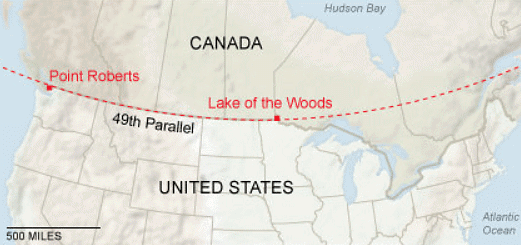
- Surveyors were struggling against great odds to map exactly what existed in the largely rugged terrain. The powers-that-were decided to use a straight line - the 49th parallel - to demarcate the border up to the Rockies.
- For now, Britain and the U.S allowed it to remain open to whoever could survive out there. Surveying mistakes led to an anomaly that still exists, the Northwest Angle. It's part of Minnesota, but if you want to go there by land, you have to travel through Canada, twice.
- 1846 - The agreement to keep the Oregon and Columbia territories neutral was falling apart. Thousands of Americans had stakes in the region, and the U.S. was pushing hard against Britain's Hudson Bay Company, which controlled Canadian interests. President James K. Polk demanded that U.S. territory be extended northward, past the 49th parallel.
- The slogan "54° 40' or Fight" became a rallying cry for his supporters. In the end, the U.S. blinked, and Polk agreed to let the 49th parallel become the official dividing line for the westernmost areas of the two countries, resolving (almost) the last major piece of the Canadian-U.S. puzzle. Spats over small areas would continue for decades.
- 1867 - Canada is granted its independence from Great Britain. Based upon a drive for self-determination from the Canadian provinces, and a desire from Britain for Canada to defend itself against American encroachment, this process was peaceful and did not lead to a military dispute as seen in America's War of Independence.
- The first Canadian prime minister Sir John A. MacDonald drives the creation of a transcontinental railroad in order to allow quick movements of troops to the western territories of Canada in case of American expansion.
1900s
- 1908 - A treaty between the two nations is signed, establishing a joint commission tasked with surveying and delineating the border between the two neighbors.
- 1925 - Canada and America agree to make the International Boundary Commission permanent, in order to maintain the land and monuments along the border.
- One of its responsibilities is maintenance of the Peace Arch, which was built on the exact line between the two nations, in Washington State in the U.S. and British Columbia in Canada. On the U.S side, the monument reads "Children Of a Common Mother," and on the Canadian side "Brethren Dwelling together in Unity." And for the most part, both are true.
Current
- The U.S. and Canada have agreed to disagree over a few remaining sections of land, including Machias Seal Island in the east, which has a Canadian lighthouse but is claimed by the U.S.
- There is also the matter of the Northwest Passage, which Canada says is hers but the U.S. says is international shipping waters. A small piece off territorial waters off the coast of the Yukon (a Canadian Territory) is claimed by the U.S. as a special economic zone.
- As far as we know, there are no more plans to invade, however. It was a long road, but in the end, Canada and the United States reached a harmonious relationship that stretches from the Atlantic to the Pacific.
FAQs on Medicine Line
| 1. What is the UPSC exam and its significance in the field of medicine? |  |
Ans. The UPSC exam, also known as the Union Public Service Commission exam, is a highly competitive examination conducted in India for various government posts, including those in the field of medicine. It is considered significant as it serves as a gateway for candidates to secure prestigious positions in government organizations, such as the Indian Administrative Service (IAS) and the Indian Foreign Service (IFS). The exam evaluates a candidate's knowledge, aptitude, and skills in various subjects, including medicine.
| 2. What are the eligibility criteria for appearing in the UPSC exam for medicine? | |
Ans. To appear in the UPSC exam for medicine, candidates must meet certain eligibility criteria. They should have completed their MBBS degree from a recognized university or institution. The upper age limit for general category candidates is 32 years, with relaxations available for candidates from reserved categories. Additionally, candidates must be Indian citizens or hold a relevant nationality as specified by the UPSC.
| 3. What is the syllabus for the UPSC exam in the field of medicine? | |
Ans. The syllabus for the UPSC exam in medicine includes various topics related to the medical field. It covers subjects like Anatomy, Physiology, Pharmacology, Pathology, Microbiology, Forensic Medicine, Preventive and Social Medicine, General Medicine, Surgery, Obstetrics and Gynecology, Pediatrics, and more. The syllabus may also include questions related to medical ethics, medical research, and recent advancements in the field of medicine.
| 4. How can one prepare effectively for the UPSC exam in medicine? | |
Ans. Effective preparation for the UPSC exam in medicine requires a systematic approach. Candidates should familiarize themselves with the syllabus and exam pattern. They can refer to standard medical textbooks and study materials recommended by experts. It is important to focus on understanding the concepts thoroughly rather than memorizing information. Regular revision, solving previous years' question papers, and taking mock tests can also help in improving time management and identifying areas that need further improvement.
| 5. What are the career prospects after clearing the UPSC exam in medicine? | |
Ans. Clearing the UPSC exam in medicine opens up various career prospects for candidates. They can be appointed to prestigious government positions, such as Medical Officer, Assistant Divisional Medical Officer, Junior Scale posts in Central Health Services, or Assistant Medical Superintendent in hospitals. These positions not only offer a stable job but also provide opportunities for growth and making a positive impact on society through healthcare services.
About this Document

Apr 18, 2026 Last updated
Related Exams
Document Description: Medicine Line for UPSC 2026 is part of UPSC preparation. The notes and questions for Medicine Line have been prepared according to the UPSC exam syllabus. Information about Medicine Line covers topics like and Medicine Line Example, for UPSC 2026 Exam. Find important definitions, questions, notes, meanings, examples, exercises and tests below for Medicine Line.
Description
Medicine Line of covers all the important topics, helping you prepare for the UPSC exam on EduRev. Start for free!
Information about Medicine Line
In this doc you can find the meaning of Medicine Line defined & explained in the simplest way possible. Besides explaining types of Medicine Line theory, EduRev gives you an ample number of questions to practice Medicine Line tests, examples and also practice UPSC tests.
Related Searches
ppt, Summary, pdf , study material, Objective type Questions, Semester Notes, mock tests for examination, MCQs, Medicine Line, Viva Questions, past year papers, Important questions, practice quizzes, video lectures, Exam, Previous Year Questions with Solutions, Medicine Line, Free, shortcuts and tricks, Extra Questions, Sample Paper, Medicine Line;