NEET Exam > NEET Notes > Physics Class 11 > Mind Map: Laws of Motion
Mind Map: Laws of Motion

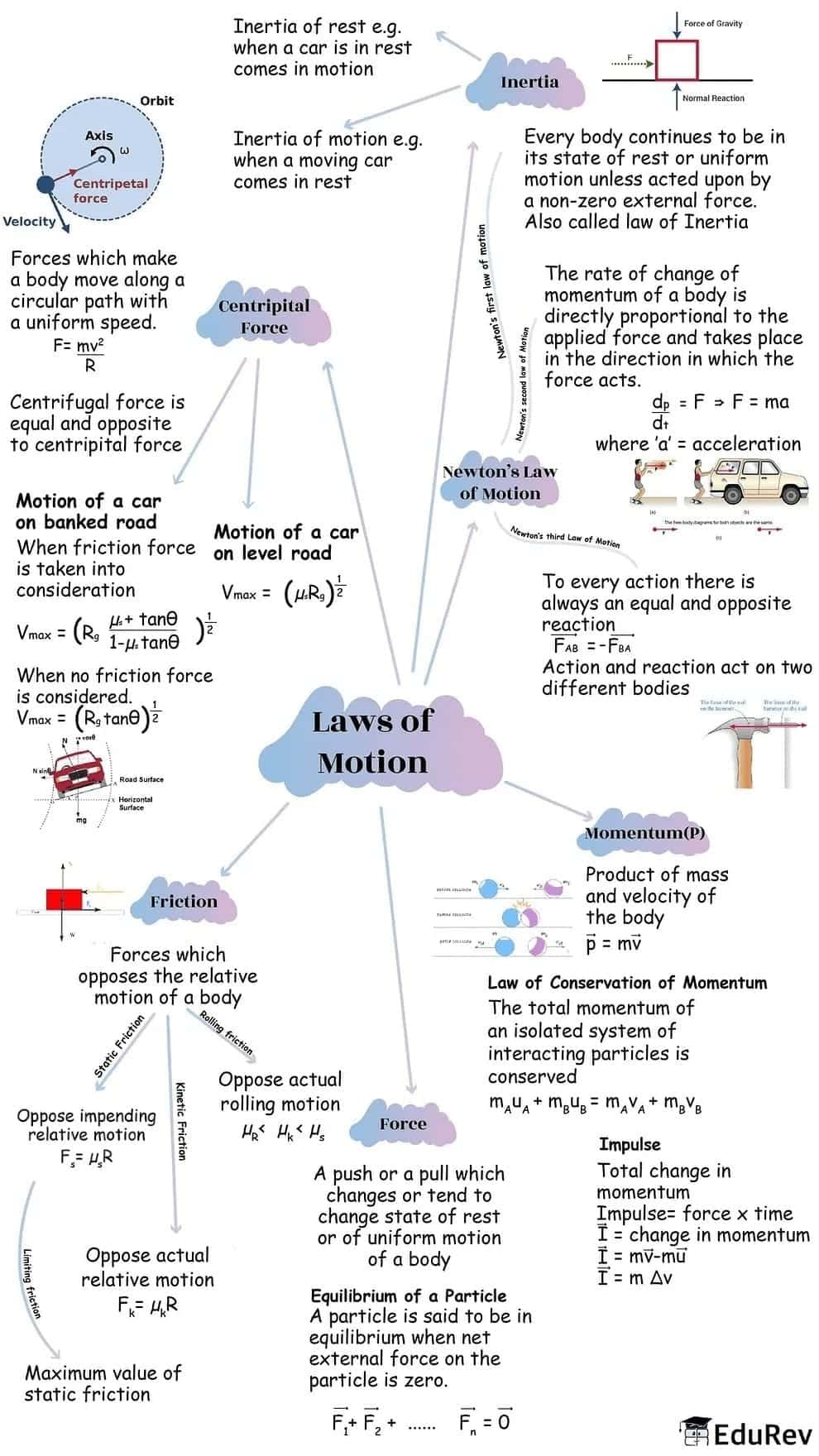
The document Mind Map: Laws of Motion is a part of the NEET Course Physics Class 11.
All you need of NEET at this link: NEET
FAQs on Mind Map: Laws of Motion
| 1. What is Newton's first law of motion and why does an object keep moving even when you stop pushing it? |  |
Ans. Newton's first law states that an object at rest stays at rest, and a moving object continues moving in a straight line unless acted upon by an external force. This happens because objects possess inertia-the natural resistance to change their state of motion. When you stop pushing, friction and air resistance are the external forces that eventually slow objects down, not the absence of force itself.
| 2. How do Newton's second and third laws of motion differ from each other in NCERT Class 11 physics? | |
Ans. Newton's second law (F = ma) describes how force causes acceleration in an object-a direct relationship between applied force and motion change. Newton's third law states that forces always occur in action-reaction pairs of equal magnitude and opposite direction. The second law explains motion causation; the third explains force interactions. Understanding both is essential for solving mechanics problems accurately.
| 3. Why do heavier objects need more force to accelerate compared to lighter ones? | |
Ans. Heavier objects have greater mass, which increases inertia-the resistance to acceleration. According to F = ma (Newton's second law), accelerating a larger mass requires proportionally greater force. For example, pushing a car requires far more effort than pushing a bicycle to achieve the same acceleration rate. Mass directly determines how much force is needed for motion change.
| 4. What's the difference between mass and weight when learning Newton's laws? | |
Ans. Mass is the amount of matter in an object (measured in kilograms) and remains constant everywhere. Weight is the gravitational force acting on that mass (W = mg, measured in Newtons) and varies with location. Newton's laws use mass, not weight. Understanding this distinction prevents calculation errors when applying F = ma or analysing motion problems in different gravitational environments.
| 5. How can I use mind maps and flashcards to remember all three laws of motion for my UPSC preparation? | |
Ans. Mind maps visually connect each law's definition, formula, and real-world examples in one diagram, aiding memory retention significantly. Flashcards condense key concepts-like "inertia = resistance to motion change"-for quick revision. EduRev provides structured mind maps, flashcards, and MCQ tests that break down Newton's laws systematically, helping candidates link concepts faster than traditional notes.
About this Document

8K Views

4.89/5 Rating

Apr 19, 2026 Last updated
Document Description: Mind Map: Laws of Motion for NEET 2026 is part of Physics Class 11 preparation. The notes and questions for Mind Map: Laws of Motion have been prepared according to the NEET exam syllabus. Information about Mind Map: Laws of Motion covers topics like and Mind Map: Laws of Motion Example, for NEET 2026 Exam. Find important definitions, questions, notes, meanings, examples, exercises and tests below for Mind Map: Laws of Motion.
Introduction of Mind Map: Laws of Motion in English is available as part of our Physics Class 11 for NEET & Mind Map: Laws of Motion in Hindi for Physics Class 11 course. Download more important topics related with notes, lectures and mock test series for NEET Exam by signing up for free. NEET: Mind Map: Laws of Motion
Description
Mind Map: Laws of Motion of Physics Class 11 provides you one-page visual summary of the chapter covering all the important topics. Download the PDF from EduRev.
Information about Mind Map: Laws of Motion
In this doc you can find the meaning of Mind Map: Laws of Motion defined & explained in the simplest way possible. Besides explaining types of Mind Map: Laws of Motion theory, EduRev gives you an ample number of questions to practice Mind Map: Laws of Motion tests, examples and also practice NEET tests



Related Searches
shortcuts and tricks, mock tests for examination, pdf , study material, Exam, Free, video lectures, Mind Map: Laws of Motion, Extra Questions, past year papers, Semester Notes, Important questions, Viva Questions, ppt, Sample Paper, Objective type Questions, MCQs, practice quizzes, Mind Map: Laws of Motion, Summary, Mind Map: Laws of Motion, Previous Year Questions with Solutions;