NCERT Solutions - Liberalisation, Privatisation and Globalisation: An Appraisal

Q1: Why were reforms introduced in India?
Ans: Economic reforms were introduced in the year 1991 in India to combat the economic crisis.
- The Economic Crisis of 1991 was a culminated outcome of policy failure in the preceding years. It was in that year that the Indian government was experiencing huge fiscal deficits, large balance of payments deficits, high inflation levels, and an acute fall in foreign exchange reserves.
- Moreover, the Gulf crisis of 1990-91 led to a sharp rise in fuel prices, which further pushed up inflation.
- Because of the combined effect of all these factors, economic reforms became inevitable and were the only viable way to move the Indian economy out of this crisis.
The following are the factors that necessitated the need for economic reforms.
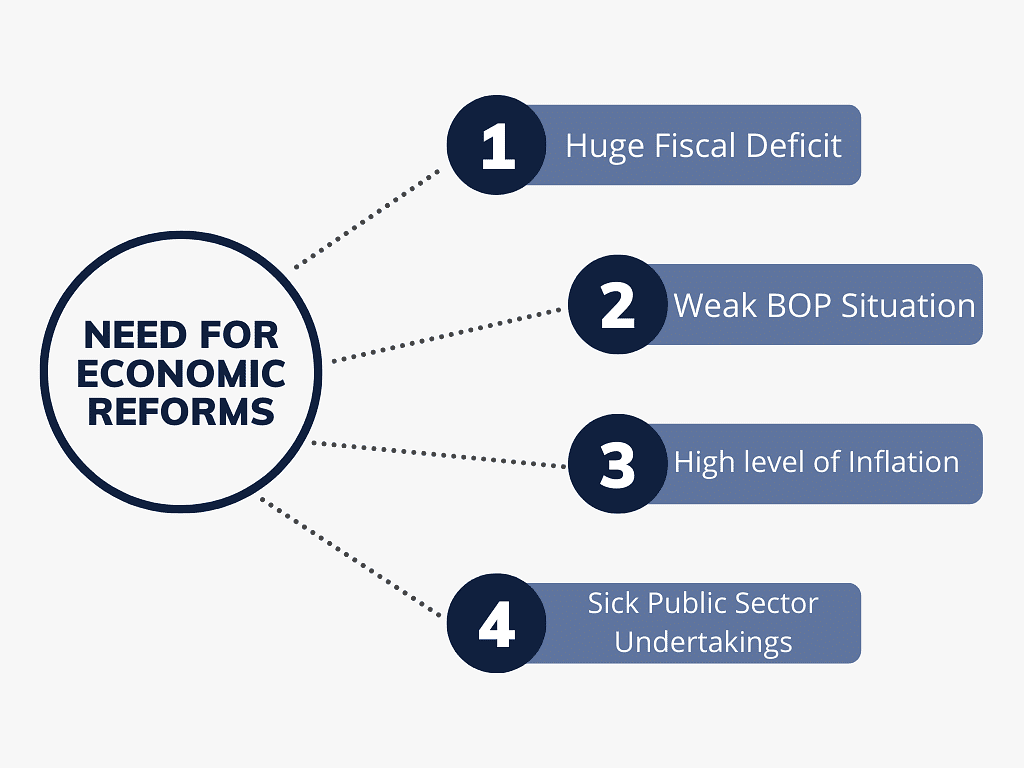
- As a result, the gross fiscal deficit rose from 5.7% of GDP to 6.6% of GDP during 1980-81 to 1990-91.
- Subsequently, a major portion of this deficit was financed by borrowings (both external and domestic), increasing public debt.
- The increased borrowings brought mounting interest payment obligations, which crowded out development spending.
- Domestic borrowings by the government increased from 35% to 49.8% of GDP during 1980-81 to 1990-91.
- Moreover, interest payment obligations accounted for a large share of the fiscal outlays, worsening fiscal stress.
- Consequently, India lost some of its financial credibility in international markets and faced a mounting debt burden. Thus, economic reforms became necessary urgently.
2. Weak BOP Situation: BOP here refers to the balance between exports and imports; India was running persistent deficits.
- Due to lack of competitiveness of many Indian products, the country could not earn enough foreign exchange through exports to finance growing imports.
- The current account deficit rose from 1.35% to 3.69% of GDP during 1980-81 to 1990-91.
- To finance this deficit, the government borrowed heavily from international markets, increasing external liabilities.
- Consequently, external debt rose from about 12% to 23% of GDP during the same period.
- At the same time, Indian exports were not strong enough to generate the foreign exchange needed to service these obligations.
- This balance of payments crisis was a major trigger for economic reform.
3. High Level of Inflation: Large fiscal deficits forced the government to partly finance its gap through monetary accommodation.
- The Reserve Bank of India printed new money to finance deficits, which fed inflation and made domestic goods more expensive.
- The rate of inflation rose from about 6.7% p.a. to around 10.3% p.a. during the 1980s to 1990-91.
- To restore price stability and confidence, policy changes in 1991 included reforms aimed at reducing inflationary financing of the deficit.
4. Sick PSUs: Public sector undertakings had been given an important developmental role but many began to underperform.
- Over time many PSUs failed to perform efficiently and ceased to be net revenue earners for the government.
- Instead of generating funds, loss-making PSUs became an additional burden on the government budget.
- These failing PSUs added fiscal pressure and strengthened the case for structural reforms including disinvestment and performance-oriented management.
Thus, because of all the above reasons operating together, economic reforms of 1991 became unavoidable to stabilise the economy and restore growth.
Q2: Why is it necessary to become a member of the WTO?
Ans: It is important for any country to become a member of the World Trade Organization (WTO) for the following reasons:
- WTO provides equal opportunities to all its member countries to participate in international trade under agreed rules.
- It gives members a larger market to produce at scale, helping them use resources more efficiently and gain from specialisation.
- It promotes removal of tariff and non-tariff barriers, encouraging fairer competition and smoother trade flows among countries.
- Countries with similar economic conditions can form coalitions within the WTO and raise common concerns to protect their interests in trade negotiations.
Q3: Why did RBI have to change its role from controller to facilitator of the financial sector in India?
Ans: Prior to liberalisation, the Reserve Bank of India (RBI) largely regulated and controlled the financial sector, including banks, capital markets and foreign exchange transactions.
- With economic liberalisation and financial sector reforms, the RBI needed to move from strict control to being a facilitator so that financial institutions could operate more efficiently in a market environment.
- This shift meant that many operational decisions were left to financial firms themselves, subject to prudential norms, rather than being centrally directed by the RBI.
- The change opened the financial sector to private participation, increased competition and promoted innovation in products and services.
- The RBI's role shifted to ensuring overall financial stability, supervising institutions, setting broad regulations and providing market infrastructure rather than controlling day-to-day operations.
In short, before liberalisation the RBI was a controller; afterwards it became a regulator and facilitator that enables market forces while safeguarding financial stability.
Q4: How is RBI controlling commercial banks?
Ans: RBI controls commercial banks through various instruments such as Statutory Liquidity Ratio (SLR), Cash Reserve Ratio (CRR), Bank Rate, Prime Lending Rate (PLR), Repo Rate and Reverse Repo Rate. It also sets prudential norms, supervises banks and influences interest rate policy. These instruments require commercial banks to maintain certain reserves, determine the cost of borrowing, and influence the availability of credit. By using these tools, the RBI controls the money supply, liquidity conditions and credit growth in the economy.
Q5: What do you understand by the devaluation of the rupee?
Ans: Devaluation of the rupee refers to a deliberate official fall in the value of the rupee relative to foreign currencies under a fixed exchange rate regime.
- It means that after devaluation one unit of foreign currency (for example, one US$) can be exchanged for more rupees than before.
- Devaluation makes exports cheaper and more competitive abroad and makes imports more expensive for domestic buyers.
- The immediate effect is to encourage exports and discourage imports, which can help correct a balance of payments deficit, though it may also raise domestic prices for imported goods and increase inflationary pressures.
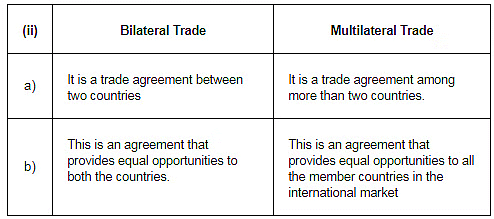
Q6: Distinguish between the following
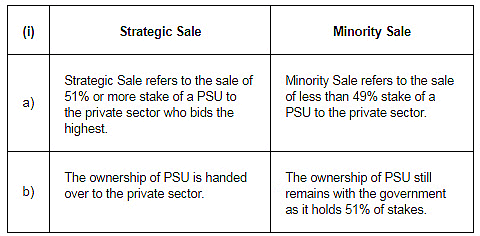
(i) Strategic and Minority sale
Ans:
Ans:
Ans: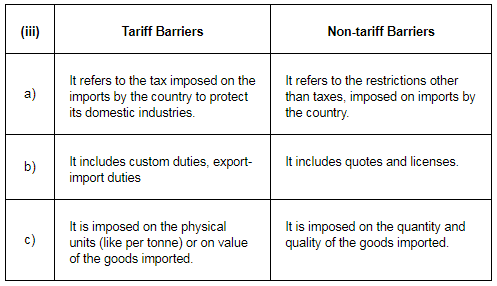
Q7: Why are tariffs imposed?
Ans: Tariffs are taxes on imported goods imposed to make imports relatively more expensive than domestic products, thereby indirectly discouraging imports.
- They protect infant or vulnerable domestic industries from competition by giving them time to develop and become competitive.
- Tariffs allow domestic firms to survive and expand until they can compete on quality and cost.
- They are also used to restrict imports of socially undesirable goods or to conserve scarce foreign exchange by lowering import volumes.
- Additionally, tariffs provide government revenue, which can be important for public finances.
Q8: What is the meaning of quantitative restrictions?
Ans: Quantitative Restrictions (QRs) are limits or quotas on the quantity of a commodity that may be imported or exported. QRs are a form of non-tariff barrier used to reduce import volumes and protect domestic producers. By restricting numerical imports, QRs aim to conserve foreign exchange and give domestic firms space to grow under limited competition. Examples include import licences and fixed quotas for particular products.

Q9: Those public sector undertakings which are making profits should be privatized. Do you agree with this view? Why?
Ans: A profit-earning PSU is a source of revenue for the government and can be used to finance public expenditure. It would not be appropriate to privatise every profit-making PSU because:
- Privatising profitable PSUs may lead to concentration of monopoly power in private hands and reduce public control over important services.
- Some PSUs (for example, in water supply, railways, power transmission) perform essential welfare functions and provide services at low cost; privatisation could reduce access or raise prices for the poor.
- Loss-making PSUs that drain public resources should be restructured or, where appropriate, privatised to stop further fiscal losses.
- For profit-making PSUs, a better option often is to grant greater operational autonomy, improve accountability and allow them to raise funds and enter joint ventures while remaining in public ownership.
Hence, only non-core or inefficient PSUs should be considered for privatisation; profitable and strategically important PSUs should be managed to improve efficiency while preserving public interest.
Q10: Do you think outsourcing is good for India? Why are developed countries opposing it?
Ans: Yes, outsourcing has generally been beneficial for India for several reasons:
- Employment: It creates jobs, often with higher wages than local alternatives, reducing unemployment for skilled workers.
- Transfer of know-how: Outsourcing brings technical skills, process knowledge and management practices.
- Foreign exchange and investment: It generates export earnings and attracts foreign investment.
- Human capital development: Training and exposure raise workforce skills and future employability.
- Spillover benefits: Growth in outsourcing supports related sectors such as infrastructure, education and transport.
Developed countries oppose outsourcing primarily because it shifts jobs and investment out of the home country, which can lead to job losses or wage pressure at home. Concerns about data security, quality control and political pressure to protect domestic employment also add to opposition in developed economies.

Q11: India has certain advantages which make it a favorite outsourcing destination. What are these advantages?
Ans: The main advantages that make India a preferred outsourcing destination are:
- Availability of low-cost labour: Lower wage rates make outsourcing cost-effective for foreign firms.
- Reasonable skill levels: A large pool of English-speaking, technically competent workers who can be trained quickly.
- International credibility: India's track record in IT and services builds confidence among global clients.
- Large domestic market: A growing internal market helps firms scale operations and innovate.
- Stable political environment: Democratic institutions offer predictable rules for investors.
- Favourable policies: Government incentives, tax concessions and special economic zones attract MNCs.
- Improving infrastructure: Continued investments in telecom, transport and power have reduced operating costs and improved reliability.
- Abundant inputs for manufacturing: Local availability of raw materials and components reduces costs and supply risks for manufacturing outsourcing.
Q12: Do you think the navaratna policy of the government helps in improving the performance of public sector undertakings in India? How?
Ans: To improve efficiency and competitiveness, the government granted 'navaratna' status to nine major PSUs:
- Indian Oil Corporation Ltd (IOCL)
- Bharat Petroleum Corporation Ltd (BPCL)
- Hindustan Petroleum Corporation Ltd (HPCL)
- Oil and Natural Gas Corporation Ltd (ONGC)
- Steel Authority of India Ltd (SAIL)
- India Petrochemicals Corporation Ltd (IPCL)
- Bharat Heavy Electricals Ltd (BHEL)
- National Thermal Power Corporation (NTPC)
- Videsh Sanchar Nigam Ltd (VSNL)
These PSUs were given greater financial, managerial and operational autonomy. As a result:
- They could take faster business decisions, raise funds and enter joint ventures.
- Many were able to improve efficiency and competitiveness, and some became significant players internationally.
- The policy combined public ownership with managerial freedom, helping these firms become more self-reliant while remaining in the public sector.
Thus, the navaratna policy helped improve performance by granting autonomy together with accountability.
Q13: What are the major factors responsible for the high growth of the service sector?
Ans: The major factors behind the rapid growth of services in India are:
- High demand for services: Strong domestic demand and international outsourcing boosted banking, IT, communication and professional services.
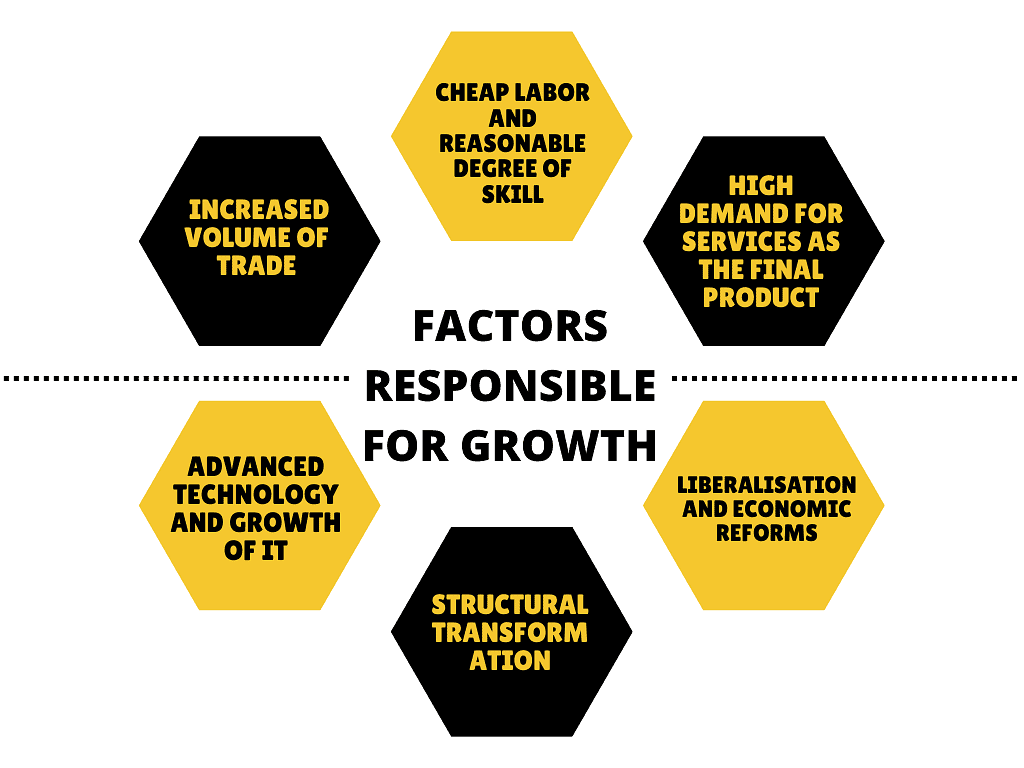
- Liberalisation and economic reforms: Reduced restrictions attracted foreign capital and allowed services to expand.
- Structural transformation: The economy shifted resources from agriculture to higher-value manufacturing and services.
- Technology and IT growth: Improvements in information technology and telecommunications enabled cross-border service delivery at low cost.
- Increased trade and investment: Lower barriers and foreign investment supported expansion of service industries.
- Cheap and skilled labour: Availability of relatively low-cost skilled manpower made service exports competitive.
Q14: Agriculture sector appears to be adversely affected by the reform process. Why?
Ans: The agricultural sector did not benefit as much from the 1991 reforms for several reasons:
- Reduction in public investment: Public spending on irrigation, rural roads, extension services and agricultural research and development declined in some years, weakening productivity growth.
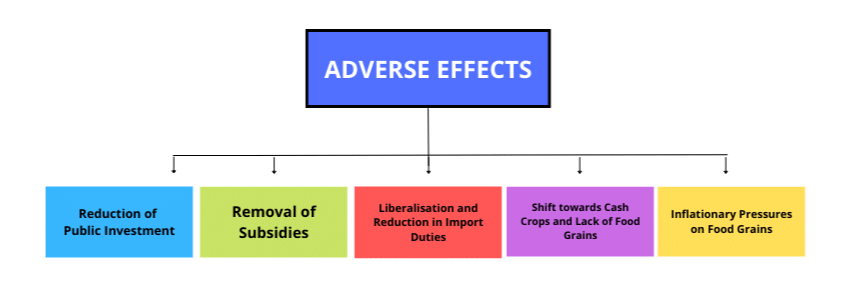
- Removal or reduction of subsidies: Cuts in input subsidies (for example on fertilisers) increased farmers' costs, especially hurting small and marginal farmers.
- Lower import protection: Reduced tariffs exposed farmers to competition from imports, often disadvantaging traditional producers.
- Shift towards cash crops: Emphasis on export-oriented production sometimes reduced food-grain cultivation and increased price volatility.
- Rising input costs: Increased costs and weaker support prices made farming less remunerative for many producers.
Q15: Why has the industrial sector performed poorly in the reform period?
Ans: The industrial sector faced difficulties during the initial reform period because:
- Cheaper imports: Reduction of import barriers exposed domestic firms to low-cost or higher-quality foreign competition, reducing demand for local products.
- Insufficient infrastructure investment: Inadequate power, transport and other infrastructure raised production costs and limited expansion.
- Limited capital investment: Slow growth in investment impeded modernisation of many firms.
- Infant and vulnerable industries: Many domestic industries were not yet modernised and could not match multinational firms on cost or quality immediately.
- Non-tariff barriers abroad: Export opportunities were sometimes limited by barriers in developed markets, restricting growth potential.
Q16: Discuss economic reforms in India in the light of social justice and welfare.
Ans: Economic reforms opened India to international markets, encouraged foreign capital inflows and boosted sectors such as IT and services, which helped accelerate GDP growth and strengthened foreign exchange reserves.
- Reforms reduced foreign exchange shortages and allowed import of advanced technologies, aiding modernisation in some sectors.
- The services and outsourcing boom created jobs and higher incomes for a segment of the workforce.
- However, agriculture and many small producers did not benefit proportionately; public investment in rural infrastructure and social sectors remained inadequate in some areas.
- Reforms tended to favour higher-income, urban and skilled groups, contributing to rising income inequality and regional disparities.
- Access to quality education, healthcare and modern services improved for some but remained out of reach for many poor households.
- Therefore, while reforms improved macroeconomic performance and growth, they did not automatically ensure social justice or broad-based welfare. Targeted social policies, redistributive measures and public investment are necessary to make growth more inclusive.
Thus, economic reforms helped growth and global integration, but equitable welfare outcomes require complementary policies that focus on the poor and disadvantaged.
FAQs on NCERT Solutions - Liberalisation, Privatisation and Globalisation: An Appraisal
| 1. What is liberalisation, privatisation, and globalisation? |  |
| 2. How has liberalisation impacted the Indian economy? | |
| 3. What are the criticisms of privatisation in India? | |
| 4. How has globalisation affected developing countries like India? | |
| 5. What are the measures taken by the Indian government to mitigate the negative effects of liberalisation, privatisation, and globalisation? | |