JEE Exam > JEE Notes > Mock Tests Main and Advanced 2026 > Revision Notes: Kinematics
Revision Notes: Kinematics

- Inertial frame of reference:- Reference frame in which Newtonian mechanics holds are called inertial reference frames or inertial frames. Reference frame in which Newtonian mechanics does not hold are called non-inertial reference frames or non-inertial frames.
- The average speed vav and average velocity
 of a body during a time interval ?t is defined as,
vav = average speed
= ?s/?t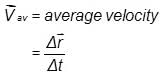
- Instantaneous speed and velocity are defined at a particular instant and are given by

Note:
(a) A change in either speed or direction of motion results in a change in velocity
(b) A particle which completes one revolution, along a circular path, with uniform speed is said to possess zero velocity and non-zero speed.
(c) It is not possible for a particle to possess zero speed with a non-zero velocity. - Average acceleration is defined as the change in velocity
 over a time interval ?t.
The instantaneous acceleration of a particle is the rate at which its velocity is changing at that instant. - The three equations of motion for an object with constant acceleration are given below.
(a) v = u+at
(b) s = ut+1/2 at2
(c) v2 = u2+2as
Here u is the initial velocity, v is the final velocity, a is the acceleration, s is the displacement travelled by the body and t is the time.
Note: Take '+ve' sign for a when the body accelerates and takes '-ve' sign when the body decelerates. - The displacement by the body in nth second is given by,
sn = u + a/2 (2n-1) - Position-time (x vs t), velocity-time (v vs t) and acceleration-time (a vs t) graph for motion in one-dimension:
(i) Variation of displacement (x), velocity (v) and acceleration (a) with respect to time for different types of motion.Displacement(x)Velocity(v)Acceleration (a)(a) At rest(b) Motion with constant velocity(c) Motion with constant acceleration(d) Motion with constant deceleration - Scalar Quantities:- Scalar quantities are those quantities which require only magnitude for their complete specification.(e.g-mass, length, volume, density)
- Vector Quantities:- Vector quantities are those quantities which require magnitude as well as direction for their complete specification. (e.g-displacement, velocity, acceleration, force)
- Null Vector (Zero Vectors):- It is a vector having zero magnitude and an arbitrary direction.
When a null vector is added or subtracted from a given vector the resultant vector is same as the given vector.
Dot product of a null vector with any arbitrary is always zero. Cross product of a null vector with any other vector is also a null vector. - Collinear vector:- Vectors having a common line of action are called collinear vector. There are two types.
Parallel vector (θ=0°):- Two vectors acting along same direction are called parallel vectors.
Anti parallel vector (θ=180°):-Two vectors which are directed in opposite directions are called anti-parallel vectors. - Co-planar vectors- Vectors situated in one plane, irrespective of their directions, are known as co-planar vectors.
- Vector addition:-
Vector addition is commutative-
Vector addition is associative-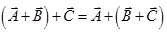
Vector addition is distributive-
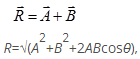
- Triangles Law of Vector addition:- If two vectors are represented by two sides of a triangle, taken in the same order, then their resultant in represented by the third side of the triangle taken in opposite order.

Magnitude of resultant vector
R=√(A2+B2+2ABcosθ)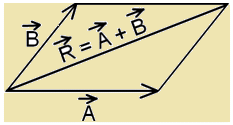
Here θ is the angle between and
and 
If β is the angle between and
and 
then,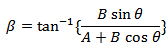
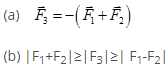
- If three vectors acting simultaneously on a particle can be represented by the three sides of a triangle taken in the same order, then the particle will remain in equilibrium.
So,
- Parallelogram law of vector addition:-
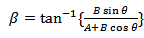
Cases 1:- When, θ = 0°, then,
R = A+B (maximum), β = 0°
Cases 2:- When, θ = 180°, then,
R= A-B (minimum), β = 0°
Cases 3:- When, θ = 90°, then,
R = √(A2+B2), β = tan-1 (B/A) - The process of subtracting one vector from another is equivalent to adding, vectorially, the negative of the vector to be subtracted.
So,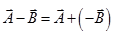
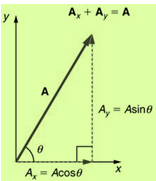
- Resolution of vector in a plane:-
- Product of two vectors:-
(a) Dot product or scalar product:-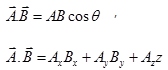
Here A is the magnitude of B is the magnitude of
  and θ is the angle between
(i) Perpendicular vector:-
(ii) Collinear vector:-
When, Parallel vector (θ = 0°),
When, Anti parallel vector (θ = 180°),
(b) Cross product or Vector product:-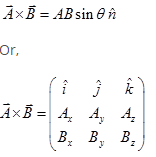
Here A is the magnitude of , B is the magnitude of
  is the angle between
 and
and  and
and  is the unit vector in a direction perpendicular to the plane containing
(i) Perpendicular vector (θ = 90°):-
(ii) Collinear vector:-
When, Parallel vector (θ = 0°), (null vector)
When, θ = 180°, (null vector)
 - Unit Vector:- Unit vector of any vector is a vector having a unit magnitude, drawn in the direction of the given vector.
In three dimension,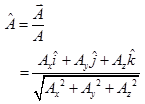
- Area:-
Area of triangle:-
Area of parallelogram:-
Volume of parallelepiped:-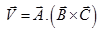
- Equation of Motion in an Inclined Plane:
(i) Perpendicular vector :- At the top of the inclined plane (t = 0, u = 0 and a = g sinq ), the equation of motion will be,
(a) v= (g sinθ)t
(b) s = ½ (g sinθ) t2
(c) v2 = 2(g sinθ)s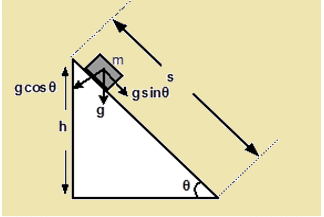
- (ii) If time taken by the body to reach the bottom is t, then s = ½ (g sinθ) t2
t = √(2s/g sinθ)
But sinθ =h/s or s= h/sinθ
So, t =(1/sinθ) √(2h/g)
(iii) The velocity of the body at the bottom
v = g(sinθ)t
=√2gh - The relative velocity of object A with respect to object B is given by
VAB = VA-VB
Here, VB is called reference object velocity. - Variation of mass:- In accordance to Einstein's mass-variation formula, the relativistic mass of body is defined as,
m= m0/√(1-v2/c2)
Here, m0 is the rest mass of the body, v is the speed of the body and c is the speed of light. - Projectile motion in a plane:- If a particle having initial speed u is projected at an angle θ (angle of projection) with x-axis, then,
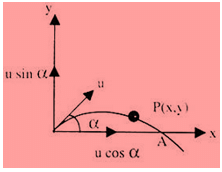
Time of Flight, T = (2u sinα)/g
Horizontal Range, R = u2sin2α/g
Maximum Height, H = u2sin2α/2g
Equation of trajectory, y = xtanα-(gx2/2u2cos2α) - Motion of a ball:-
(a) When dropped:- Time period, t = √(2h/g) and speed, v = √(2gh
(b) When thrown up:- Time period, t = u/g and height, h = u2/2g - Condition of equilibrium:-
The document Revision Notes: Kinematics is a part of the JEE Course Mock Tests for JEE Main and Advanced 2026.
All you need of JEE at this link: JEE
FAQs on Revision Notes: Kinematics
| 1. What is kinematics? |  |
Ans. Kinematics is the branch of physics that studies the motion of objects without considering the forces causing the motion. It focuses on concepts such as displacement, velocity, and acceleration.
| 2. How is displacement different from distance? | |
Ans. Displacement refers to the change in position of an object from its initial position to its final position, taking into account both the distance and direction. On the other hand, distance is the total length covered by an object irrespective of its direction.
| 3. What is the difference between speed and velocity? | |
Ans. Speed is a scalar quantity that refers to how fast an object is moving, while velocity is a vector quantity that includes both the speed and direction of the object's motion. In other words, velocity specifies both the magnitude and the direction of the object's speed.
| 4. How is average velocity calculated? | |
Ans. Average velocity is calculated by dividing the total displacement of an object by the total time taken. It is a vector quantity that indicates the change in position per unit of time.
| 5. What is the difference between uniform and non-uniform motion? | |
Ans. Uniform motion refers to the motion of an object at a constant speed, where the object covers equal distances in equal intervals of time. Non-uniform motion, on the other hand, refers to the motion of an object at varying speeds, where the object covers unequal distances in equal intervals of time.
About this Document

2.2K Views

4.96/5 Rating

Apr 19, 2026 Last updated
Document Description: Revision Notes: Kinematics for JEE 2026 is part of Mock Tests for JEE Main and Advanced 2026 preparation. The notes and questions for Revision Notes: Kinematics have been prepared according to the JEE exam syllabus. Information about Revision Notes: Kinematics covers topics like and Revision Notes: Kinematics Example, for JEE 2026 Exam. Find important definitions, questions, notes, meanings, examples, exercises and tests below for Revision Notes: Kinematics.
Introduction of Revision Notes: Kinematics in English is available as part of our Mock Tests for JEE Main and Advanced 2026 for JEE & Revision Notes: Kinematics in Hindi for Mock Tests for JEE Main and Advanced 2026 course. Download more important topics related with notes, lectures and mock test series for JEE Exam by signing up for free. JEE: Revision Notes: Kinematics
Description
Revision Notes: Kinematics of Mock Tests with clear explanations of key concepts & important topics of the chapter, to help you underst& lessons better & revise quickly, & crack the JEE exam.
Information about Revision Notes: Kinematics
In this doc you can find the meaning of Revision Notes: Kinematics defined & explained in the simplest way possible. Besides explaining types of Revision Notes: Kinematics theory, EduRev gives you an ample number of questions to practice Revision Notes: Kinematics tests, examples and also practice JEE tests



Related Searches
Exam, Semester Notes, Viva Questions, Objective type Questions, Revision Notes: Kinematics, ppt, shortcuts and tricks, Extra Questions, Revision Notes: Kinematics, Previous Year Questions with Solutions, Revision Notes: Kinematics, practice quizzes, Summary, MCQs, Important questions, video lectures, Free, pdf , past year papers, study material, Sample Paper, mock tests for examination;