CBSE Class 10 > Class 10 Notes > Social Studies (SST) > Mind Map: Development
Mind Map: Development

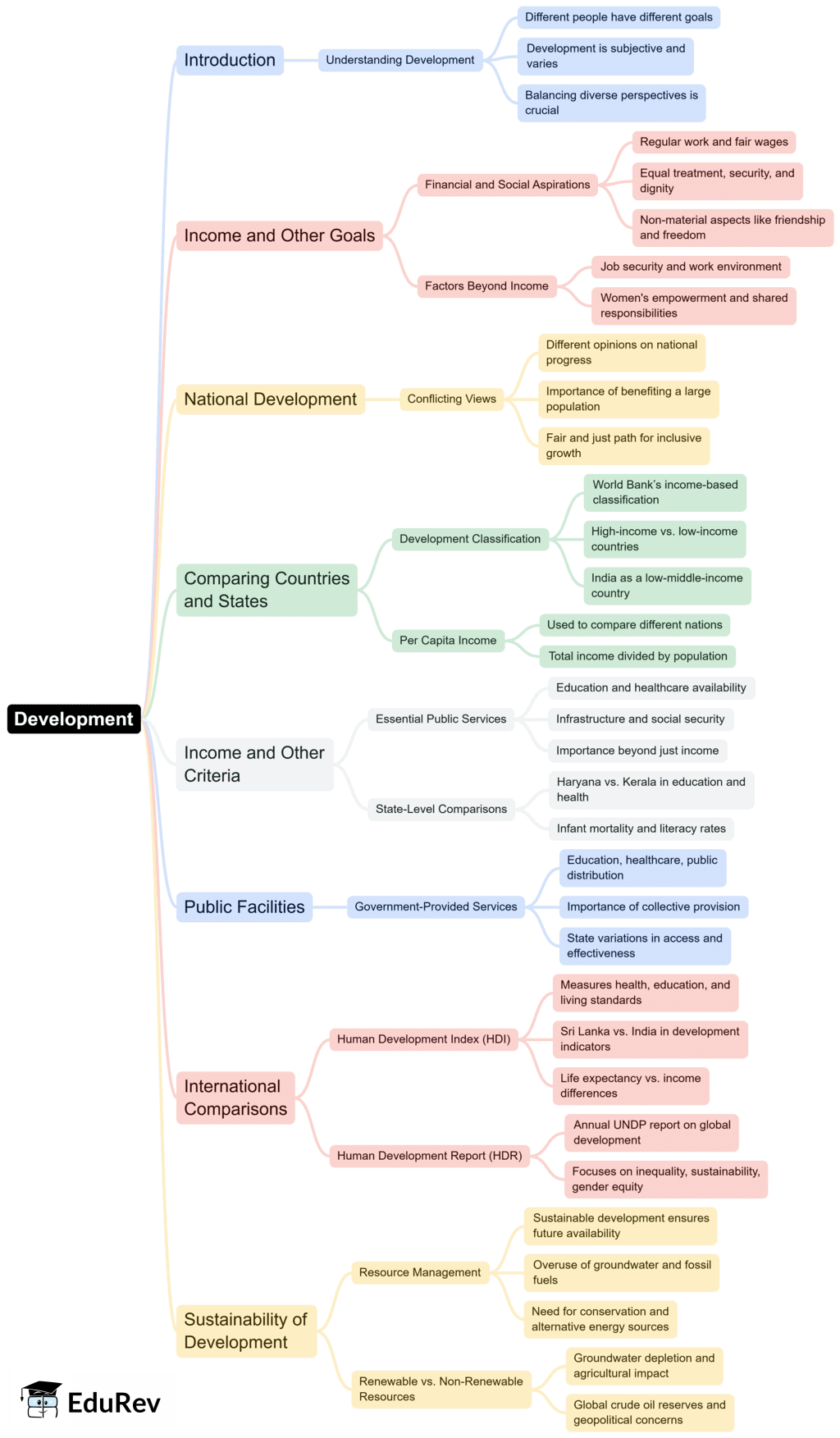
The document Mind Map: Development is a part of the Class 10 Course Social Studies (SST) Class 10.
All you need of Class 10 at this link: Class 10
FAQs on Mind Map: Development
| 1. What are the main indicators used to measure development in CBSE Class 10 Social Studies? |  |
Ans. Development is measured using indicators like per capita income, literacy rate, life expectancy, infant mortality rate, and access to healthcare and education. These human development indicators help compare progress across countries and regions. Income alone doesn't reflect true development; composite measures like the Human Development Index (HDI) provide a more comprehensive picture of societal advancement and quality of life.
| 2. How is sustainable development different from regular economic growth? | |
Ans. Sustainable development balances economic progress with environmental conservation and social equity, ensuring resources meet present needs without harming future generations. Regular growth focuses only on increasing GDP and production. Sustainable development considers long-term impacts on ecosystems, communities, and natural resources. It emphasises meeting basic human needs while preserving ecological balance and promoting equitable distribution of wealth across society.
| 3. Why do different countries have different levels of development despite similar resources? | |
Ans. Development levels vary due to differences in governance quality, investment in education and healthcare, industrialisation rates, infrastructure development, and historical circumstances. Political stability, corruption levels, and access to international markets significantly influence progress. Natural resources alone don't guarantee development; effective utilisation through policy, technology adoption, and human capital development determines actual advancement and prosperity.
| 4. What role do infrastructure and technology play in a country's development process? | |
Ans. Infrastructure-roads, electricity, ports, and communication networks-enables trade, reduces production costs, and improves living standards. Technology increases productivity, creates employment, and facilitates innovation across sectors. Together, they attract investment, connect rural and urban areas, and improve service delivery. Strong infrastructure and technological advancement are essential catalysts for industrial growth, agricultural modernisation, and overall socio-economic progress in developing nations.
| 5. How can students understand the relationship between natural resources and development outcomes using mind maps? | |
Ans. Mind maps visually connect natural resources (minerals, forests, water) to economic activities, employment, and living standards. They illustrate how resource management policies affect development outcomes and environmental sustainability. By mapping resource availability to infrastructure needs, industries, and population welfare, students grasp complex cause-and-effect relationships. Visual learning through mind maps helps identify how resource mismanagement or depletion impacts long-term development trajectories and regional inequality in developing economies.
About this Document

9.2K Views

4.67/5 Rating

Apr 18, 2026 Last updated
Document Description: Mind Map: Development for Class 10 2026 is part of Social Studies (SST) Class 10 preparation. The notes and questions for Mind Map: Development have been prepared according to the Class 10 exam syllabus. Information about Mind Map: Development covers topics like and Mind Map: Development Example, for Class 10 2026 Exam. Find important definitions, questions, notes, meanings, examples, exercises and tests below for Mind Map: Development.
Introduction of Mind Map: Development in English is available as part of our Social Studies (SST) Class 10 for Class 10 & Mind Map: Development in Hindi for Social Studies (SST) Class 10 course. Download more important topics related with notes, lectures and mock test series for Class 10 Exam by signing up for free. Class 10: Mind Map: Development
Description
Mind Map: Development of SST provides you one-page visual summary of the chapter covering all the important topics. Download the PDF from EduRev.
Information about Mind Map: Development
In this doc you can find the meaning of Mind Map: Development defined & explained in the simplest way possible. Besides explaining types of Mind Map: Development theory, EduRev gives you an ample number of questions to practice Mind Map: Development tests, examples and also practice Class 10 tests



Related Searches
Viva Questions, Previous Year Questions with Solutions, Mind Map: Development, ppt, Sample Paper, past year papers, Mind Map: Development, video lectures, practice quizzes, Mind Map: Development, MCQs, mock tests for examination, Summary, pdf , Semester Notes, Important questions, Extra Questions, shortcuts and tricks, Objective type Questions, Exam, study material, Free;