NEET Exam > NEET Notes > Chemistry Class 11 > Mind Map: The p-block Elements
Mind Map: The p-block Elements

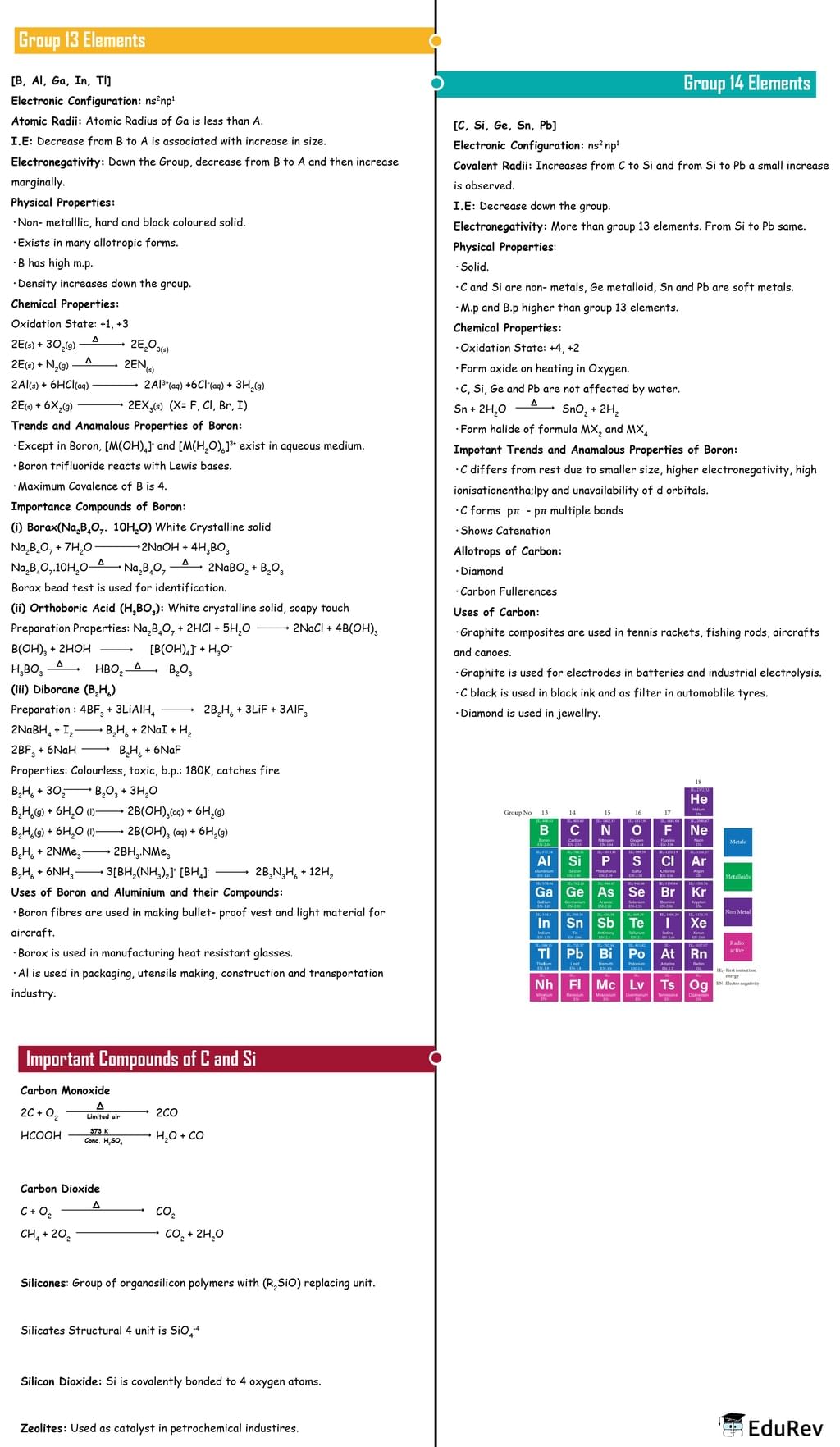
The document Mind Map: The p-block Elements is a part of the NEET Course Chemistry Class 11.
All you need of NEET at this link: NEET
FAQs on Mind Map: The p-block Elements
| 1. What are the main characteristics of p-block elements and how do they differ from other blocks? |  |
Ans. P-block elements occupy groups 13-18 and have valence electrons in p-orbitals, distinguishing them from s-block and d-block elements. They display diverse chemical properties, varying electronegativity, and include metals, nonmetals, and metalloids. These elements show trends in ionization energy and atomic radius across periods and groups, making their behaviour predictable yet complex for NEET preparation.
| 2. Why do p-block elements show variable oxidation states and what's the significance of this for reactions? | |
Ans. P-block elements exhibit multiple oxidation states because electrons in p-orbitals can participate in bonding in various ways, especially when d-orbitals become available. This variability affects reactivity patterns, compound stability, and reaction mechanisms. Understanding oxidation state trends helps predict products in redox reactions and is crucial for solving NEET chemistry problems involving these elements.
| 3. How should I approach learning about group 13 to group 18 elements systematically using mind maps? | |
Ans. Organize each group's elements by focusing on electronic configuration, atomic size trends, ionization enthalpy, and electronegativity patterns. Mind maps effectively illustrate how properties change down a group and across periods. Visual representations help memorize anomalous behaviour in lighter elements like boron and fluorine, making complex p-block chemistry more manageable for exam revision.
| 4. What are the most important allotropes in p-block elements and why do they matter for NEET exams? | |
Ans. Carbon (diamond, graphite, fullerenes), phosphorus (white, red, black), and sulfur display significant allotropic forms affecting physical and chemical properties. These allotropes demonstrate how atomic arrangement influences reactivity and bonding strength. NEET frequently tests allotrope identification, property differences, and their industrial applications, making this concept essential for scoring well.
| 5. Which p-block elements form the most important compounds and what reactions should I focus on for competitive exams? | |
Ans. Halogens, oxygen, nitrogen, and carbon form compounds with widespread reactivity patterns and industrial significance. Focus on halogen displacement reactions, nitrogen oxides formation, oxygen's allotropes, and carbon compound properties. These elements' reactions frequently appear in NEET as both objective and numerical problems, so understanding their behaviour across different reaction conditions is critical.
About this Document

1.6K Views

4.86/5 Rating

Apr 18, 2026 Last updated
Document Description: Mind Map: The p-block Elements for NEET 2026 is part of Chemistry Class 11 preparation. The notes and questions for Mind Map: The p-block Elements have been prepared according to the NEET exam syllabus. Information about Mind Map: The p-block Elements covers topics like and Mind Map: The p-block Elements Example, for NEET 2026 Exam. Find important definitions, questions, notes, meanings, examples, exercises and tests below for Mind Map: The p-block Elements.
Introduction of Mind Map: The p-block Elements in English is available as part of our Chemistry Class 11 for NEET & Mind Map: The p-block Elements in Hindi for Chemistry Class 11 course. Download more important topics related with notes, lectures and mock test series for NEET Exam by signing up for free. NEET: Mind Map: The p-block Elements
Description
Mind Map: The p of Chemistry Class 11 provides you one-page visual summary of the chapter covering all the important topics. Download the PDF from EduRev.
Information about Mind Map: The p-block Elements
In this doc you can find the meaning of Mind Map: The p-block Elements defined & explained in the simplest way possible. Besides explaining types of Mind Map: The p-block Elements theory, EduRev gives you an ample number of questions to practice Mind Map: The p-block Elements tests, examples and also practice NEET tests



Related Searches
pdf , Semester Notes, Viva Questions, Free, Important questions, ppt, Summary, mock tests for examination, study material, past year papers, shortcuts and tricks, Objective type Questions, Sample Paper, practice quizzes, Mind Map: The p-block Elements, Exam, Previous Year Questions with Solutions, Mind Map: The p-block Elements, Extra Questions, video lectures, MCQs, Mind Map: The p-block Elements;