Question 1. Amit, Deepak and Prabha have saved a good amount from their pocket money. They wish to donate it for a good cause. They sat on a round table of 20 cm radius, to decide the mode of donation. In the adjoining figure, Amit, Deepak and Prabha are sitting at A, S and D respectively, such that AS = SD = AD i.e., ∆ASD is an equilateral triangle.
(a) Find the distance between Amit, Deepak and Prabha.
(b) Which mathematical concept is used in the above problem?
(c) By donating the savings from the pocket money what values are depicted by Amit, Deepak and Prabha?
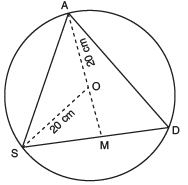
Sol. (a) Since AS = SD = AD, ∆ASD is an equilateral triangle.
Let O be the centre of the circle and M be the midpoint of chord SD. The perpendicular from a vertex to the opposite side passes through the centre, so AM is a perpendicular to SD and passes through O.
Let SM = x cm. Then SD = 2x cm.
In right-angled ∆ASM, by Pythagoras,
AM2 + SM2 = AS2.
So AM2 = (2x)2 - x2 = 4x2 - x2 = 3x2.
Hence AM = √3 x.
The distance OM = AM - AO = √3 x - 20 cm, because AO = radius = 20 cm and AM > AO for this configuration.
In right-angled ∆OSM, again by Pythagoras,
OS2 = SM2 + OM2.
So 202 = x2 + (√3 x - 20)2.
Therefore 400 = x2 + 3x2 - 40√3 x + 400.
Simplifying gives 4x2 - 40√3 x = 0 ⇒ 4x(x - 10√3) = 0.
Thus x = 0 (not possible) or x = 10√3 cm.
So SD = 2x = 2 × 10√3 cm = 20√3 cm.
Therefore the distance between Amit, Deepak and Prabha is 20√3 cm.
(b) The mathematical concept used is circle geometry, in particular properties of a circle (radius, chords and perpendicular bisectors) and an equilateral triangle.
(c) By donating their savings they show the values: Charity, habit of saving and making the right decision to help others.





