Practice Questions: Surface Areas & Volume


Q1. A canal is 300 cm wide and 120 cm deep. The water in the canal is flowing at a speed of 20 km/h. How much area will it irrigate in 20 minutes if 8 cm of standing water is desired?
Sol:
The width of the canal = 300 cm = 3 m.
The depth of the canal = 120 cm = 1.2 m.
The cross-sectional area of the canal = width × depth.
Cross-sectional area = 3 × 1.2 = 3.6 m2.
The speed of flow = 20 km/h = 20,000 m per hour.
Distance travelled by water in one hour = 20,000 m.
Volume of water passing in one hour = cross-sectional area × distance in one hour.
Volume per hour = 3.6 × 20,000 = 72,000 m3.
Volume in 20 minutes = (72,000 × 20) / 60 = 24,000 m3.
Required standing depth of water = 8 cm = 0.08 m.
Area irrigated = volume in 20 minutes / standing depth.
Area = 24,000 / 0.08 = 300,000 m2.
Area in hectares = 300,000 / 10,000 = 30 hectares.
Q2. Find the number of solid spheres each of diameter 6 cm that can be made by melting a solid metal cylinder of height 45 cm and diameter 4 cm.
Sol:
Diameter of each sphere = 6 cm, so radius r1 = 3 cm.
Diameter of cylinder = 4 cm, so radius r2 = 2 cm and height h = 45 cm.
Let n be the number of spheres formed.
Volume of one sphere = (4/3)πr13.
Volume of cylinder = πr22h.
Equate total volume of spheres to volume of cylinder: n × (4/3)πr13 = πr22h.
Cancel π from both sides and substitute values.
n × (4/3) × 33 = 22 × 45.
n × 36 = 180.
n = 180 / 36 = 5.
Hence, 5 spheres can be made.
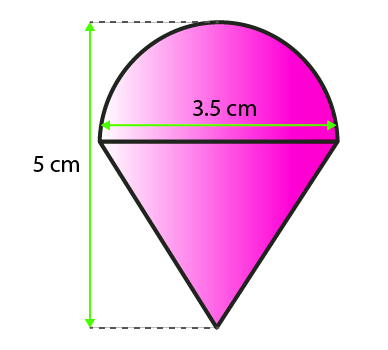
Q3. Rasheed got a playing top (lattu) as his birthday present, which surprisingly had no colour on it. He wanted to colour it with his crayons. The top is shaped like a cone surmounted by a hemisphere. The entire top is 5 cm in height, and the diameter of the top is 3.5 cm. Find the area he has to colour. (Take π = 22/7)
Sol:
Diameter of the top = 3.5 cm, so radius r = 3.5 / 2 = 1.75 cm.
Height of entire top = 5 cm.
Height of hemispherical part = radius = 1.75 cm.
Height of cone = total height - radius of hemisphere.
Height of cone = 5 - 1.75 = 3.25 cm.
Curved surface area (CSA) of hemisphere = 2πr2.
CSA of hemisphere = 2 × (22/7) × (1.75) × (1.75) = 19.25 cm2 (approx.).
Slant height of cone, l = √(r2 + h2) = √(1.752 + 3.252) ≈ 3.69 cm.
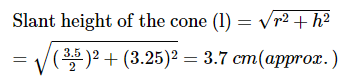
CSA of cone = πrl.
CSA of cone ≈ (22/7) × 1.75 × 3.69 ≈ 20.35 cm2.
Total area to be coloured = CSA of hemisphere + CSA of cone.
Total ≈ 19.25 + 20.35 = 39.6 cm2 (approx.).
Q4. Two cones have their heights in the ratio 1 : 3 and radii in the ratio 3 : 1. What is the ratio of their volumes?
Sol:
Let heights be h1 : h2 = 1 : 3, so h1 = h, h2 = 3h.
Let radii be r1 : r2 = 3 : 1, so r1 = 3r, r2 = r.
Volume of a cone = (1/3)πr2h.
Ratio of volumes = [(1/3)π(3r)2(h)] / [(1/3)π(r)2(3h)].
Cancel common factors: = (9r2h) / (3r2h) = 3/1.
Hence, the ratio of volumes = 3 : 1.
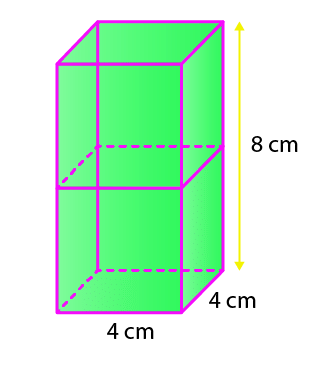
Q5. 2 cubes each of volume 64 cm3 are joined end to end. Find the surface area of the resulting cuboid.
Sol:
Volume of each cube = 64 cm3.
Side of each cube, a, satisfies a3 = 64, so a = 4 cm.
When two cubes are joined end to end, dimensions of resulting cuboid are length = 8 cm, breadth = 4 cm, height = 4 cm.
Total surface area (TSA) of cuboid = 2(lb + bh + lh).
TSA = 2(8×4 + 4×4 + 8×4) cm2.
TSA = 2(32 + 16 + 32) = 2 × 80 = 160 cm2.
Q6. A cone of height 24 cm and radius of base 6 cm is made up of modelling clay. A child reshapes it in the form of a sphere. Find the radius of the sphere.
Sol:
Volume of cone = (1/3)πr2h.
Volume of cone = (1/3) × π × 62 × 24.
Let r be the radius of the sphere formed.
Volume of sphere = (4/3)πr3.
Equate volumes: (4/3)πr3 = (1/3)π × 62 × 24.
Cancel π and (1/3): 4r3 = 62 × 24 = 36 × 24.
r3 = (36 × 24) / 4 = 9 × 24 = 216.
r = ∛216 = 6 cm.
Therefore, the radius of the sphere is 6 cm.
Q7. Metallic spheres of radii 6 cm, 8 cm and 10 cm, respectively, are melted to form a single solid sphere. Find the radius of the resulting sphere.
Sol:
Volume of sphere = (4/3)πr3.
Sum of volumes of three spheres = (4/3)π(63 + 83 + 103).
Let r be radius of resulting sphere. Then (4/3)πr3 = (4/3)π(216 + 512 + 1000).
Cancel (4/3)π: r3 = 216 + 512 + 1000 = 1728.
r = ∛1728 = 12 cm.
Therefore, the radius of the resulting sphere is 12 cm.
Q8. A cubical ice-cream brick of edge 22 cm is to be distributed among some children by filling ice-cream cones of radius 2 cm and height 7 cm up to its brim. How many children will get the ice cream cones?
Sol:
Volume of cubical brick = 22 × 22 × 22 cm3 = 223 cm3.
Radius of cone r = 2 cm, height h = 7 cm.
Volume of one cone = (1/3)πr2h.
Using π = 22/7, volume of one cone = (1/3) × (22/7) × 4 × 7 = (1/3) × 22 × 4 = 88/3 cm3.
Let n be number of cones.
n × (88/3) = 223.
n = (223 × 3) / 88 = (22 × 22 × 22 × 3) / (88).
Simplify: 88 = 22 × 4, so n = (22 × 22 × 3) / 4 = 363.
Therefore, 363 children will get the cones.
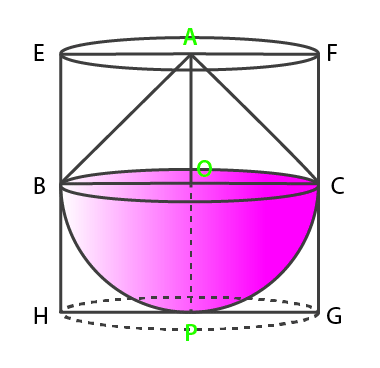
Q9. A solid toy is in the form of a hemisphere surmounted by a right circular cone. The height of the cone is 2 cm, and the diameter of the base is 4 cm. Determine the volume of the toy. If a right circular cylinder circumscribes the toy, find the difference between the volumes of the cylinder and the toy. (Take π = 3.14)
Sol:
Diameter of base = 4 cm, so radius r = 2 cm.
Height of cone h = 2 cm.
Volume of hemisphere = (2/3)πr3.
Volume of cone = (1/3)πr2h.
Volume of toy = (2/3)πr3 + (1/3)πr2h.
Substitute r = 2, h = 2 and π = 3.14.
Volume of toy = (2/3) × 3.14 × 8 + (1/3) × 3.14 × 4 × 2.
Volume of toy = 16.7467 + 8.3733 ≈ 25.12 cm3.
Circumscribing cylinder has radius = 2 cm and height = cone height + hemisphere radius = 2 + 2 = 4 cm.
Volume of cylinder = πr2h = 3.14 × 4 × 4 = 50.24 cm3.
Difference = Volume of cylinder - Volume of toy = 50.24 - 25.12 = 25.12 cm3.
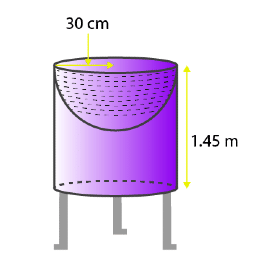
Q10. Mayank made a bird-bath for his garden in the shape of a cylinder with a hemispherical depression at one end, as shown in the figure. The height of the cylinder is 1.45 m, and its radius is 30 cm. Find the total surface area of the bird-bath. (Take π = 22/7)
Sol:
Radius r = 30 cm.
Height of cylinder h = 1.45 m = 145 cm.
Total surface area = curved surface area of cylinder + curved surface area of hemisphere.
CSA of cylinder = 2πrh.
CSA of hemisphere = 2πr2.
Total surface area = 2πr(h + r).
Substitute values with π = 22/7, r = 30 cm, h = 145 cm.
Total surface area = 2 × (22/7) × 30 × (145 + 30) cm2.
Total surface area = 33,000 cm2 = 3.3 m2 (since 1 m2 = 10,000 cm2).
Q11. Three cubes of a metal whose edges are in the ratio 3:4:5 are melted and converted into a single cube whose diagonal is 12√3 cm. Find the edges of the three cubes.
Sol:
Let edges be 3x, 4x and 5x respectively.
Sum of volumes = (3x)3 + (4x)3 + (5x)3 = 27x3 + 64x3 + 125x3 = 216x3.
Let side of new cube be a. Then a3 = 216x3.
So a = 6x.
Given diagonal of new cube = 12√3 cm.
Diagonal of cube = a√3 = 12√3.
Thus a = 12.
So 6x = 12 ⇒ x = 2.
Edges of three cubes are 3x = 6 cm, 4x = 8 cm and 5x = 10 cm.
Q12. Selvi's house has an overhead tank in the shape of a cylinder. This is filled by pumping water from a sump (an underground tank) which is in the shape of a cuboid. The sump has dimensions 1.57 m × 1.44 m × 95cm. The overhead tank has a radius of 60 cm and a height of 95 cm. Find the height of the water left in the sump after the overhead tank has been completely filled with water from the sump which had been full. Compare the capacity of the tank with that of the sump. (Use π = 3.14)
Sol:
Sump dimensions: length = 1.57 m, breadth = 1.44 m, height = 95 cm = 0.95 m.
Base area of sump = 1.57 × 1.44 m2 = 2.2608 m2.
Volume of sump when full = 1.57 × 1.44 × 0.95 m3 = 2.14896 m3.
Overhead tank: radius = 60 cm = 0.6 m, height = 95 cm = 0.95 m.
Volume of overhead tank = πr2h = 3.14 × 0.62 × 0.95 m3.
Volume of tank ≈ 3.14 × 0.36 × 0.95 = 1.07388 m3.
Volume of water left in sump = Volume of sump - Volume transferred to tank.
Remaining volume = 2.14896 - 1.07388 = 1.07508 m3.
Height of water left = remaining volume / base area = 1.07508 / 2.2608 ≈ 0.475 m = 47.5 cm.
Capacity ratio (tank : sump) = 1.07388 : 2.14896 = 1 : 2.
Therefore, the height of water left in the sump is 47.5 cm and the tank's capacity is half the sump's capacity.
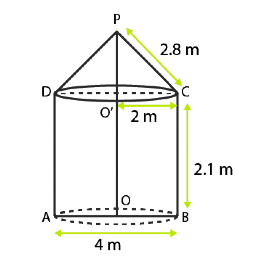
Q13. A tent is in the shape of a cylinder surmounted by a conical top. If the height and diameter of the cylindrical part are 2.1 m and 4 m respectively, and the slant height of the top is 2.8 m, find the area of the canvas used for making the tent. Also, find the cost of the canvas of the tent at the rate of Rs. 500 per m2. (Note that the base of the tent will not be covered with canvas.)
Sol:
Diameter = 4 m, so radius r = 2 m.
Height of cylindrical part h = 2.1 m.
Slant height of conical top l = 2.8 m.
Area of canvas = lateral surface area of cone + lateral surface area of cylinder.
Area = πrl + 2πrh.
Factor: Area = πr(l + 2h).
Substitute r = 2, l = 2.8, h = 2.1 and use π ≈ 3.14 (or leave in π form).
Area = π × 2 × (2.8 + 4.2) = 2π × 7 = 14π ≈ 44 m2.
Cost at Rs. 500 per m2 = 44 × 500 = Rs. 22,000.
Q14. An open metal bucket is in the shape of a frustum of a cone, mounted on a hollow cylindrical base made of the same metallic sheet as shown in the figure. The diameters of the two circular ends of the bucket are 45 cm and 25 cm, the total vertical height of the bucket is 40 cm and that of the cylindrical base is 6 cm. Find the area of the metallic sheet used to make the bucket, where we do not take into account the handle of the bucket. Also, find the volume of water the bucket can hold. (Take π = 22/7)

Sol:
Total vertical height of bucket = 40 cm; cylindrical base height = 6 cm.
Height of frustum = 40 - 6 = 34 cm.
Radii: r1 = 45/2 = 22.5 cm, r2 = 25/2 = 12.5 cm.
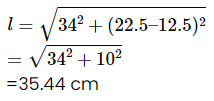
Slant height of frustum, s = √[(r1 - r2)2 + h2] = √[(10)2 + 342] = √1256 ≈ 35.44 cm.
Curved surface area (CSA) of frustum = πs(r1 + r2).
Area of circular base (smaller circle at bottom of frustum) = πr22.
CSA of cylindrical base = 2πr2 × height of base = 2π × 12.5 × 6.
Total area of metallic sheet = π × 35.44 × (22.5 + 12.5) + π × (12.5)2 + 2π × 12.5 × 6.
Total area ≈ (22/7) × (1240.4 + 156.25 + 150) cm2 ≈ 4860.9 cm2.
Volume of frustum = (πh/3) [r12 + r22 + r1r2].
Substitute h = 34 cm, r1 = 22.5, r2 = 12.5.
Volume ≈ (22/7) × (34/3) × 943.75 ≈ 33,615.48 cm3 ≈ 33.62 litres.
Hence, area of metallic sheet ≈ 4860.9 cm2 and capacity ≈ 33.62 litres.
Q15. A spherical glass vessel has a cylindrical neck 8 cm long, 2 cm in diameter; the diameter of the spherical part is 8.5 cm. By measuring the amount of water it holds, a child finds its volume to be 345 cm3. Check whether she is correct, taking the above as the inside measurements, and π = 3.14.
Sol:
Cylindrical neck: height = 8 cm, diameter = 2 cm, so radius R = 1 cm.
Spherical part: diameter = 8.5 cm, so radius r = 4.25 cm.
Volume of cylinder = πR2h.
Volume of cylinder = 3.14 × 12 × 8 = 25.12 cm3.
Volume of sphere = (4/3)πr3.
Volume of sphere = (4/3) × 3.14 × (4.25)3 ≈ 321.55 cm3.
Total internal volume = Volume of cylinder + Volume of sphere.
Total ≈ 25.12 + 321.55 = 346.67 cm3 (approx.).
The child's measured value 345 cm3 is slightly less than the calculated volume 346.67 cm3; the measured value is not exactly correct but is very close.
FAQs on Practice Questions: Surface Areas & Volume
| 1. What is the formula for calculating the surface area of a sphere? |  |
| 2. How do you find the volume of a cylinder? | |
| 3. What is the difference between surface area and volume? | |
| 4. How do you calculate the surface area of a cone? | |
| 5. What is the formula for the volume of a cube? | |




