Additional Questions Solutions - Coordinate Geometry

Question 1. Look at the following figure and fill in the blanks:
(i) The abscissa and the ordinate of the point B are ____ and ____ respectively. Hence, the coordinates of B are (____, ____).
(ii) The x-coordinate and the y-coordiante of the point A are ____ and ____ respectively.
Hence, the coordinates of A are (____, ____).
(iii) The x-coordinate and the y-coordinate of the point D are ____ and ____ respectively.
Hence, the coordinates of D are (____, ____).
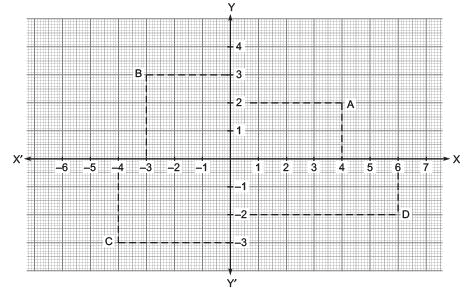
Ans: (i) The abscissa (x-coordinate) of point B is -3 and the ordinate (y-coordinate) is 3. Hence, the coordinates of B are (-3, 3).
(ii) The x-coordinate of point A is 4 and the y-coordinate is 2. Hence, the coordinates of A are (4, 2).
(iii) The x-coordinate of point D is 6 and the y-coordinate is -2. Hence, the coordinates of D are (6, -2).
Question 2. Look at the following figure and answer the following:
(i) What are the coordinates of the origin?
(ii) What is the abscissa of P?
(iii) What is the ordinate of Q?
(iv) What is the x-coordinate of A?
(v) What is the y-coordiante of B?
(vi) Name the point determined by the coordiantes (-5, 3).
(vii) Name the point determined by the coordinates (-1, -1).
(viii) Name the point determined by the coordinates (-4, 0)
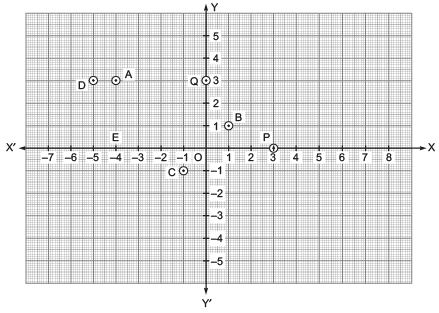
Ans: (i) The coordinates of the origin are (0, 0).
(ii) The abscissa of P (its x-coordinate) is 3.
(iii) The ordinate of Q (its y-coordinate) is 3.
(iv) The x-coordinate of A is -4.
(v) The y-coordinate of B is 1.
(vi) The point determined by (-5, 3) is D.
(vii) The point determined by (-1, -1) is C.
(viii) The point determined by (-4, 0) is E.
Question 3. Draw X'OX and YOY' as axes on the plane of a paper and plot the points given below: (i) A(3, 5) (ii) B(2, -3) (iii) C(-4, -5) (iv) D(-6, 2)
Solution: We draw X'OX and YOY' as axes and fix convenient units. Starting from O, mark equal distances on OX, OX', OY and OY'. Now,
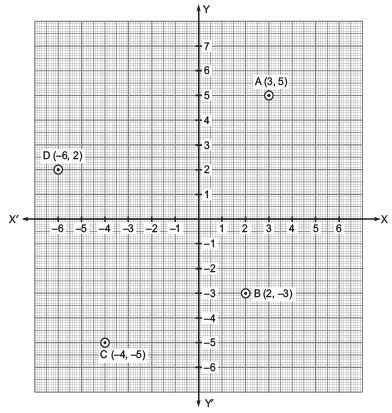
(i) Starting from O (origin), move 3 units to the right along the x-axis (since x = +3) and then 5 units up along the y-axis (since y = +5) to obtain the point A(3, 5).
(ii) From O, move 2 units to the right (x = +2) and then 3 units down (y = -3) to obtain the point B(2, -3).
(iii) From O, move 4 units to the left (x = -4) and then 5 units down (y = -5) to obtain the point C(-4, -5).
(iv) From O, move 6 units to the left (x = -6) and then 2 units up (y = +2) to obtain the point D(-6, 2).
Question 4. In which quadrants do the following points lie?
(i) (5, -3)
(ii) (-8, 4)
(iii) (-3, -6)
(iv) (5, 4)
Solution: (i) Points with (+, -) lie in the 4th quadrant.
∴ The point (5, -3) lies in Quadrant IV.
(ii) Points with (-, +) lie in the 2nd quadrant.
∴ The point (-8, 4) lies in Quadrant II.
(iii) Points with (-, -) lie in the 3rd quadrant.
∴ The point (-3, -6) lies in Quadrant III.
(iv) Points with (+, +) lie in the 1st quadrant.
∴ The point (5, 4) lies in Quadrant I.
FAQs on Additional Questions Solutions - Coordinate Geometry
| 1. What is coordinate geometry? |  |
| 2. How do you find the distance between two points in coordinate geometry? | |
| 3. What is the midpoint formula in coordinate geometry? | |
| 4. How do you determine if three points are collinear in coordinate geometry? | |
| 5. What is the equation of a line in coordinate geometry? | |




