Short Answer Questions: Surface Areas & Volumes

Q1: A sphere of diameter 6cm is dropped in a right circular cylindrical vessel partly filled with water. The diameter of the cylindrical vessel is 12 cm. If the sphere is completely submerged in water, by how much will the level of water rise in the cylindrical vessel?
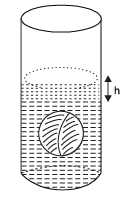
Ans: Let the rise in water level be h cm.
Radius of the sphere, r = 6/2 = 3 cm.
Volume of the sphere = (4/3)πr3 = (4/3)π × 33 = 36π cm3.
Radius of the cylindrical vessel = 12/2 = 6 cm.


or h = 1 cm
Thus, the water level is raised by 1 cm
Q2: The figure shows a decorative block that is made of two solids-a cube and a hemisphere. The base of the block is a cube with edge 5 cm and the hemisphere, fixed on the top, has a diameter of 4.2 cm.
Find the total surface area of the block. [Take π = 22/7]
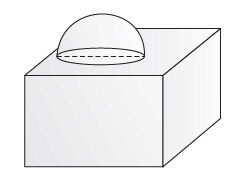
Ans: Edge of cube, a = 5 cm.
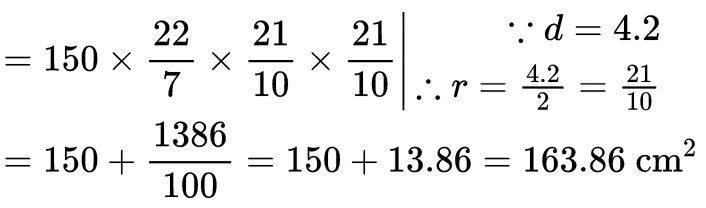
Diameter of hemisphere = 4.2 cm ⇒ radius r = 2.1 cm.
Total surface area of cube = 6a2 = 6 × 52 = 150 cm2.
When the hemisphere is fixed on the top, the circular area of radius r on the top face is not visible, so subtract πr2 from the cube's total area.
Curved surface area of hemisphere = 2πr2.
Therefore total surface area = 150 - πr2 + 2πr2 = 150 + πr2
Q3: A toy is in the form of a cone mounted on a hemisphere with the same radius. The diameter of the base of the conical portion is 7 cm and the total height of the toy is 14.5 cm. Find the volume of the toy. [Use π = 22/7]
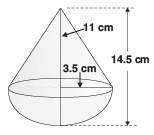
Ans: Radius, r = 7/2 = 3.5 cm.
Height of hemisphere = r = 3.5 cm.
Height of conical portion, h = total height - hemisphere height = 14.5 - 3.5 = 11 cm.
 Now, Volume of the toy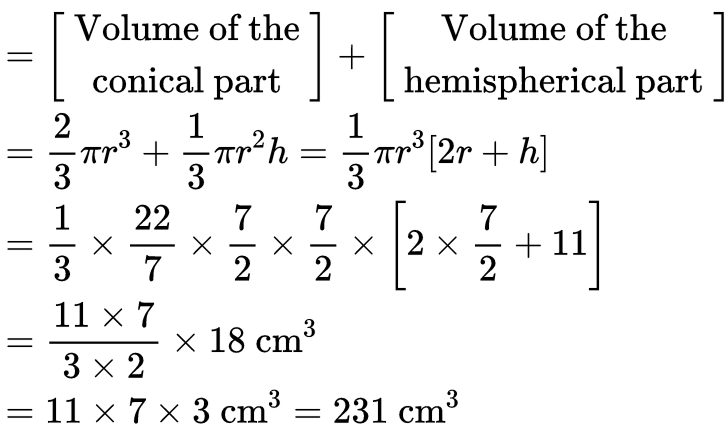
Q4: In the figure, the shape of a solid copper piece (made of two pieces) with dimensions as shown. The face ABCDEFA has a uniform cross-section. Assume that the angles at A, B, C, D, E and F are right angles. Calculate the volume of the piece.
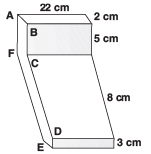
Ans: Treat the piece as two cuboids joined together.
Horizontal piece: length = 22 cm, breadth = (8 + 2) cm = 10 cm, height = 3 cm.
Volume of horizontal piece = 22 × 10 × 3 = 660 cm3.
Vertical piece: length = 22 cm, breadth = 2 cm, height = 5 cm.
Volume of vertical piece = 22 × 2 × 5 = 220 cm3.
Total volume = 660 + 220 = 880 cm3.
Thus, the volume of the copper piece is 880 cm3.
Q5: A toy is in the form of a cone mounted on a hemisphere of a common base radius 7 cm. The total height of the toy is 31 cm. Find the total surface area of the toy. [Use π = 22/7]
Ans: Radius r = 7 cm.
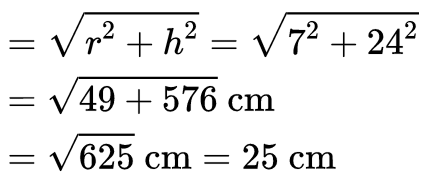
Height of cone, h = total height - hemisphere height = 31 - 7 = 24 cm.
Now, Slant height, l
 ∴ Total surface area of the toy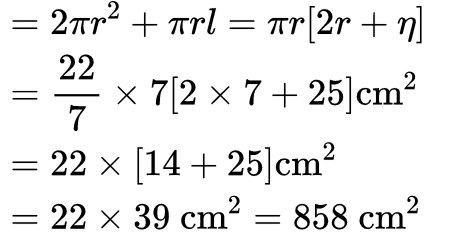
Q6: A canal is 300 cm wide and 120 cm deep. The water in the canal is flowing at a speed of 20 km/h. How much area will it irrigate in 20 minutes if 8 cm of standing water is desired?
Ans: Convert dimensions to metres: width = 300 cm = 3 m, depth = 120 cm = 1.2 m.
Speed = 20 km/h = 20,000 m/h.
Cross-sectional area of canal = 3 × 1.2 = 3.6 m2.
Volume of water flowing in one hour = cross-sectional area × speed = 3.6 × 20,000 = 72,000 m3.
In 20 minutes (which is 1/3 hour), volume = 72,000 × (20/60) = 24,000 m3.
If 8 cm = 0.08 m of standing water is required, area irrigated = volume / depth = 24,000 / 0.08 = 3,00,000 m2.
In hectares, area = 3,00,000 / 10,000 = 30 hectares.
Therefore, the canal will irrigate 3,00,000 m2 (30 hectares) in 20 minutes.
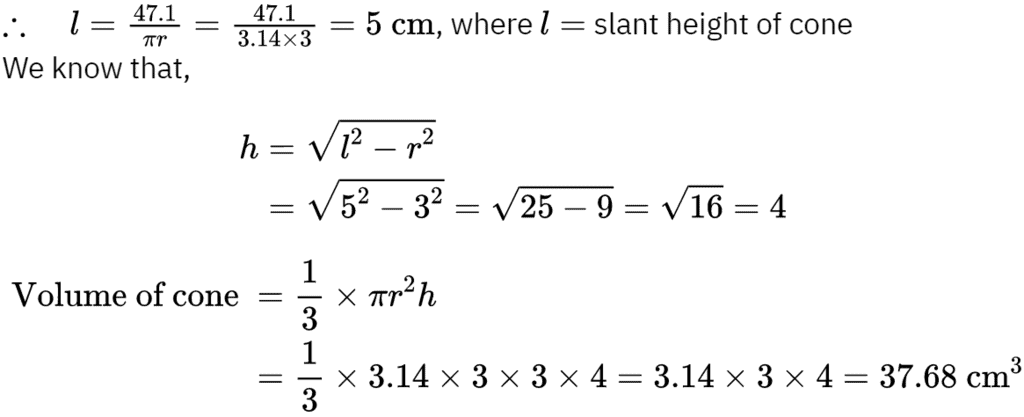
Q7: A right circular cone of radius 3 cm, has a curved surface area of 47.1 cm2. Find the volume of the cone, (use π = 3.14)
Ans: Radius r = 3 cm.
Curved surface area (CSA) = πrl = 47.1 cm2.
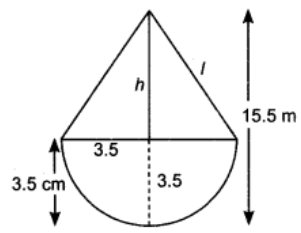
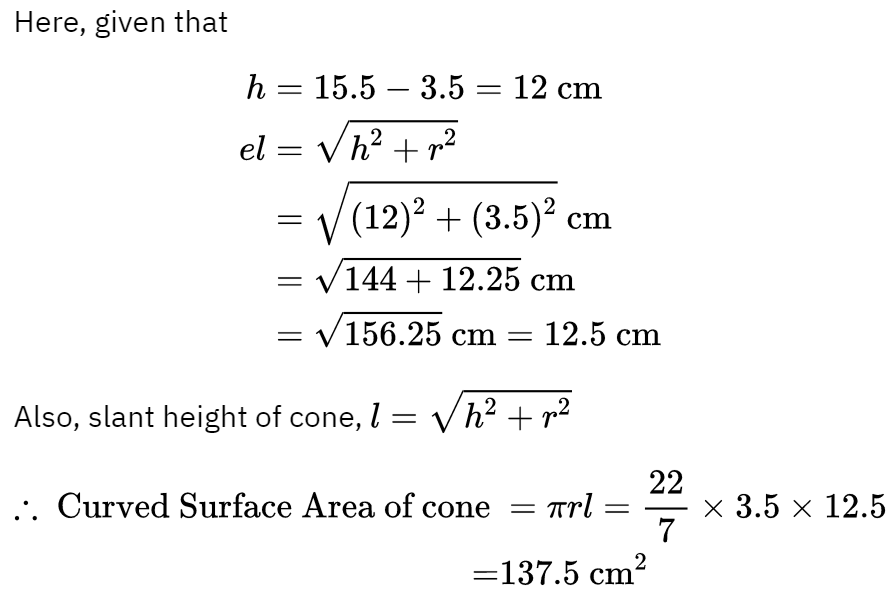
Q8: A toy is in the form of a cone of base radius 3.5 cm mounted on a hemisphere of base diameter 7 cm. If the total height of the toy is 15.5 cm, find the total surface area of the toy. (use π =22/7)
Ans:

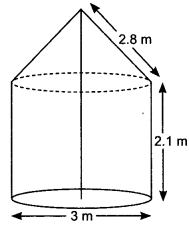
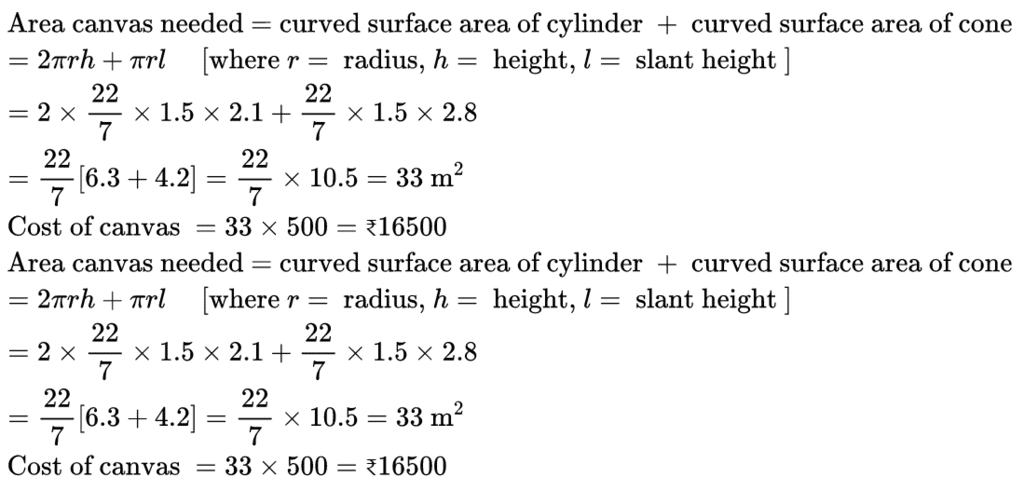
Q9: In figure, a tent is in the shape of a cylinder surmounted by a conical top of same diameter. If the height and diameter of cylindrical part are 2.1 m and 3 m respectively and the slant height of conical part is 2.8 m, find the cost of canvas needed to make the tent if the canvas is available at therate of rupees 500/sq. metre. (use π=22/7)
Ans:
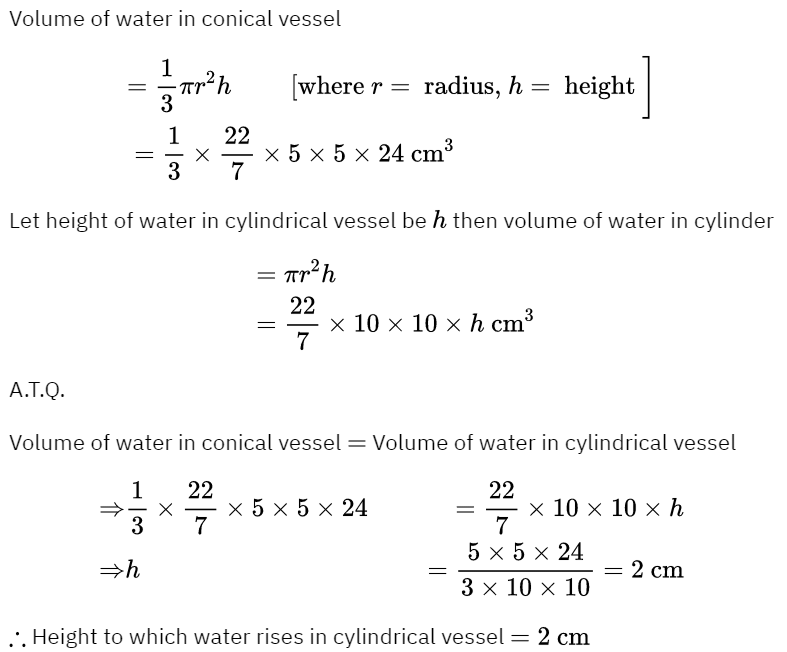
Q10: A conical vessel, with base radius 5 cm and height 24 cm, is full of water. This water is emptied into a cylindrical vessel of base radius 10 cm. Find the height to which the water will rise in the cylindrical vessel.
Ans:
FAQs on Short Answer Questions: Surface Areas & Volumes
| 1. What is the formula for finding the surface area of a cube? |  |
| 2. How do you find the surface area of a cylinder? | |
| 3. What is the formula for finding the volume of a cone? | |
| 4. How do you find the total surface area of a cuboid? | |
| 5. How do you find the volume of a sphere? | |





