JEE Advanced Previous Year Questions (2018 - 2025): Trigonometric Functions & Equations

JEE ADVANCED PYQs 2024
Q1: Let π2 < x < π be such that cot x = -5√11. Then ( sin 11x2 ) (sin 6x - cos 6x) + ( cos 11x2 ) (sin 6x + cos 6x) is equal to:
(a) √11 - 12√3
(b) √11 + 12√3
(c) √11 + 13√2
(d) √11 - 13√2 [JEE Advanced 2024 Paper 1]
Ans: (b)
Given the information, let's start by analyzing the trigonometric relationships involving:
cot x = -5√11 where π2 < x < π.
We know that cot x is the reciprocal of tan x. Hence,
cot x = cos xsin x = -5√11
From the above, it follows that:
cos x = -5k and sin x = √11k
For some constant k. Using the Pythagorean identity:
cos² x + sin² x = 1
Substituting the values of cos x and sin x into this identity:
(-5k)² + (√11k)² = 1
25k² + 11k² = 1
36k² = 1
k² = 136
k = 16 or k = -16
Therefore, we have two sets of values:
cos x = -5/6 and sin x = √11/6
Given that x is in the interval ( π2 , π), where sine is positive and cosine is negative, we take:
cos x = -5/6, sin x = √11/6
Now consider the expression:
(sin 11x2 ) (sin 6x - cos 6x) + (cos 11x2 ) (sin 6x + cos 6x)
Using trigonometric identities, we simplify the expression step by step.
Thus, the correct option is:
Option B
√11 + 12√3
JEE ADVANCED PYQs 2023
Q1: Consider an obtuse-angled triangle ABC in which the difference between the largest and the smallest angle is π/2 and whose sides are in arithmetic progression. Suppose that the vertices of this triangle lie on a circle of radius 1.
Then the inradius of the triangle ABC is : _______. [JEE Advanced 2023 Paper 2]
Ans: 0.25
In radius r = ΔS = a2R(sin A + sin B + sin C)
r = asin (π/2 - 2C) sin (π/2 + C) + sin C
= acos 2C + cos C + sin C
= acos 2C + √1 + sin 2C
= 3√7 / 16√(7/4) + √(7/2) = 14
⇒ r = 14 = 0.25
⇒ r = 0.25
JEE ADVANCED PYQs 2022
Q1: Consider the following lists :
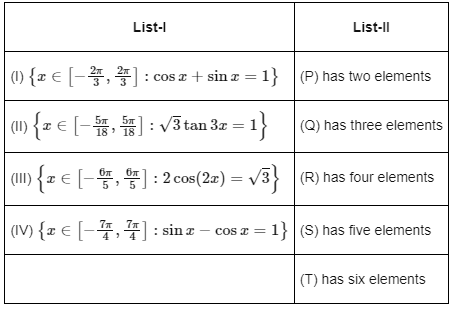
The correct option is
(a) (I) →(P); (II) →(S); (III) →(P); (IV) →(S)
(b) (I) → (P); (II) → (P); (III) → (T); (IV) → (R)
(c) (I) → (Q); (II) →(P); (III) → (T); (IV) → (S)
(d) (I) →(Q); (II) →(S); (III) →(P); (IV) →(R) [JEE Advanced 2022 Paper 1]
Ans: (b)
Solving all question one by one we get,
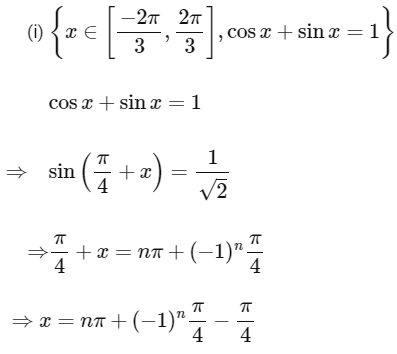
So, 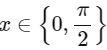
∴ x has 2 elements → P
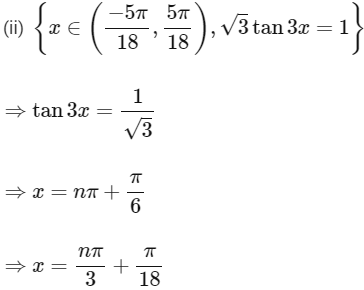
So, 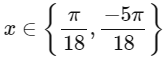
∴ x has 2 elements → P
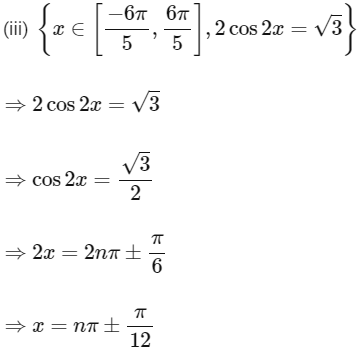
So, 
∴ x has 6 elements →T
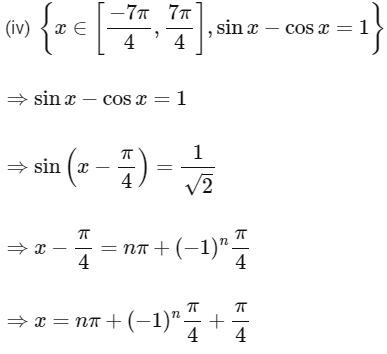
So,
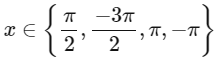
∴ x has 4 elements →R
Q2: Let α and β be real numbers such that  .
.
If 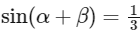 and
and 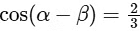 , then the greatest integer less than or equal to
  is: [JEE Advanced 2022 Paper 2]
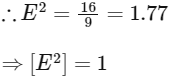
Ans: 1
Given, 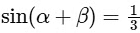
and 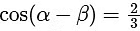
Let, 
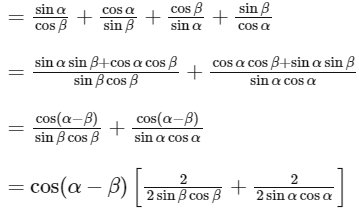
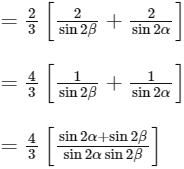
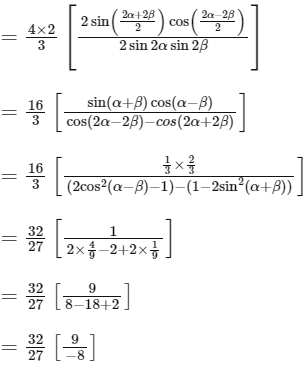
= 4/3
JEE ADVANCED PYQs 2019
Q1: For non-negative integers n, let
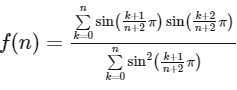
Assuming cos-1 x takes values in [0, π], which of the following options is/are correct?
(a) If α = tan(cos-1 f(6)), then α2 + 2α -1 = 0
(b) 
(c) sin(7 cos-1 f(5)) = 0
(d) 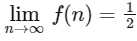 [JEE Advanced 2019 Paper 2]
Ans: (a), (b) & (c)
It is given, that for non-negative integers 'n',
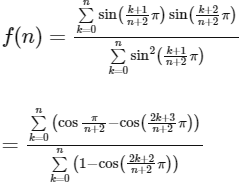

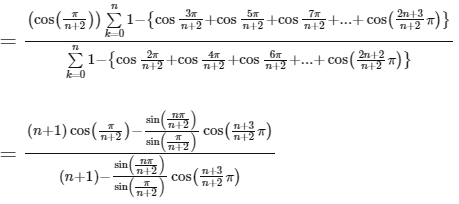
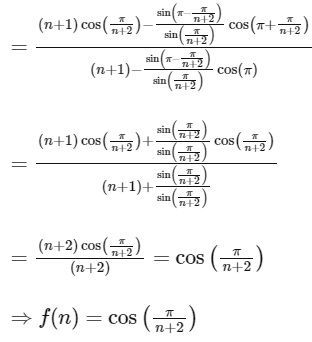
Now, 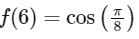
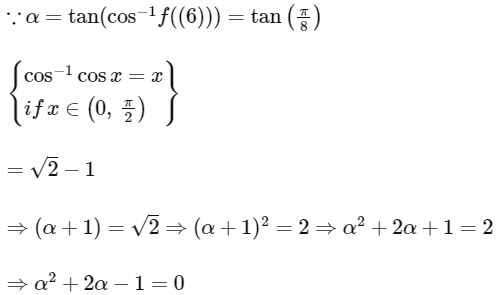
Now, 
Now,
and Now, 
Hence, options (a), (b) and (c) are correct.
Q2: Let f(x) = sin(π cos x) and g(x) = cos(2π sin x) be two functions defined for x > 0. Define the following sets whose elements are written in the increasing order:
X = {x : f(x) = 0}, Y = {x : f'(x) = 0}
Z = {x : g(x) = 0}, W = {x : g'(x) = 0}
List - I contains the sets X, Y, Z and W. List - II contains some information regarding these sets.
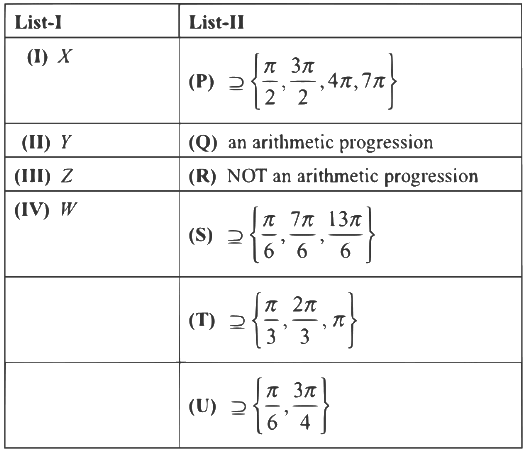
(a) (IV), (P), (R), (S)
(b) (III), (P), (Q), (U)
(c) (III), (R), (U)
(d) (IV), (Q), (T) [JEE Advanced 2019 Paper 2]
Ans: (a)
For Z = {x : g(x) = 0}, x > 0
∵ g(x) = cos(2π sin x) = 0
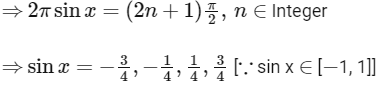
here values of sin x, 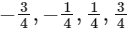 are in an A.P. but corresponding values of x are not in an AP so, (iii) → R.
For W = {x : g'(x) = 0}, x > 0
So, g'(x) = -2 π cos x sin(2π sin x) = 0
⇒ either cos x = 0 or sin(2π sin x) = 0
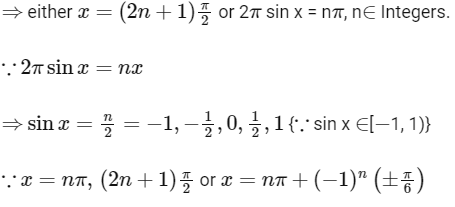
⇒ (iv) → P, R, S
Hence, option (a) is correct.
JEE ADVANCED PYQs 2018
Q1: In a ΔPQR = 30∘ and the sides PQ and QR have lengths 10√3 and 10, respectively. Then, which of the following statement(s) is(are) TRUE?
(a) ∠QPR=45∘
(b) The area of the ΔPQR is 25√3 and ∠QRP=120∘
(c) The radius of the incircle of the ΔPQR is 103 - 15
(d) The area of the circumcircle of the ΔPQR is 100 [JEE Advanced 2018 Paper 1]
Ans: (b), (c) & (d)
We have,
In ΔPQR
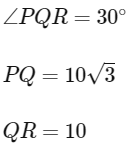
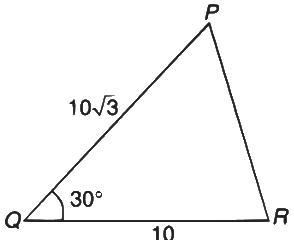
By cosine rule
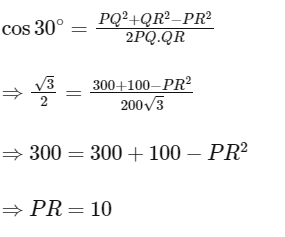
Since, PR = QR = 10
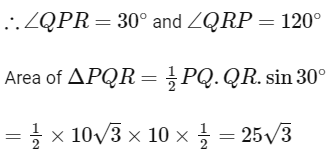
Radius of incircle of
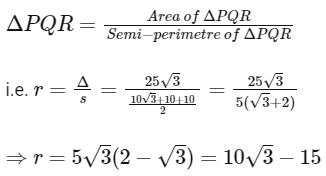
and radius of circumcircle

∴ Area of circumcircle of
Hence, option (b), (c) and (d) are correct answer.
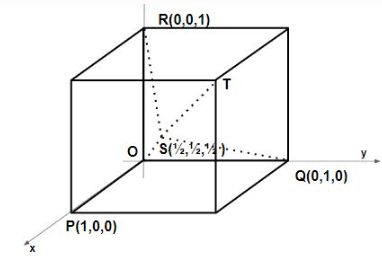
Q2: Consider the cube in the first octant with sides OP, OQ and OR of length 1, along the X-axis, Y-axis and Z-axis, respectively, where O(0, 0, 0) is the origin. Let 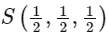 be the centre of the cube and T be the vertex of the cube opposite to the origin O such that S lies on the diagonal OT. If p = SP, q = SQ, r = SR and t = ST, then the value of |(p × q) × (r × t)| is _________ [JEE Advanced 2018 Paper 2]
Ans: 0.5
Here, P(1, 0, 0), Q(0, 1, 0), R(0, 0, 1), T = (1, 1, 1) and 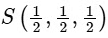
Now, 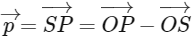
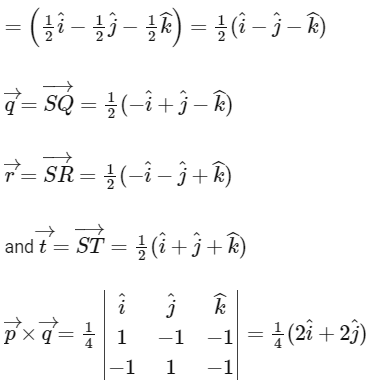
and 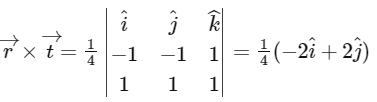
Now, 
∴ 
= 1/2
= 0.5
FAQs on JEE Advanced Previous Year Questions (2018 - 2025): Trigonometric Functions & Equations
| 1. How do I solve trigonometric equations that appear in JEE Advanced papers? |  |
| 2. What's the difference between trigonometric functions and trigonometric equations in JEE exam questions? | |
| 3. Why do trigonometric equations have infinite solutions sometimes? | |
| 4. What are the most common mistakes students make with trigonometric equation solutions in JEE Advanced papers? | |
| 5. Which trigonometric identities are most important for solving JEE Advanced equation problems? | |





