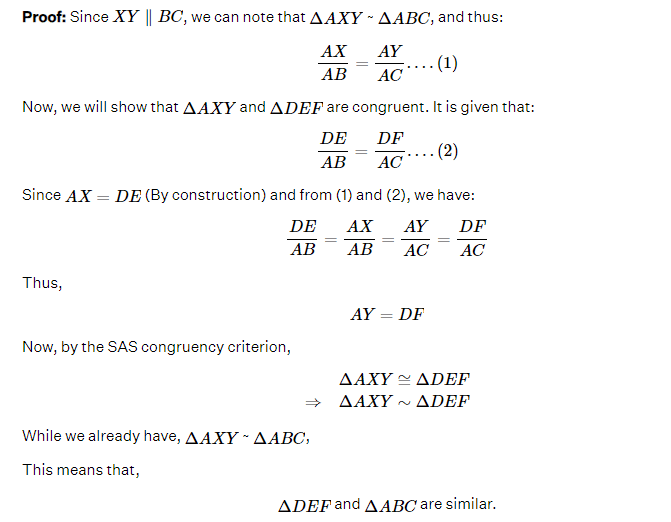
In this chapter, we delve into the fascinating realm of figures that share the same shape but may differ in size - these are aptly termed similar figures. Building upon the groundwork laid in Class IX regarding the congruence of triangles, we now explore the concept of similarity. Unlike congruent figures that possess both the same shape and size, similar figures exhibit identical shapes while allowing for variations in size.
Similar Figures
Two geometrical figures are said to be similar figures if they have the same shape but not necessarily the same size. Or A shape is said to be similar to other if the ratio of their corresponding sides is equal and the corresponding angles are equal.
Two polygons having the same number of sides are similar, if: (i) all the corresponding angles are equal and (ii) all the corresponding sides are in the same ratio or proportion. If only one condition from (i) and (ii) is true for two polygons, then they cannot be similar.
Similarity of Triangles
Two triangles are said to be similar triangles if:
Their corresponding angles are equal and
their corresponding sides are proportional (i.e., the ratios between the lengths of corresponding sides are equal).
For example: If in ∆ABC and ∆PQR ∠A = ∠P, ∠B = ∠Q, ∠C = ∠R and, AB/PQ = BC/QR = AC/PR Then, △ABC∼△PQR where the symbol ∼ is read as 'is similar to'. Conversely If △ABC is similar to △PQR, then ∠A = ∠P, ∠B = ∠Q, ∠C = ∠R and, AB/PQ = BC/QR = AC/PR
Note: The ratio of any two corresponding sides in two equiangular triangles is always the same.
Theorem 1 ( Thales theorem)
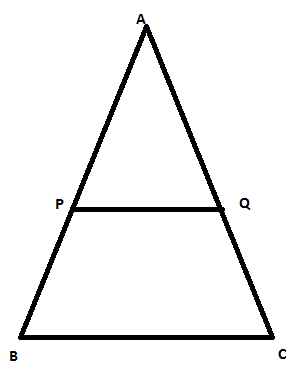
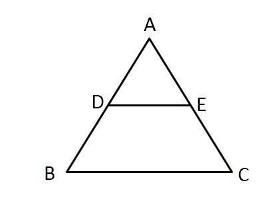
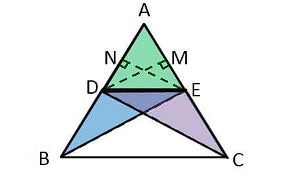
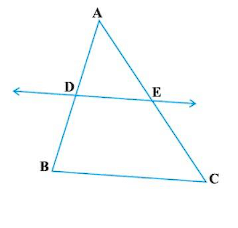
If a line is drawn parallel to one side of a triangle to intersect the other two sides in distinct points, then other two sides are divided in the same ratio. This theorem is known as the Basic Proportionality Theorem (BPT) or Thales theorem.
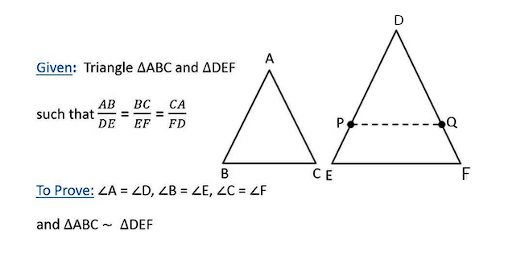
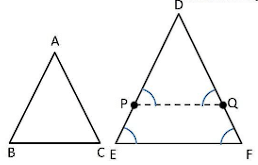
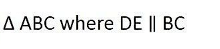
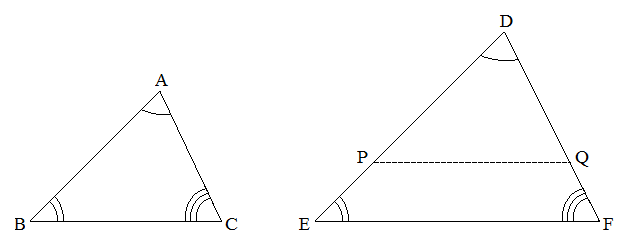
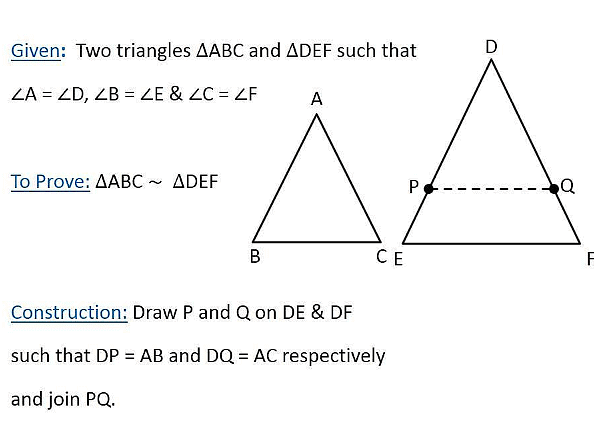
Given:
To Proof:
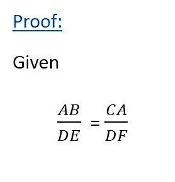
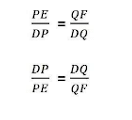
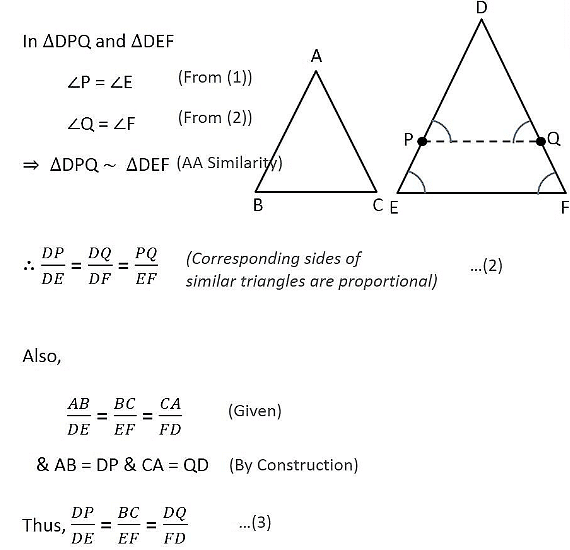
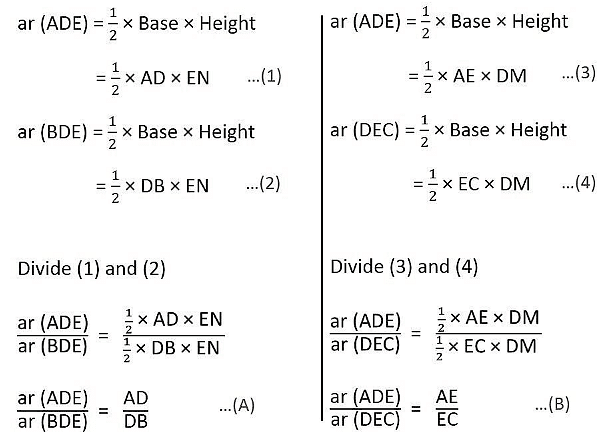
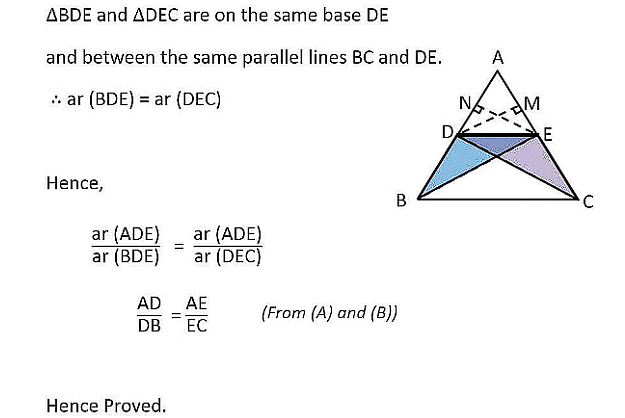
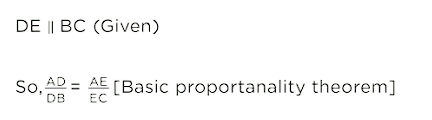
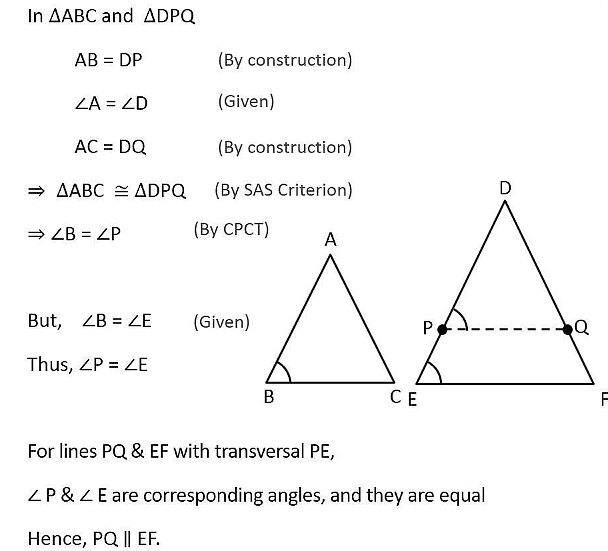
Proof:
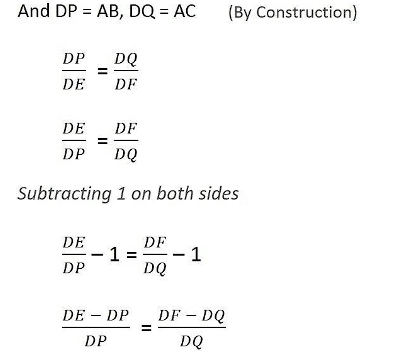
Now,
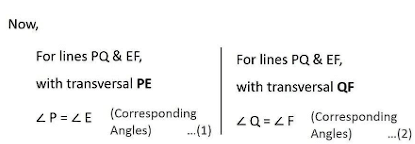
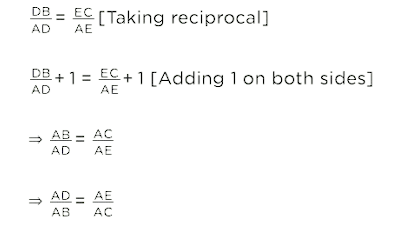
Now,
MULTIPLE CHOICE QUESTION
Try yourself: Which of the following conditions determine if two polygons are similar?
A
All corresponding angles are equal.
B
All corresponding sides are equal.
C
All corresponding angles are equal and all corresponding sides are in the same ratio.
D
All corresponding sides are in the same ratio.
Correct Answer: C
- Two polygons are said to be similar if both the corresponding angles and corresponding sides satisfy certain conditions. - Option A is incorrect because having equal corresponding angles alone does not guarantee similarity. - Option B is incorrect because having equal corresponding sides alone does not guarantee similarity. - Option D is incorrect because having corresponding sides in the same ratio alone does not guarantee similarity. - Only option C states that both the corresponding angles are equal and the corresponding sides are in the same ratio, which is the correct condition for similarity. - Thus, option C is the correct answer.
Report a problem
Theorem 2 ( Converse of Thales theorem)
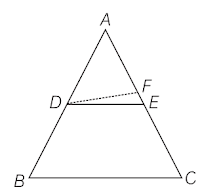
If a line divides any two sides of a triangle in the same ratio, then the line is parallel to the third side.
1. Construction: Assume DE is not parallel to BC. Draw DF ∥ BC, meeting AC at F. This is a standard contradiction setup.
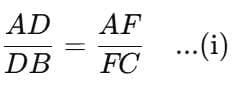
2. Since DF ∥ BC, by BPT:
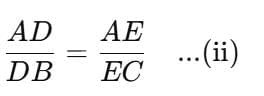
3. From the given:
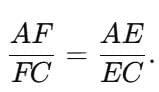
4. From (i) and (ii):
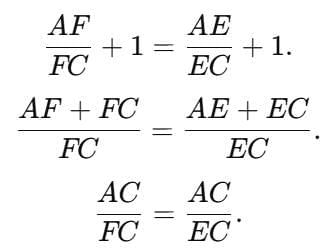
5. Add 1 to both sides:
6. ⇒ FC = EC. ⇒ F and E must coincide. Therefore, DF passes through E, meaning DE ∥ BC.
Example 1: If a line intersects sides AB and AC of a triangle ABC at D and E respectively and is parallel to BC,
prove that
Solution:
If a line is drawn parallel to one side of a triangle to intersect the other two sides in distinct points, the other two sides are divided in the same ratio.
Criteria For Similarity of Triangles
Two triangles are said to be similar triangles if their corresponding angles are equal and their corresponding sides are proportional (i.e., the ratios between the lengths of corresponding sides are equal).
For example: If in ∆ABC and ∆PQR
∠A = ∠P, ∠B = ∠Q, ∠C = ∠R and,
AB/PQ = BC/QR = AC/PR
The, △ABC∼△PQR
where, symbol ∼ is read as, 'is similar to'.
Conversely
If △ABC is similar to △PQR, then
∠A = ∠P, ∠B = ∠Q, ∠C = ∠R and,
AB/PQ = BC/QR = AC/PR
1. AAA Similarity
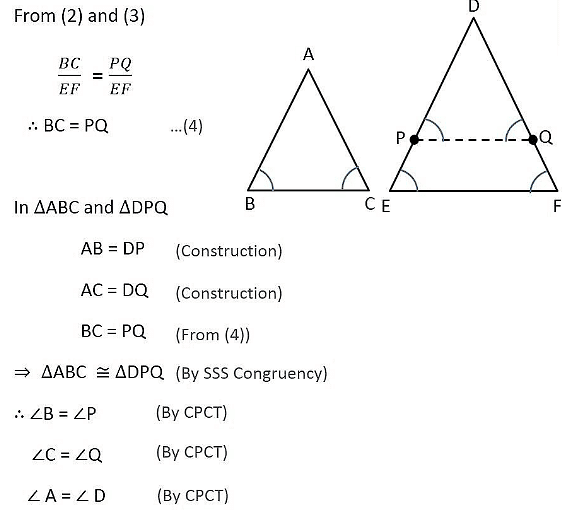
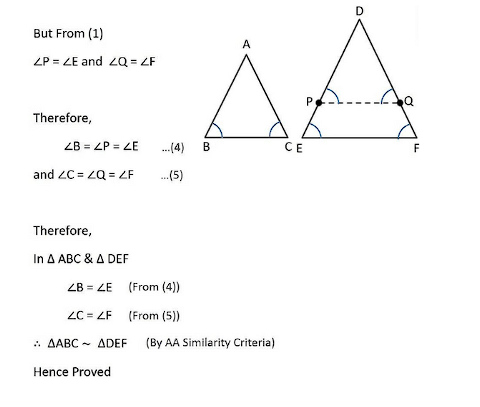
Theorem 3 : If in two triangles, if corresponding angles are equal, then their corresponding sides are in the same ratio i.e., they are proportional, and hence the two triangles are similar.
This criterion is referred to as the AAA (Angle-Angle-Angle) criterion of similarity of two triangles.
2. AA Similarity
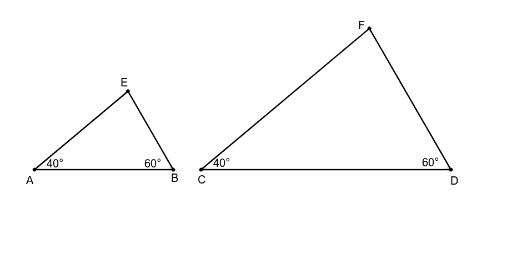
If two angles of one triangle are respectively equal to two angles of another triangle, then the two triangles are similar
If ∠A=∠C and ∠B=∠D then △ABC∼△DEF
Example: In theΔABC length of the sides are given as AP = 5 cm , PB = 10 cm and BC = 20 cm. Also PQ||BC. Find PQ.
Solution: In ΔABC and ΔAPQ, ∠PAQ is common and ∠APQ = ∠ABC (corresponding angles)
⇒ ΔABC ~ ΔAPQ (AA criterion for similar triangles)
⇒ AP/AB = PQ/BC
⇒ 5/15 = PQ/20
⇒ PQ = 20/3 cm
3. SSS similarity
If in two triangles, sides of one triangle are proportional to (i.e., in the same ratio of ) the sides of the other triangle, then their corresponding angles are equal and hence the two triangles are similiar
This criterion is referred to as the SSS (Side-Side-Side) similarity criterion for two triangles.
Using Theorem: if a line divides two sides of a triangle in the same ratio, then the line is parallel to the third side. This theorem is often referred to as the Basic Proportionality Theorem or Thales' Theorem.
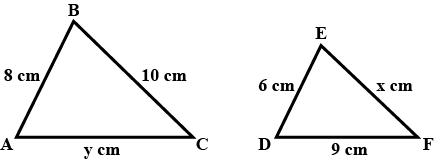
Example:Two triangles ABC and DEF are similar such that AB = 8cm, BC = 10cm, CA =y cm, DE = 6 cm, EF = x cm and FD = 9 cm . Find the Values of x and y?
Solution: As△ABC∼△DEF then AB/DE=AC/DF=BC/EF
So now putting values 8/6=y/9=10/x
8/6=y/9 and 8/6=10/x
4/3=y/9 and 4/3=10/x
4*9=y*3 and 4*x=10*3 (Cross multiplying)
so y comes out to be =12
and x=7.5
4. SAS Similarity
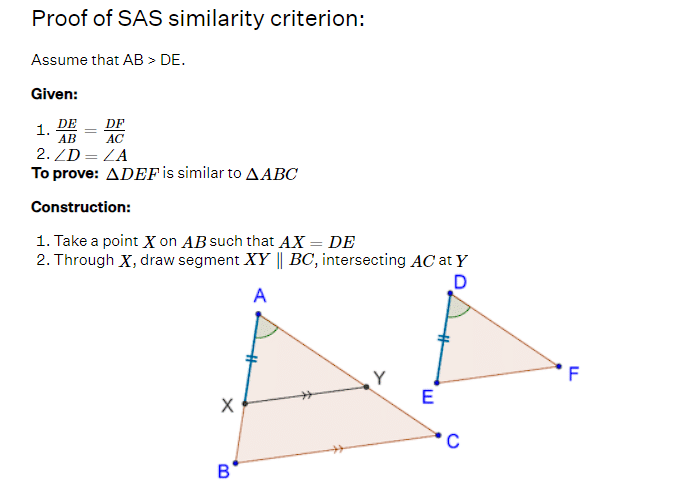
Theorem: If one angle of a triangle is equal to one angle of the other triangle and the sides including these angles are proportional, then the two triangles are similar.
This criterion is referred to as the SAS (Side-Angle-Side) similarity criterion for two triangles.
If AB/ED=BC/EF and ∠B=∠E Then △ABC∼△DEF
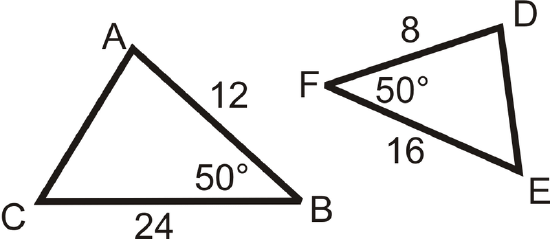
Example: Determine if the following triangles are similar. If so, write the similarity criteria
Solution:
We can see that ∠B≅∠F∠B=∠F and these are both included angles. We just have to check that the sides around the angles are proportional.
ABDFBCFE=128=32=2416=32BC/FE=24/16=3/2 and AB/DF=12/8=3/2
Since the ratios are the same ΔABC∼ΔDFEΔABC∼ΔDFE by the SAS Similarity Theorem.
MULTIPLE CHOICE QUESTION
Try yourself: In two triangles, if two angles of one triangle are equal to two angles of the other triangle, which of the following similarity criteria can be used to prove that the triangles are similar?
A
AAA similarity
B
AA similarity
C
SSS similarity
D
SAS similarity
Correct Answer: B
The AA (Angle-Angle) similarity rule states that if two angles of one triangle are equal to two angles of another triangle, the two triangles are similar.
Report a problem
Summary
Similar Figures: Figures with the same shape, regardless of size, are termed similar figures.
Congruence vs. Similarity: While all congruent figures are similar, the reverse is not necessarily true.
Conditions for Similar Polygons: Two polygons with the same number of sides are similar if their corresponding angles are equal, and their corresponding sides are in proportion.
Parallel Lines and Triangle Side Division: Drawing a line parallel to one side of a triangle divides the other two sides in the same ratio.
Converse of Triangle Side Division: If a line divides any two sides of a triangle in the same ratio, it is parallel to the third side.
AAA Similarity Criterion: If corresponding angles in two triangles are equal, their corresponding sides are in the same ratio, and the triangles are similar.
AA Similarity Criterion: If two angles in one triangle are respectively equal to two angles in another triangle, the triangles are similar.
SSS Similarity Criterion: If corresponding sides in two triangles are in the same ratio, their corresponding angles are equal, leading to similarity.
SAS Similarity Criterion: If one angle of a triangle is equal to one angle of another triangle, and the sides including these angles are in proportion, the triangles are similar.
1. What are the different criteria for proving two triangles are congruent?
Ans. Two triangles are congruent when their sides and angles match exactly. The main congruence criteria are SSS (all three sides equal), SAS (two sides and included angle equal), ASA (two angles and included side equal), AAS (two angles and non-included side equal), and RHS (right angle, hypotenuse, and one side equal). Each criterion provides a reliable shortcut to prove triangle congruence without measuring all six elements.
2. How do I identify similar triangles and what's the difference between similarity and congruence?
Ans. Similar triangles have identical angles but proportional sides; congruent triangles are identical in every way. For similarity, use AA (two angles equal), SSS (all sides proportional), or SAS (two sides proportional with included angle equal). Similar triangles appear the same shape but different sizes. This distinction matters because similarity allows comparisons between differently-sized triangles while congruence means exact duplication.
3. Why is the angle sum property of triangles always 180 degrees and how do I use it in problems?
Ans. The angle sum property states that all three interior angles in any triangle always total 180 degrees. This fundamental rule helps find missing angles when two are known by simple subtraction. In CBSE Class 10 problems, apply this property alongside exterior angle relationships-an exterior angle equals the sum of two non-adjacent interior angles-to solve complex angle-finding questions and prove triangle properties systematically.
4. What's the basic proportionality theorem and when should I apply it to solve triangle problems?
Ans. The basic proportionality theorem (Thales' theorem) states that if a line parallel to one side of a triangle intersects the other two sides, it divides them proportionally. Apply this theorem when you encounter parallel lines within triangles or need to find unknown side lengths. It's essential for Class 10 CBSE geometry and directly links to similar triangles, making it critical for board exam success.
5. How do I use the Pythagoras theorem to solve right-angled triangle questions?
Ans. The Pythagoras theorem states that in a right-angled triangle, the square of the hypotenuse equals the sum of squares of the other two sides (a² + b² = c²). Use it to find missing side lengths when two sides are known, verify if a triangle is right-angled, or solve real-world distance problems. Refer to flashcards and mind maps on EduRev for quick formula references and worked examples during revision.
practice quizzes, Summary, Exam, Objective type Questions, MCQs, Important questions, past year papers, Semester Notes, Chapter Notes: Triangles, Extra Questions, Sample Paper, video lectures, shortcuts and tricks, Free, ppt, mock tests for examination, Chapter Notes: Triangles, Chapter Notes: Triangles, Previous Year Questions with Solutions, study material, Viva Questions, pdf ;

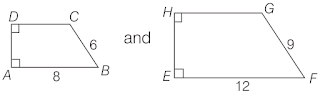 If only one condition from (i) and (ii) is true for two polygons, then they cannot be similar.
∠A = ∠P, ∠B = ∠Q, ∠C = ∠R and,


 If ∠A=∠C and ∠B=∠D then △ABC∼△DEF