Long Answer Type Questions:- Reach for the Top

Part 1: Santosh Yadav
Q1. Write a brief character sketch of Santosh Yadav.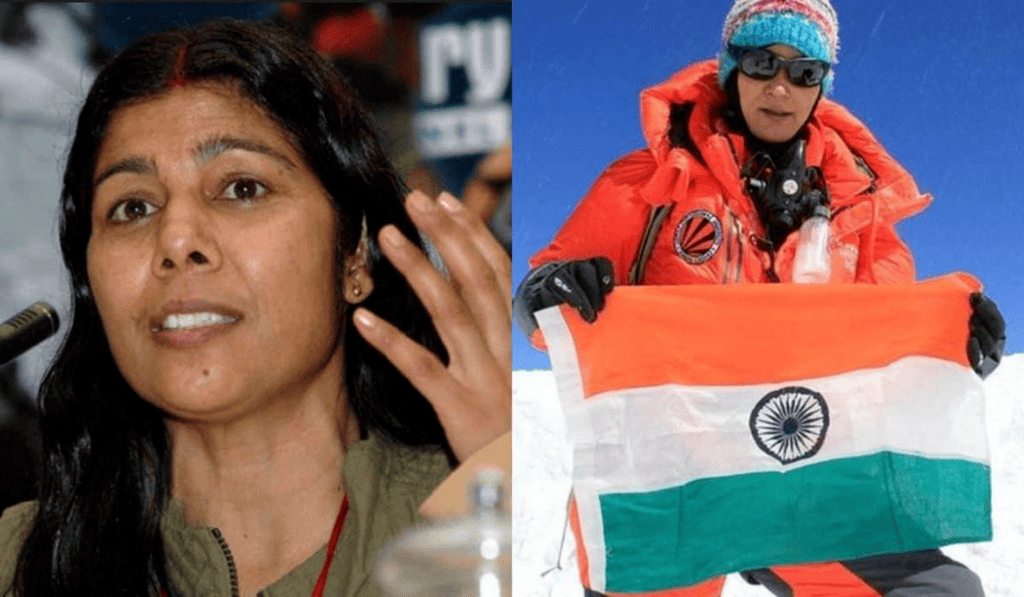 Santosh Yadav
Ans: Santosh Yadav is a brave, determined woman from a small village in Haryana who rose above social expectations to become an outstanding mountaineer. Born the only girl among five brothers in a community that preferred boys, she refused to accept the limited role assigned to her and chose education and independence over an early marriage.
Her name means "contentment", yet she was never content with a simple, prescribed life. She adopted practical clothing suitable for climbing, continued her studies, and stood firm against early marriage to pursue her ambitions. Santosh left home to study in Delhi and supported herself by working part-time when her family did not initially fund her education.
While at college in Jaipur she developed an interest in climbing after seeing people on the Aravalli Hills. She then joined mountaineering training in Uttarkashi, where she rapidly grew physically fit, technically skilled and mentally strong. At twenty, in 1992, she climbed Mount Everest and returned to the summit a year later, becoming the first woman to scale Everest twice.
Santosh combined courage with compassion. On Everest she shared her oxygen with an ailing climber, helping to save a life, and she showed concern for fellow climbers throughout her expeditions. She also cared deeply for the mountain environment and brought down 500 kilograms of garbage from the Himalayas.
Her pride in representing India, her perseverance, and her kindness make her a true role model for young people, especially girls who want to break social barriers and follow their ambitions.
Q2. How did Santosh carve her own destiny?
Ans: Santosh Yadav carved her destiny by refusing to accept traditional expectations and by taking firm, independent decisions about her life. When village norms pushed many girls into early marriage, she insisted on continuing her education and made it clear that she would not marry without proper schooling.
Facing parental opposition and a lack of financial support, she enrolled in a school in Delhi and supported herself through part-time work until her parents relented. Her refusal to seek permission before joining the Nehru Institute of Mountaineering in Uttarkashi shows how determined she was to follow a path she believed was right.
Throughout, her actions showed a deliberate belief that others should adapt to her reasoned choices rather than she conforming to outdated customs. By prioritising education and training, and by taking calculated risks, Santosh shaped her own future and became an inspiration for others.
Q3. Santosh had all the qualities of a good mountaineer. Comment.
Ans: Santosh possessed the main qualities required of a successful mountaineer: courage, determination, physical endurance and strong teamwork. Mountaineering demands steady nerves and the ability to endure harsh conditions. Santosh demonstrated these when she trained intensively and faced extreme cold and high altitudes. Her rapid progress in training and the fact that she summited Mount Everest twice within a short period show her physical fitness and technical skill. Equally important was her mental toughness: she remained composed under danger. A notable instance of her selflessness was when she shared her oxygen with a climber in distress, showcasing her composure, dedication, bravery and concern for others. Her consistent teamwork, readiness to help fellow climbers and the self-discipline required for such expeditions mark her out as an exemplary mountaineer who earned respect from peers and juniors alike.
Q4. Santosh is not only a good mountaineer but also a genuinely good human being. Discuss.
Ans: Santosh's achievements on the mountain are matched by her humane qualities such as empathy and selflessness. She showed real compassion during expeditions, tending to climbers in danger and, in one instance, sacrificing her own oxygen supply for a fellow climber, which saved his life.
Her concern extended beyond people to the environment. She actively worked to keep the Himalayas clean and brought down 500 kilograms of garbage from Mount Everest, showing a strong sense of responsibility towards both her fellow climbers and the natural world. .
These actions - courage under pressure, willingness to help others and care for the environment - reveal Santosh as a person of high moral character as well as an accomplished mountaineer.
Q5. Imagine you are Santosh Yaday. You are feeling uncomfortable about enrolling yourself for climbing without seeking your father's permission. Write a letter of apology to your father politely explaining your situation.
Ans:
Kasturba Hostel
Maharani College
Jaipur
17 May 1988
Dear Father,
I hope you are in good health. I am writing to apologise for joining the mountaineering course at Uttarkashi without asking your permission. I regret that my eagerness led me to act hastily and that I failed to consult you first.
I have always loved climbing and when I found the opportunity at the Nehru Institute of Mountaineering, I was excited and impatient to begin. I understand now that I should have discussed it with you because your guidance matters to me. My intention was never to be disrespectful.
I promise to consult you before making important decisions in future and I hope you will forgive my mistake. I ask for your support as I pursue this path; I am determined to work hard and make you proud.
Your loving daughter,
Santosh Yadav
Part 2: Maria Sharapova
Q1. Explain the early challenges Maria Sharapova faced on her journey to becoming the world's number one tennis player. How did her determination and mental toughness help her overcome these obstacles?
 Maria Sharapova
Ans:
Maria Sharapova faced many hardships from an early age. At nine she moved from Russia to the United States to train, leaving her mother behind for two years because of visa restrictions. This separation and the loneliness that followed were emotionally painful but became a source of inner strength.
Her daily life in the academy involved tough training, difficult living conditions and situations where older players made life harder for her. Rather than giving up, Maria used these challenges to develop mental toughness. She learnt to stay calm under pressure, to be self-reliant and to keep her focus on long-term goals.
Her perseverance paid off: she won the Wimbledon women's singles title in 2004 and reached the world number one ranking within a few years of turning professional. Her early sacrifices and the resilience they produced were key to that rapid rise.
Q2. Discuss the sacrifices Maria Sharapova and her family had to make in order for her to pursue her tennis career. How did these sacrifices contribute to her eventual success, both emotionally and professionally?
Ans:
Maria and her family made significant sacrifices for her tennis career. At nine she and her father moved to the United States for training, which meant a painful two-year separation from her mother. Her father worked hard to support her training while the family lived apart.
In the training academy Maria often faced hardship and loneliness; she had to cope with chores and interruptions from older players. These difficulties taught her responsibility and made her more determined rather than discouraged. Emotionally, the separation and hard work strengthened her resolve; professionally, they gave her the discipline and focus needed to excel on the court.
The family's sacrifices, combined with Maria's persistent effort, helped her to achieve her dream of reaching the top of women's tennis.
 Maria Sharapova won the women's singles at Wimbledon in 2004
Q3. How did Maria Sharapova's early experiences in the United States, including her loneliness and separation from her mother, shape her mental toughness and resolve? Provide examples from the text to support your answer.
Ans:
Maria's early years in the United States were marked by loneliness and long periods away from her mother, which forced her to grow up quickly. The emotional strain of being separated from family and living in a demanding training environment taught her to rely on herself.
Examples of how these experiences shaped her include her acceptance of difficult living conditions, her refusal to quit despite discouraging treatment by some older players, and her determination to improve through hard work. She herself has said that coming from nothing made her "very hungry and determined".
These lessons in resilience and self-discipline helped her cope with pressure in major tournaments and were vital to her later successes, including Wimbledon and her ascent to world number one.
Q4. Despite living and training in the United States, Maria Sharapova strongly identifies as Russian. Discuss how she balances her national identity with her professional life. How does this reflect her ambition and focus?
Ans:
Maria maintains a strong sense of Russian identity even though much of her training and professional life took place in the United States. She has stated that her roots are Russian and has expressed pride in representing Russia at events such as the Olympics.
At the same time, she acknowledges the role the United States played in her development as a tennis player. This balance shows that she keeps a clear sense of personal identity while using the best available resources to achieve her professional goals. Her focus on becoming the best is not limited by geography: ambition and discipline drive her progress more than national location.
Q5. How does Maria Sharapova view her success and monetary gains in tennis? Explain how her ambition and desire to be the best in the world motivated her to work hard and achieve success.
Ans:
Maria views monetary gain as one part of a professional career in tennis but not the primary aim. Her chief motivation has been the ambition to be the world's best. That desire pushed her to accept hardships, train relentlessly and remain focused on performance rather than on immediate rewards.
She understands that tennis is both a sport and a business, yet her decisions and sacrifices show that striving for excellence came first. Winning Wimbledon in 2004 and reaching the top ranking were results of her sustained effort, persistence and competitive drive. Her attitude illustrates that ambition, backed by hard work, produces both sporting success and its accompanying financial rewards.
FAQs on Long Answer Type Questions:- Reach for the Top
| 1. What are the main themes and messages in "Reach for the Top" that I need to understand for my Class 9 exams? |  |
| 2. How should I structure my long answer responses about the characters' achievements in "Reach for the Top"? | |
| 3. What are the key differences between Santosh Yadav and Maria Sharapova's stories in this chapter? | |
| 4. What kind of long answer questions typically appear in CBSE exams about "Reach for the Top"? | |
| 5. How can I use textual evidence effectively when answering long questions about "Reach for the Top"? | |