Try yourself: Directions: In the following questions, A statement of Assertion (A) is followed by a statement of Reason (R). Mark the correct choice as.
Assertion (A): The ordinate of a point A on y-axis is 5 and B has coordinates (-3, 1). Then the length of AB is 5 units.
Reason (R): The point A(2, 7) lies on the perpendicular bisector of line segment joining the points P(6, 5) and Q(0, -4).
A
Both A and R are true and R is the correct explanation of A
B
Both A and R are true but R is NOT the correct explanation of A
C
A is true but R is false
D
A is false and R is True
Correct Answer: C
In case of assertion
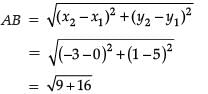
Here, A → (0 , 5) and B → (- 3 , 1)
= 5 units
∴ Assertion is correct.
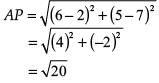
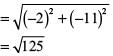
In case of reason: If A (2, 7) lies on perpendicular bisector of P (6, 5) and Q (0, -4), then
AP = AQ
∴ By using Distance Formula,
As, AP ≠ AQ
Therefore, A does not lie on the perpendicular bisector of PQ.
∴ Reason is incorrect.
Hence, assertion is correct but reason is incorrect.
Report a problem
Q2:
MULTIPLE CHOICE QUESTION
Try yourself: Directions: In the following questions, a statement of Assertion (A) is followed by a statement of Reason (R). Mark the correct choice as.
Assertion: The area of the triangle with vertices (-5, -1), (3, -5), and (5, 2) is 32 square units.
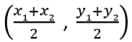
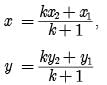
Reason: The point (x, y) divides the line segment joining the points (x1, y1) and (x2, y2) in the ratio k : 1 externally, then
A
Both A and R are true and R is the correct explanation of A
B
Both A and R are true but R is NOT the correct explanation of A
C
A is true but R is false
D
A is false and R is True
Correct Answer: C
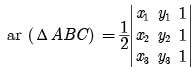
Using the formula for area of triangle using coordinates,
and section formula (externally), we have
Report a problem
Q3:
MULTIPLE CHOICE QUESTION
Try yourself: Directions: In the following questions, A statement of Assertion (A) is followed by a statement of Reason (R). Mark the correct choice as.
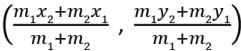
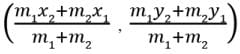
Assertion : The co-ordinates of the point which divides the join of A(-5, 11) and B(4,-7) in the ratio 7 : 2 is (2, -3) Reason : The coordinates of the point P(x, y) which divides the line segment joining the points A(x1, y1) and B(x2, y2) in the ratio m1 : m2 is
A
Both A and R are true and R is the correct explanation of A
B
Both A and R are true but R is NOT the correct explanation of A
C
A is true but R is false
D
A is false and R is True
Correct Answer: A
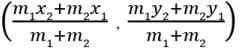
We know that the coordinates of the point P(x, y) which divides the line segment joining the points A(x1, y1) and B(x2, y2) in the ratio m1 : m2 is
Try yourself: Directions: In the following questions, A statement of Assertion (A) is followed by a statement of Reason (R). Mark the correct choice as.
Assertion (A): △ABC with vertices A(-2, 0), B(2, 0) and C(0, 2) is similar to △DEF with vertices D(-4, 0), E(4, 0) and F(0, 4).
Reason (R): A circle has its centre at the origin and a point P(5, 0) lies on it. The point Q(6, 8) lies outside the circle.
A
Both A and R are true and R is the correct explanation of A
B
Both A and R are true but R is NOT the correct explanation of A
C
A is true but R is false
D
A is false and R is True
Correct Answer: B
In case of assertion: By using Distance Formula,
∴ Distance between A (-2, 0) and B (2, 0),
[∵ distance between the points (x1, y1) and (x2, y2)
Similarly, distance between B (2, 0) and C (0, 2),
In △ABC, distance between C (0, 2) and A (-2, 0),
Distance between F (0, 4) and D (-4, 0),
Distance between F (0, 4) and E (4, 0),
and distance between E (4, 0) and D (-4, 0),
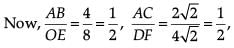
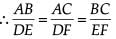
Here, we see that sides of DABC and DFDE are proportional.
Therefore, by SSS similarity rule, both the triangles are similar.
∴ Assertion is correct.
In case of reason: Point Q (6, 8) will lie outside the circle if its distance from the centre of circle is greater than the radius of the circle.
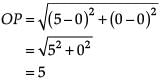
Distance between centre O (0, 0) and P (5, 0),
As, point P lies at the circle, therefore, OP = Radius of circle.
Distance between centre O (0, 0) and Q (6, 8),
As OQ > OP, therefore, point Q (6, 8) lies outside of the circle.
∴ Reason is correct.
Hence, both assertion and reason are correct but reason is not the correct explanation for assertion.
Report a problem
Q5:
MULTIPLE CHOICE QUESTION
Try yourself: Directions: In the following questions, A statement of Assertion (A) is followed by a statement of Reason (R). Mark the correct choice as.
Assertion : The points (k, 2 -2k), (- k+ 1,2k) and (- 4 - k, 6 - 2k) are collinear if k = 1/2. Reason : Three points A,B and C are collinear in same straight line, if AB + BC = AC.
A
Both A and R are true and R is the correct explanation of A
B
Both A and R are true but R is NOT the correct explanation of A
C
A is true but R is false
D
A is false and R is True
Correct Answer: A
Consider the given points.
(-k + 1, 2k), (k, 2 - 2k),(-4 -k, 6 - 2k)
Since, these points are collinear. Therefore the area of triangle formed by the triangle formed by the points will be zero.
Try yourself: Directions: In the following questions, A statement of Assertion (A) is followed by a statement of Reason (R). Mark the correct choice as.
Assertion : If the points A(4, 3) and B(x, 5) lies on a circle with the centre O(2,3) then the value of x is 2.
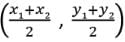
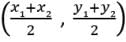
Reason : The mid-point of the line segment joining the points P(x1, y1) and Q(x2, y2) is
A
Both A and R are true and R is the correct explanation of A
B
Both A and R are true but R is NOT the correct explanation of A
C
A is true but R is false
D
A is false and R is True
Correct Answer: B
We know that the mid-point of the line segment joining the points P(x1, y1) and Q(x2, y2) is
So, Reason is correct.
Given, the points A (4,3) and B (x, 5) lie on a circle with center O(2,3).
Try yourself: Directions: In the following questions, A statement of Assertion (A) is followed by a statement of Reason (R). Mark the correct choice as.
Assertion (A): If the distance between the point (4, p) and (1, 0) is 5, then the value of p is 4.
Reason (R): The point which divides the line segment joining the points (7, - 6) and (3, 4) in ratio 1 : 2 internally lies in the fourth quadrant.
A
Both A and R are true and R is the correct explanation of A
B
Both A and R are true but R is NOT the correct explanation of A
C
A is true but R is false
D
A is false and R is True
Correct Answer: D
In case of assertion: Distance between two points (x1, y1) and (x2, y2) is given as,
where, (x1, y1) = (4, p)
(x2, y2) = (1, 0)
And, d = 5
Put the values, we have
52 = (1 - 4)2 + (0 - p)2
25 = (-3)2 + (-p)2
25 - 9 = p2
16 = p2
+4, -4 = p
∴ Assertion is incorrect.
In case of reason:
Let (x, y) be the point
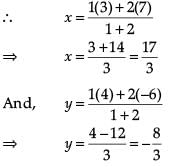
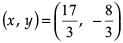
Here, x1 = 7, y1 = -6, x2 = 3, y2 = 4, m = 1 and n = 2
So, the required point lies in IVth quadrant.
∴ Reason is correct.
Hence, assertion is incorrect but reason is correct.
Report a problem
Q8:
MULTIPLE CHOICE QUESTION
Try yourself: Directions: In the following questions, A statement of Assertion (A) is followed by a statement of Reason (R). Mark the correct choice as.
Assertion : Centroid of a triangle formed by the points (a, b) (b, c), and (c, a) is at origin, Then a + b + c = 0 .
Reason : Centroid of a △ABC with vertices A (x1, y1), B(x2, y2) and C (x3, y3) is given by
A
Both A and R are true and R is the correct explanation of A
B
Both A and R are true but R is NOT the correct explanation of A
C
A is true but R is false
D
A is false and R is True
Correct Answer: A
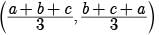
Centroid of a triangle with vertices (a, b) (b, c), and (c, a) is
a + b + c = 0
Report a problem
Q9:
MULTIPLE CHOICE QUESTION
Try yourself: Directions: In the following questions, A statement of Assertion (A) is followed by a statement of Reason (R). Mark the correct choice as.
Assertion : The possible values of x for which the distance between the points A(x, -1) and B(5, 3) is 5 units are 2 and 8.
Reason : Distance between two given points A(x1, y1) and B(x2, y2) is given by,
A
Both A and R are true and R is the correct explanation of A
B
Both A and R are true but R is NOT the correct explanation of A
C
A is true but R is false
D
A is false and R is True
Correct Answer: A
We know that the Distance between two given points A(x1, y1) and B(x2, y2) is given by,
So, Reason is correct.
Now, AB = 5 ⇒ AB2 = 25
⇒ (x - 5)2 + (-1 - 3)2 = 25
⇒ (x - 5)2 = 25 - 16 = 9
⇒ x - 5 = ±3
⇒ x = 5 ± 3
⇒ x = 2, 8
So, Assertion is also correct
Report a problem
Q10:
MULTIPLE CHOICE QUESTION
Try yourself: Directions: In the following questions, A statement of Assertion (A) is followed by a statement of Reason (R). Mark the correct choice as.
Assertion : Mid-point of a line segment divides line in the ratio 1 : 1.
Reason : If area of triangle is zero that means points are collinear.
A
Both A and R are true and R is the correct explanation of A
B
Both A and R are true but R is NOT the correct explanation of A
C
A is true but R is false
D
A is false and R is True
Correct Answer: B
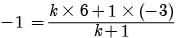
Let us assume that point B divides the line AC in the ratio k : 1
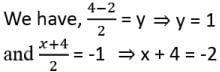
Let(x1, y1, z1) = (0, 0, 0)
(x, y ,z) = (2, -3, 3)
(x2, y2, z2) = (-2, 3, -3)
By section formula:
x = m1 + m2 m1 x 2 + m2 x 1
⇒ 2 = k + 1 k.(-2) + 1.(0)
⇒ k = 4 - 1 on neglecting the negative sign
we get, therefore ratio is 1:4.
Report a problem
Q11:
MULTIPLE CHOICE QUESTION
Try yourself: Directions: In the following questions, A statement of Assertion (A) is followed by a statement of Reason (R). Mark the correct choice as.
Assertion : The point (-1, 6) divides the line segment joining the points (-3, 10) and (6, -8) in the ratio 2 : 7 internally.
Reason : Three points A,B and C are collinear if AB + BC = AC
A
Both A and R are true and R is the correct explanation of A
B
Both A and R are true but R is NOT the correct explanation of A
C
A is true but R is false
D
A is false and R is True
Correct Answer: B
We know that the three points A,B and C are collinear if AB + BC = AC
So, Reason is correct.
Let the ratio is k : 1. Here, x1 = -3, y1 = 10, x2 = 6, y2 = -8, x = -1, y = 6
Now, y-coordinate
⇒ -8k + 10 = 6k + 6
⇒ 10 - 6 = 6k + 8k
⇒ 14k = 4
⇒ k = 4/14 = 2/7
So, Assertion is correct
But reason (R) is not the correct explanation of assertion (A).
Report a problem
Q12:
MULTIPLE CHOICE QUESTION
Try yourself: Directions: In the following questions, A statement of Assertion (A) is followed by a statement of Reason (R). Mark the correct choice as.
Assertion : The point (-1, 6) divides the line segment joining the points (-3, 10) and (6, -8) in the ratio 2 :7 internally.
Reason : Three points A,B and C are collinear if area of △ ABC = 0 .
A
Both A and R are true and R is the correct explanation of A
B
Both A and R are true but R is NOT the correct explanation of A
C
A is true but R is false
D
A is false and R is True
Correct Answer: B
Using section formula, we have
- k- 1 = 6k -3
7k = 2
k = 2/7
Ratio be 2 :7 internally.
Also, if ar(△ ABC) = 0
A,B and C all these points are collinear.
Report a problem
Q13:
MULTIPLE CHOICE QUESTION
Try yourself: Directions: In the following questions, A statement of Assertion (A) is followed by a statement of Reason (R). Mark the correct choice as.
Assertion : The value of y is 6, for which the distance between the points P(2,- 3) and Q(10, y) is 10.
Reason : Distance between two given points A(x1, y1) and B(x2, y2) is given by,
A
Both A and R are true and R is the correct explanation of A
B
Both A and R are true but R is NOT the correct explanation of A
C
A is true but R is false
D
A is false and R is True
Correct Answer: D
We know that the Distance between two given points A(x1, y1) and B(x2, y2) is given by,
So, Reason is correct.
Now, PQ = 10 ⇒ PQ2 = 100
⇒ (10 - 2)2 + (y + 3)2 = 100
⇒ (y + 3)2 = 100 - 64 = 36
⇒ y + 3 = ±6
⇒ y = -3 ± 6 ⇒ y = 3, -9
So, Assertion is not correct
Report a problem
Q14:
MULTIPLE CHOICE QUESTION
Try yourself: Directions: In the following questions, A statement of Assertion (A) is followed by a statement of Reason (R). Mark the correct choice as.
Assertion : If A (2a, 4a) and B (2a, 6a) are two vertices of a equilateral triangle ABC then the vertex C is given by (2a + a√3, 5a).
Reason : In equilateral triangle all the coordinates of three vertices can be rational.
A
Both A and R are true and R is the correct explanation of A
B
Both A and R are true but R is NOT the correct explanation of A
C
A is true but R is false
D
A is false and R is True
Correct Answer: C
LHS = rational
RHS = irrational
Hence, (x1, y1) (x2, y2) and (x3, y3) cannot be all rational.
Report a problem
Q15:
MULTIPLE CHOICE QUESTION
Try yourself: Directions: In the following questions, A statement of Assertion (A) is followed by a statement of Reason (R). Mark the correct choice as.
Assertion : The point (0, 4) lies on y -axis.
Reason : The x co-ordinate on the point on y -axis is zero.
A
Both A and R are true and R is the correct explanation of A
B
Both A and R are true but R is NOT the correct explanation of A
C
A is true but R is false
D
A is false and R is True
Correct Answer: A
We know that the if the point lies on y-axis, its x-coordinate is 0.
So, Reason is correct.
The x co-ordinate of the point (0, 4) is zero.
So, Point (0, 4) lies on y -axis.
So, Assertion is also correct
Report a problem
Q16:
MULTIPLE CHOICE QUESTION
Try yourself: Directions: In the following questions, A statement of Assertion (A) is followed by a statement of Reason (R). Mark the correct choice as.
Assertion : The value of y is 6, for which the distance between the points P(2, -3) and Q(10, y) is 10.
Reason : Distance between two given points A (x1, y1) and B(x2, y2) is given 6,
A
Both A and R are true and R is the correct explanation of A
B
Both A and R are true but R is NOT the correct explanation of A
C
A is true but R is false
D
A is false and R is True
Correct Answer: D
PQ = 10
PQ2 = 100
(10 - 2)2 + (y + 3)2 = 100
(y + 3)2 = 100 - 64 = 36
y + 3 = + 6
y = - 3 + 6
y = 3, -9
Report a problem
Q17:
MULTIPLE CHOICE QUESTION
Try yourself: Directions: In the following questions, A statement of Assertion (A) is followed by a statement of Reason (R). Mark the correct choice as.
Assertion : C is the mid-point of PQ, if P is (4, x), C is (y,- 1) and Q is (- 2, 4), then x and y respectively are -6 and 1.
Reason : The mid-point of the line segment joining the points P(x1, y1) and Q(x2, y2) is
A
Both A and R are true and R is the correct explanation of A
B
Both A and R are true but R is NOT the correct explanation of A
C
A is true but R is false
D
A is false and R is True
Correct Answer: A
We know that the mid-point of the line segment joining the points P(x1, y1) and Q(x2, y2) is
So, Reason is correct.
Since, C(y,- 1) is the mid-point of P(4, x) and Q(- 2, 4).
⇒ x = -6
So, Assertion is correct
Report a problem
Q18:
MULTIPLE CHOICE QUESTION
Try yourself: Directions: In the following questions, A statement of Assertion (A) is followed by a statement of Reason (R). Mark the correct choice as.
Assertion : The point (0, 4) lies on y -axis.
Reason : The x co-ordinate on the point on y -axis is zero.
A
Both A and R are true and R is the correct explanation of A
B
Both A and R are true but R is NOT the correct explanation of A
C
A is true but R is false
D
A is false and R is True
Correct Answer: A
The x co-ordinate of the point (0, 4) is zero.
Point (0, 4) lies on y -axis.
Report a problem
Q19:
MULTIPLE CHOICE QUESTION
Try yourself: Directions: In the following questions, A statement of Assertion (A) is followed by a statement of Reason (R). Mark the correct choice as.
Assertion : Ratio in which the line 3x + 4y = 7 divides the line segment joining the points (1, 2) and (- 2, 1) is 3 : 5Reason : The coordinates of the point P(x, y) which divides the line segment joining the points A(x1, y1) and B(x2, y2) in the ratio m1 : m2is
A
Both A and R are true and R is the correct explanation of A
B
Both A and R are true but R is NOT the correct explanation of A
C
A is true but R is false
D
A is false and R is True
Correct Answer: D
We know that the coordinates of the point P(x, y) which divides the line segment joining the points A(x1, y1) and B(x2, y2) in the ratio m1 : m2 is
Try yourself: Directions: In the following questions, A statement of Assertion (A) is followed by a statement of Reason (R). Mark the correct choice as.
Assertion: The point which divides the line joining the points A(1, 2) and B(- 1, 1) internally in the ratio 1: 2 is
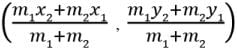
Reason : The coordinates of the point P(x, y) which divides the line segment joining the points A(x1, y1) and B(x2, y2) in the ratio m1 : m2 is
A
Both A and R are true and R is the correct explanation of A
B
Both A and R are true but R is NOT the correct explanation of A
C
A is true but R is false
D
A is false and R is True
Correct Answer: A
We know that the coordinates of the point P(x, y) which divides the line segment joining the points A(x1, y1) and B(x2, y2) in the ratio m1 : m2 is
pdf , Free, Extra Questions, shortcuts and tricks, Assertion & Reason Type Questions: Coordinate Geometry, practice quizzes, mock tests for examination, Semester Notes, MCQs, Objective type Questions, ppt, Exam, Viva Questions, Assertion & Reason Type Questions: Coordinate Geometry, past year papers, Important questions, Sample Paper, Assertion & Reason Type Questions: Coordinate Geometry, video lectures, study material, Previous Year Questions with Solutions, Summary;






















 lies in IVth quadrant.