Introduction to Determinants


Having studied matrices, we now introduce determinants, a fundamental concept in linear algebra. Determinants assign to every square matrix a single number that encodes important information about the matrix and the linear transformation it represents. Determinants are used to determine whether a matrix is invertible, to compute areas and volumes under linear maps, to solve systems of linear equations using Cramer's rule, and to study eigenvalues and change of variables in multiple integrals.
Intuitively, the determinant is a numerical signature of a square matrix that captures how the matrix scales oriented volume in the underlying vector space. A determinant of zero indicates that the matrix collapses the space into a lower dimension and so is singular (non-invertible).

How do we write a Determinant?
Let A = [aij] be a square matrix of order n with entries from a field K (for our purposes, K is usually the real numbers ℝ or complex numbers ℂ). The determinant of A is a scalar associated with A and is denoted by |A|, det A, or Δ. The determinant defines a function
f : Mn(K) → K, where f(A) = det A.
Only square matrices have determinants.
Determinant of a 1 × 1 matrix
If A = [a] is a 1 × 1 matrix, then det A = a.
Determinant of a 2 × 2 matrix
For A = [ [a b] [c d] ] (a 2 × 2 matrix), the determinant is given by


det A = ad - bc.
Note
- |A| is read as the determinant of A, not the modulus of A.
- Only square matrices have determinants.
Solved Example:
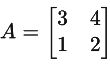
Calculate the determinant of the matrix A = [ [3 4] [1 2] ].
The determinant of A is det A = ad - bc.
det A = 3 × 2 - 4 × 1
det A = 6 - 4
det A = 2
So, the determinant |A| is 2.
Determinant of a 3 × 3 matrix
Let A = [aij] be a 3 × 3 matrix. The determinant can be computed by expansion (Laplace expansion) along any row or any column. Define the minor Mij as the determinant of the (n-1) × (n-1) matrix obtained by deleting the i-th row and j-th column. The cofactor Cij is given by Cij = (-1)i+j Mij. The determinant equals the sum of entries of any row (or column) multiplied by their corresponding cofactors.
For a 3 × 3 matrix A:
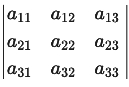
Expansion along the first row gives
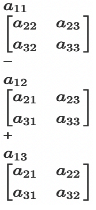
Example: For the given 3 × 3 matrix below, calculate its determinant by expansion along the first row.
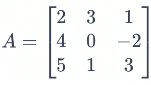

Compute the cofactors and evaluate the determinant.
det A = 2 × det [ [0 -2] [1 3] ] - 3 × det [ [4 -2] [5 3] ] + 1 × det [ [4 0] [5 1] ]
det A = 2 × (0 × 3 - (-2) × 1)
det A = 2 × (0 + 2)
det A = 4
det A = det A - 3 × (4 × 3 - (-2) × 5)
det A = 4 - 3 × (12 + 10)
det A = 4 - 3 × 22
det A = 4 - 66
det A = -62
det A = det A + 1 × (4 × 1 - 0 × 5)
det A = -62 + 4
det A = -58
Thus, |A| = -58.
Any row or column may be used for expansion; choose the one with the most zeros to simplify calculations.
Minors, Cofactors and Laplace Expansion
- Minor Mij: determinant of the matrix left after removing row i and column j.
- Cofactor Cij = (-1)i+j Mij.
- Laplace expansion: det A = Σj=1n aij Cij (expansion along the i-th row), or det A = Σi=1n aij Cij (expansion along the j-th column).
Important Properties of Determinants
- Determinant of the identity matrix: det In = 1.
- Effect of row operations: Swapping two rows multiplies the determinant by -1.
- Row scaling: Multiplying a row by scalar k multiplies the determinant by k.
- Row addition: Adding to a row a scalar multiple of another row leaves the determinant unchanged.
- Triangular matrices: For an upper or lower triangular matrix, the determinant equals the product of diagonal entries.
- Multiplicative property: det(AB) = det(A) det(B) for square matrices A and B of the same order.
- Transpose: det(AT) = det(A).
- Scalar multiple of matrix: det(kA) = kn det(A) for A of order n.
- Invertibility: A is invertible ⇔ det(A) ≠ 0. If A is invertible, det(A-1) = 1 / det(A).
- Zero determinant: det(A) = 0 ⇔ the rows (or columns) of A are linearly dependent.
- Determinant by row reduction: Use elementary row operations to convert to triangular form while tracking changes to the determinant, then multiply diagonal entries.
- Adjoint and inverse: If A is invertible, A-1 = (1 / det A) adj(A), where adj(A) is the transpose of the cofactor matrix.
Geometric Interpretation
For a 2 × 2 matrix representing a linear map in the plane, the absolute value of the determinant equals the area-scaling factor; the sign indicates whether orientation is preserved (positive) or reversed (negative). For an n × n matrix, the absolute value of the determinant gives the factor by which n-dimensional volumes are scaled.
Area of a Triangle using Determinants
The area of a triangle with vertices (x1, y1), (x2, y2), (x3, y3) in the plane is
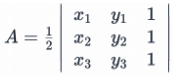
A = 1/2 × |det [ [x1 y1 1] [x2 y2 1] [x3 y3 1] ]|.
Example: Find the area of the triangle with vertices (1, 2), (3, 4) and (5, 1).
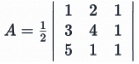
Form the 3 × 3 matrix of coordinates with a column of ones and compute its determinant.
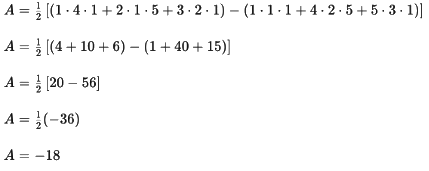
Compute the determinant value:
det = 1 × (4 × 1 - 4 × 1) - 2 × (3 × 1 - 5 × 1) + 1 × (3 × 1 - 5 × 4)
det = 1 × (4 - 4) - 2 × (3 - 5) + 1 × (3 - 20)
det = 0 - 2 × (-2) + (-17)
det = 0 + 4 - 17
det = -13
Area A = 1/2 × |det|
Area A = 1/2 × 13
Area A = 6.5 square units
Note: The earlier illustrative calculation in some texts may give 18 for a different set of points; always compute the determinant for the specific vertices given and take absolute value.
Computation Tips and Strategies
- Use expansion along a row or column with the most zeros to minimise work.
- Apply row operations to create zeros before expansion; remember to account for determinant changes when rows are swapped or scaled.
- For large matrices, convert to triangular form (Gaussian elimination) and multiply diagonal entries, keeping track of any row swaps or scalar multiplications performed.
- Use properties such as det(AB) = det(A)det(B) and det(AT) = det(A) to simplify calculations when possible.
Determinants are a compact and powerful tool in linear algebra. Mastery of their computation and properties is essential for solving systems of equations, understanding linear transformations, and tackling many problems in geometry and calculus.




