Introduction to Complex Number

What is a Complex Number?
- Complex Numbers are the numbers which along with the real part also have the imaginary part included with it.
- It is defined as the combination of real part and imaginary part. Either of the parts can be zero.
- If 'a' is the real part and 'b' represents the imaginary part, then the complex number is represented as
- z = a + ib where i, stands for iota which itself is a square root of negative unity.
- Examples
| Complex Number | Real Part | Imaginary Part |
| 3 + 5i | 3 | -5 |
| 5 | 5 | 0 |
| -2i | 0 | -2 |
Thus, we can also write z = Re(z) + i Im(z). This form of representation is also called as the Cartesian or algebraic form of representation.
If z = -2 + j4, then Re(z) = -2 and Im(z) = 4.
Similarly, for z = 3+j5, Re(z) = 3 and Im(z) = (5).
Representation of Complex Number
Complex Numbers have many ways in which it can be expressed. Some of the most commonly used forms are:- Cartesian , algebraic or rectangular form
- Trigonometric or polar form
- Exponential form
- Vector form
Can we take the square root of a negative number?
- Yes of course, but to understand this question, let's go into more deep of complex numbers,
- Consider the equation x2+1 = 0,
If we try to get its solution, we would stuck at x = √(-1) so in Complex Number we assume that √(-1) =i or i2 =-1 which means i can be assumed as the solution of this equation. i is called an iota in Complex Numbers. - We can further formulate as,
i2 = -1
i3 = i2 x i = -i
i4 =i2 x i2 =1 - So, we can say now, i4n = 1 where n is any positive integer.
Also, note that i + i2 + i3 + i4 = 0 or in + i2n + i3n + i4n= 0
This means the sum of the consecutive four powers of iota leads the result to zero.
Try yourself: Which of the following is the correct representation of a complex number in Cartesian form?
What is the form a + ib?
- We know from the above discussion that, Complex Numbers can be represented in four different ways. Out of which, algebraic or rectangular form is one of the forms.
- Z = a + ib is the algebraic form in which 'a' represents the real part and 'b' represents the imaginary part. Two mutually perpendicular axes locate any complex point on the plane. The horizontal axis represents the real part while the vertical axis represents the imaginary part.
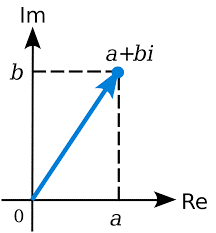
How do we locate any Complex Number on the plane?
Let us take a few examples to understand, how can we locate any point on the complex or argand plane.
Example 1:
Consider a complex number z = 6 +j4 ('i' and 'j', both can be used for representing imaginary part), if we compare this number with z = a + jb form. Then we can easily equate the two and get a = 6 and b = 4. Since both a and b are positive, which means the number will be lying in the first quadrant. 'z' will be 6 units on the right and 4 units upwards from the origin. You can see the same point in the figure below.
Example 2:
Now consider a point in the second quadrant that is. z = -7 + j6, Here since a= -7 and b = 6 and thus will be lying in the second quadrant.
Point z is 7 units in the left and 6 units upwards from the origin. Refer the figure to understand it pictorially.
Example 3:
Now let's consider a point in the third quadrant as z = -2 - j3. Since in third quadrant both a and b are negative and thus a = -2 and b = -3 in our example. This point will be lying 2 units in the left and 3 units downwards from the origin.
Example 4:
Let now take the fourth (of the fourth quadrant) and the last case where z = 5 - j6. Here, a = 5 and b = - 6 i.e. a positive and b negative. This point will be lying 5 units in the right and 6 units downwards.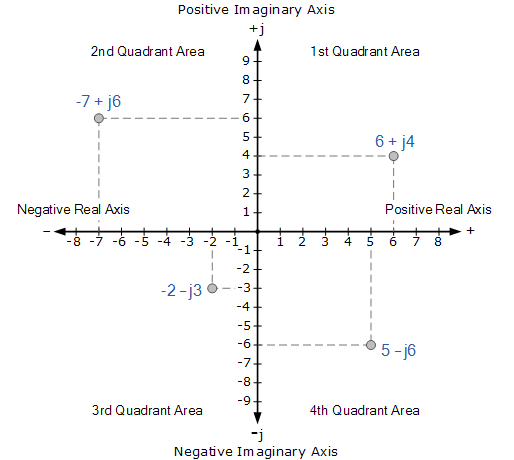
Are all Real Numbers Complex Numbers?
- A complex number has two parts, the real part and the imaginary part that is. z = a + ib
- if b = 0, z = a which is called the Purely Real Number
and if a = 0, z = ib which is called the Purely Imaginary Number. - Thus we can say that all real numbers are also complex numbers with imaginary part zero.
Complex Equations
Any equation involving complex numbers in it are called as the complex equation.For example: x = (2+3i) (3+4i), In this example, x is a multiple of two complex numbers. On multiplying these two complex number we can get the value of x.
z2 + 2z + 3 = 0 is also an example of complex equation whose solution can be any complex number.
Solved Examples
Illustration 1: Let a and b be roots of the equation x2 + x + 1 = 0. Then find the equation whose roots are a = 19 and b = 7.
Sol: Given that x² + x + 1 = 0, its roots are the non-real cube roots of unity, namely ω and ω². This means that a = ω and b = ω².
Since ω³ = 1, we can reduce the exponents modulo 3.
For a19: 19 mod 3 = 1, so a¹⁹ = ω¹⁹ = ω¹⁸ · ω = (ω³)⁶ · ω = 1⁶ · ω = ω.
For b7: 7 mod 3 = 1, so b⁷ = (ω²)⁷ = ω¹⁴ = ω¹² · ω² = (ω³)⁴ · ω² = 1⁴ · ω² = ω².
Thus, the new roots are ω and ω², just as in the original equation.
Now, the quadratic equation with roots ω and ω² is formed by: x² - (ω + ω²)x + (ω · ω²) = 0.
It is known that 1 + ω + ω² = 0, which means ω + ω² = -1. Also, ω · ω² = ω³ = 1.
Substitute these into the equation: x² - (-1)x + 1 = x² + x + 1 = 0.
Therefore, the required equation is x² + x + 1 = 0.
Illustration 2: Dividing f(z) by z - i, we obtain the remainder i and dividing it by z + i, we get remainder 1 + i. Find the remainder upon the division of f(z) by z2 + 1.
Sol: Since z² + 1 is a quadratic polynomial, the remainder when f(z) is divided by (z² + 1) will be a linear polynomial. Let this remainder be a·z + b.
Then we can write: f(z) = g(z) · (z² + 1) + a·z + bSubstituting z = i: f(i) = g(i) · (i² + 1) + a·i + b Since i² + 1 = -1 + 1 = 0, we have:
f(i) = a·i + b But f(i) = i, so a·i + b = i (1)
Similarly, substituting z = -i: f(-i) = g(-i) · ((-i)² + 1) + a·(-i) + b Again, (-i)² + 1 = -1 + 1 = 0, so: f(-i) = -a·i + b And we are given f(-i) = 1 + i, hence: -a·i + b = 1 + i (2)
Now, we have two equations: (1) a·i + b = i (2) -a·i + b = 1 + i
Subtract equation (2) from equation (1): (a·i + b) - (-a·i + b) = i - (1 + i) 2a·i = -1 a = -1/(2i) Recall that 1/i = -i, so: a = (i)/2
Next, substitute a = i/2 into equation (1): (i/2)·i + b = i
i²/2 + b = i Since i² = -1, this becomes:
(-1)/2 + b = i b = i + 1/2
Thus, the required remainder is:
a·z + b = (i/2)·z + (1/2 + i).
Illustration 3: Find all complex numbers z for which arg [(3z-6-3i)/(2z-8-6i)] = π/4 and |z-3+4i| = 3.
Solution: arg[(3z - 6 - 3i)/(2z - 8 - 6i)] = π/4
and write z = x + it.
Step 1. Rewrite the numerator and denominator in a convenient form. Notice that
3z - 6 - 3i = 3(x + iy) - 6 - 3i = 3(x - 2) + i·3(y - 1)
2z - 8 - 6i = 2(x + iy) - 8 - 6i = 2(x - 4) + i·2(y - 3)
Thus the quotient becomes
(3/2)·[(x - 2) + i(y - 1)]/[(x - 4) + i(y - 3)]
Since (3/2) is a positive real number, its argument is 0. Therefore the given condition reduces to
arg[(x - 2) + i(y - 1)] - arg[(x - 4) + i(y - 3)] = π/4
When a complex number has an argument equal to π/4 its imaginary part equals its real part. Thus if we write the quotient in standard form as A + iB, we must have A = B. Carrying out the division (by multiplying numerator and denominator by the complex conjugate of the denominator) leads to
A = ( (x - 2)(x - 4) + (y - 1)(y - 3) )/( (x - 4)² + (y - 3)² )
B = ( (y - 1)(x - 4) - (x - 2)(y - 3) )/( (x - 4)² + (y - 3)² )
Setting A = B and multiplying through by the common denominator gives
(x - 2)(x - 4) + (y - 1)(y - 3) = (y - 1)(x - 4) - (x - 2)(y - 3)
Expanding both sides and simplifying yields
x² + y² - 8x - 2y + 13 = 0 (1)
Step 2. The second condition is
|z - 3 + i| = 3
Since z = x + iy this becomes
| (x - 3) + i(y + 1) | = 3
which leads to the circle
(x - 3)² + (y + 1)² = 9 (2)
Expanding (2) we get
x² + y² - 6x + 2y + 1 = 0
Step 3. Subtract equation (2) from equation (1):
[ x² + y² - 8x - 2y + 13 ] - [ x² + y² - 6x + 2y + 1 ] = 0
Simplify term‐by‐term:
(-8x + 6x) + (-2y - 2y) + (13 - 1) = 0
which gives
-2x - 4y + 12 = 0
Divide both sides by -2:
x + 2y - 6 = 0
Thus
x = 6 - 2y (3)
Step 4. Substitute (3) into equation (2). Replace x by (6 - 2y) in
(6 - 2y - 3)² + (y + 1)² = 9
That is,
(3 - 2y)² + (y + 1)² = 9
Expanding:
(9 - 12y + 4y²) + (y² + 2y + 1) = 9
Combine like terms:
5y² - 10y + 10 = 9
Subtract 9 from both sides:
5y² - 10y + 1 = 0
Solve this quadratic in y using the quadratic formula:
y = [10 ± √(100 - 20)]/(2·5) = [10 ± √80]/10 = [10 ± 4√5]/10
Simplify:
y = 1 ± (2/√5)Step 5. Now, substitute these y-values back into (3) to find x:
x = 6 - 2y = 6 - 2[1 ± (2/√5)] = 6 - 2 ∓ (4/√5) = 4 ∓ (4/√5)
Thus the solutions for z are:
z = x + iy = [4 ∓ (4/√5)] + i[1 ± (2/√5)]
In summary, the complex numbers z that satisfy the given conditions arez = 4 ∓ 4/√5 + i(1 ± 2/√5)
FAQs on Introduction to Complex Number
| 1. What exactly is a complex number and why do we need it in JEE Maths? |  |
| 2. How do you add, subtract, and multiply complex numbers in the correct way? | |
| 3. What's the difference between the real part, imaginary part, and modulus of a complex number? | |
| 4. Can a complex number ever be purely real or purely imaginary, and does it matter for JEE? | |
| 5. How do conjugate complex numbers work and why are they important for solving equations? | |





