Magnetic Lines & Their Characteristics

What is a Magnetic Field?

The magnetic field is the region around a magnet (or a magnetic material or a current-carrying conductor) where magnetic forces can be detected.
It is a vector quantity, symbolized by B.
Magnetic fields are detected using magnetic needles or iron filings.
Visualizing the Magnetic Field Lines
Michael Faraday introduced the concept of magnetic field lines to represent magnetic fields graphically.
A magnetic field line is an imaginary line such that the tangent at any point gives the direction of the magnetic field at that point.
These lines help visualize the strength and direction of the magnetic field.
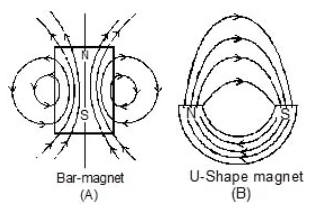
Key Characteristics of Magnetic Field Lines
(i) Outside a magnet, the lines go from the north to the south pole, while inside, they go from south to north. This means magnetic lines form closed curves.
(ii) The number of lines starting or ending on a pole reflects its strength. The total magnetic flux through a closed surface is always zero.
(iii) Magnetic lines of field cannot cross each other, as this would imply two directions at the same point, which is impossible.
(iv) Magnetic lines tend to pull together like a stretched elastic band (attracting opposite poles) and push apart (repelling similar poles).
(v) The greater the number of lines crossing a unit area, the stronger the magnetic field B. If the lines are straight and equally spaced, the field is uniform; if not, it is not.
(vi) The total magnetic flux through any closed surface is zero. Therefore, at a neutral point (where the overall field is zero), there cannot be any field lines.
(vii) Magnetic lines can enter or exit a magnetic material at any angle.
(viii) Magnetic lines exist within all magnetised materials.
(ix) Since monopoles do not exist, the total magnetic flux through a closed surface is always zero.
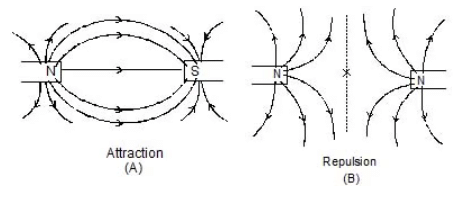
This principle is known as Gauss's law for magnetism.
Different Magnetic Field Lines
1. Straight Current-Carrying Wire
Right-hand thumb rule:
If the thumb points in the direction of current, the fingers curl in the direction of magnetic field lines.Field lines: Concentric circles around the wire.
Field strength:
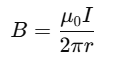 where I = current, r = radial distance from the wire.
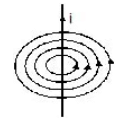
2. Circular Loop of Wire
Magnetic field lines form concentric circles around the wire.
At the center, field lines are straight and perpendicular to the plane of the loop.
The field at the center:
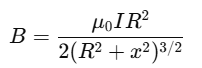
where R is the radius of the loop and x is the distance from the center along the axis.
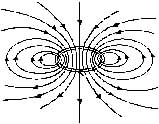
3. Solenoid
A solenoid is a coil of many circular loops of wire stacked together.
Magnetic field inside: Strong, uniform, and parallel lines
Magnetic field outside: Very weak
Resembles the field of a bar magnet.
Field inside a long solenoid:
B=μ0nIwhere n = number of turns per unit length, I = current

FAQs on Magnetic Lines & Their Characteristics
| 1. What are magnetic lines? |  |
| 2. What are the characteristics of magnetic lines? | |
| 3. How are magnetic lines formed? | |
| 4. What is the significance of magnetic lines? | |
| 5. Can magnetic lines be influenced by external factors? | |





