CBSE Class 2  >  Class 2 Notes  >  Mathematics (Joyful-Mathematics)  >  Worksheet Solutions: Shapes Around Us (3D Shapes)

Worksheet Solutions: Shapes Around Us (3D Shapes)

Worksheet Solutions: Shapes Around Us (3D Shapes)

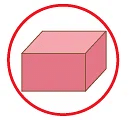
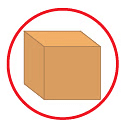
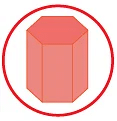
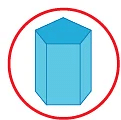
Q1: Circle the 3D shapes that stack.

(i) 
 Q1: Circle the 3D shapes that stack.
(ii) 
 Q1: Circle the 3D shapes that stack.
(iii) 
 Q1: Circle the 3D shapes that stack.
(iv) 
 Q1: Circle the 3D shapes that stack.
(v) 
 Q1: Circle the 3D shapes that stack.
(vi) 
 Q1: Circle the 3D shapes that stack.
Ans:
(i)
Q1: Circle the 3D shapes that stack.
(ii)
Q1: Circle the 3D shapes that stack.
(iii)
Q1: Circle the 3D shapes that stack.
(iv)
Q1: Circle the 3D shapes that stack.

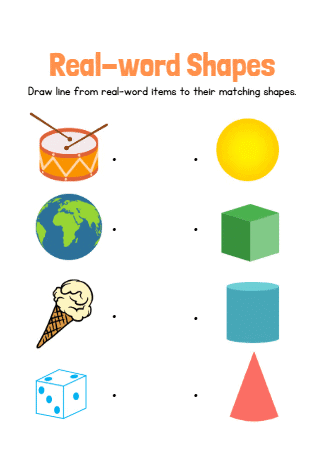
Q2: Match the following:

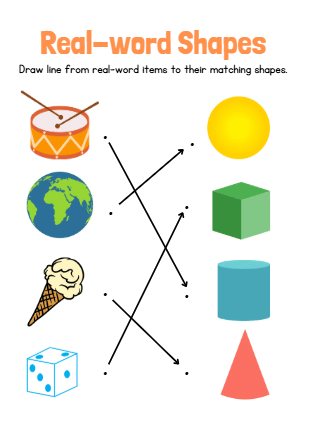
Q2: Match the following:Ans: Q2: Match the following:

Q3: Find out the 3D shapes that roll

(i) 
 Q3: Find out the 3D shapes that roll
(ii) 
Q3: Find out the 3D shapes that roll
(iii) 
 Q3: Find out the 3D shapes that roll
(iv) 
 Q3: Find out the 3D shapes that roll
(v) 
 Q3: Find out the 3D shapes that roll
(vi) 
 Q3: Find out the 3D shapes that roll
Ans:
(i)
 
Q3: Find out the 3D shapes that roll
(ii) 
Q3: Find out the 3D shapes that roll
(iii)  

Q3: Find out the 3D shapes that roll


Q4: Fill in the blanks:


Q4: Fill in the blanks:(i) The cube and the cuboid each has _________ plane surfaces, _________ edges, and _________ vertices.
(ii) 
The cuboid has _________ pairs of identical plane surfaces.
(iii) 
All the surfaces of a cube are _________ to each other.
(iv) 
All the edges of a cube are _________.
(v) 
Opposite edges of a cuboid are _________.
(vi) 
A _________ has no vertex, and no edge.
Ans:

(i) 6, 12, 8
(ii) 3
(iii) equal line
(iv) straight lines
(v) same in size
(vi) sphere

Q5: Write 'true' or 'false' for each statement as the case may be:
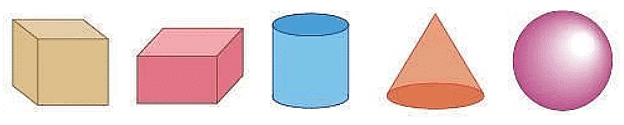

Q5: Write `true` or `false` for each statement as the case may be:(i) Every cuboid is a cube.
(ii) 
Every cube is a cuboid.
(iii) 
All faces of a cube are similar in shape and size.
(iv) 
All the faces of a cuboid are identical.
(v) 
The cube has 6 faces.
(vi) 
The base and bottom of a cylinder are identical.
(vii) 
A cone has no vertex.
(viii) 
A cylinder has two edges.
(ix) 
A sphere has no edge.
(x) 
A cone has two surfaces.
Ans:

(i) False

A cuboid has different lengths, widths, and heights. A cube has all sides equal.

Not every cuboid is a cube.

(ii) True

Explanation: A cube has all sides equal and every cube fits the shape of a cuboid (a box with flat faces), so every cube is a cuboid.

(iii) True

Explanation: All faces of a cube are squares of the same size and shape, so they are similar in shape and size.

(iv) False

A cuboid has 6 faces, but they are not always the same size.

Example: A brick is a cuboid. The front and back may be the same, but the top and sides can be different.

(v) True

Explanation: A cube has six faces.

(vi) True

Explanation: A cylinder has two circular ends (base and top) that are identical in size and shape.

(vii) False

A cone has one pointed end called a vertex.

Example: An ice cream cone has a sharp tip.

(viii) True

Explanation: A cylinder have two circular edges.

(ix) True

Explanation: A sphere is perfectly round and has no edges or vertices.

(x) True

Explanation: A cone has two surfaces: one curved surface and one flat circular base.

The document Worksheet Solutions: Shapes Around Us (3D Shapes) is a part of the Class 2 Course Mathematics for Class 2 (Joyful-Mathematics).
All you need of Class 2 at this link: Class 2

FAQs on Worksheet Solutions: Shapes Around Us (3D Shapes)

1. What are the common types of 3D shapes found in everyday life?
Ans.Common types of 3D shapes include cubes, spheres, cylinders, cones, and pyramids. These shapes can be seen in various objects around us, such as dice (cubes), balls (spheres), cans (cylinders), ice cream cones (cones), and pyramids in architecture.
2. How can I identify different 3D shapes in my environment?
Ans.To identify different 3D shapes in your environment, look for their specific characteristics: cubes have six equal square faces, spheres are perfectly round, cylinders have two circular bases connected by a curved surface, cones have a circular base tapering to a point, and pyramids have a polygonal base with triangular faces meeting at a vertex.
3. Why is it important to learn about 3D shapes?
Ans.Learning about 3D shapes is important as it helps develop spatial awareness, enhances problem-solving skills, and is essential in fields such as architecture, engineering, and design. Understanding these shapes also aids in visualizing and manipulating objects in real life.
4. How do I calculate the volume of a 3D shape?
Ans.The volume of a 3D shape can be calculated using specific formulas depending on the shape. For example, the volume of a cube is found using the formula V = side³, for a sphere it is V = (4/3)πr³, for a cylinder it is V = πr²h, for a cone it is V = (1/3)πr²h, and for a pyramid it is V = (1/3)Bh, where B is the area of the base.
5. Can you explain the difference between 2D and 3D shapes?
Ans.The main difference between 2D and 3D shapes is that 2D shapes have only length and width, such as squares and circles, while 3D shapes have depth in addition to length and width, giving them volume, such as cubes and spheres. This distinction is crucial for understanding geometry and its applications in the real world.
Explore Courses for Class 2 exam
Get EduRev Notes directly in your Google search
Related Searches
Sample Paper, Previous Year Questions with Solutions, Exam, study material, shortcuts and tricks, Summary, Semester Notes, Viva Questions, Worksheet Solutions: Shapes Around Us (3D Shapes), Free, ppt, Worksheet Solutions: Shapes Around Us (3D Shapes), mock tests for examination, Objective type Questions, past year papers, Worksheet Solutions: Shapes Around Us (3D Shapes), video lectures, MCQs, practice quizzes, Extra Questions, pdf , Important questions;