Motion under Gravity

2. Motion under gravity :
I format : (When a body is thrown vertically upward)
It includes two types of motion
(i) Deaccelerated motion from A to B because the direction of velocity and acceleration is opposite. So speed
decreases
(ii) Accelerated motion from B to C because the direction of velocity and acceleration is same (downward). So speed increases 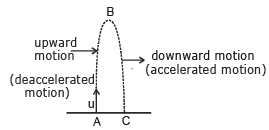
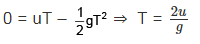
(a) Time of flight :
It is the time taken by the particle to reach the ground. If the particle is thrown vertically upward with initial velocity u then
ui = u
a = - g (take downward direction negative)
from equation
S = ut +  ⇒ Snet = 0 (when particle again reaches the ground)
t = T (time of flight)
(b) Maximum Height :
from v2 = u2 + 2as
at maximum height v = 0, s = Hmax
⇒ 0 = u2 -2 gHmax ⇒ 
(c) Final velocity
from v = u + at
v = vf a = - g 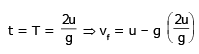
vf = - u
i.e. the body reaches the ground with the same speed with which it was thrown vertically upwards as it thrown vertically upward.
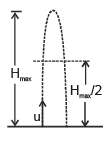
(d) Time to reach half of the maximum height :-
ui = u a = - g
from 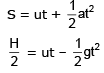
H = 2ut - gt2 ⇒ gt2 - 2ut + H = 0
⇒ 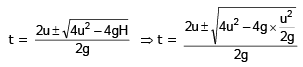

 (.....1)
Equation 1 gives two value of time which corresponds to
t1 =  (from ground to Hmax/2 in upward motion)
t2 =  (from ground to Hmax/2 in downward motion)
(e) Time to reach any general height h
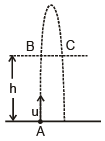
Let us assume that particle reaches from A to B in time t1 & from A to C is time t2.

gt2 - 2ut + 2h = 0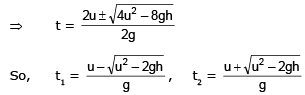
⇒ t1 + t2 = T (Time of flight)
II Format (Free fall) :
A body released near the surface of the earth is accelerated downward under the influence of force of gravity.
(a) Time of Flight :
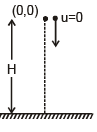

S = - H, u = 0, a = - g
t = T (Let assume)
⇒ - H = (0)T - 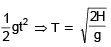
(b) Final Velocity when body reaches the ground
from v2 - u2 = 2as
s = - H v = vf u = 0 a = - g
⇒ - 0 = 2 (-g) (-H) ⇒ vf = 
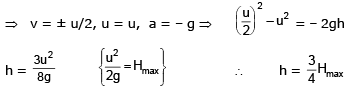
Ex.17 A ball is thrown vertically upwards with a velocity u from the ground. The ball attains a maximum height Hmax. Then find out the time and displacement at which ball have half of the maximum speed.
Sol. Maximum speed of the ball is u At point B and C ball have speed u/2 but direction 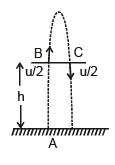
is opposite so from
v = u + at
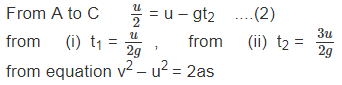
Let t1 is the time taken by the ball from point A to B and t2 is the time taken by the ball from A to C
Ex.18 A ball thrown vertically upwards with a speed of 19.6 ms-1 from the top of a tower returns to the earth in 6 s. Find the height of the tower.
Sol. Here u = 19.6 ms-1
g = -9.8 ms-2
Net displacement, s = - h
Negative sign is taken because displacement is in the opposite direction of initial velocity.
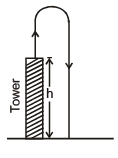

∴ - h = 19.6 × 6 + 1/2 × (-9.8) × 62
= 117.6 - 176.4 = -58.8
or h = 58.8 m
Ex.19 A ball is thrown vertically upwards with a velocity of 20 ms-1 from the top of a multi-storeyed building. The height of the point from where the ball is thrown is 25 m from the ground. (i) How high will the ball rise and (ii) how long will it be before the ball hits the ground?
Sol. (i) Here u = +20 ms-1, g = -10 ms-2
At the highest point, v = 0
Suppose the ball rises to the height h from the point of projection.
As v2 - u2 = 2gs
∴ 02 - 202 = 2 × (-10) × h or h = + 20 m.
(ii) Net displacement, s = -25 m
Negative sign is taken because displacement is in the opposite direction of initial velocity.
As s = ut +

or 5t2 - 20t - 25 = 0 or t2 - 4t - 5 = 0
or (t+ 1) (t - 5) = 0
As t ≠ -1, so t = 5s.
Ex.20 A ball thrown up is caught by the thrower after 4s. How high did it go and with what velocity was it thrown ? How far was it below the highest point 3 s after it was thrown?
Sol. As time of ascent = time of descent
∴ Time taken by the ball to reach the highest point = 2 s
For upward motion of the ball : u = ?, v = 0, t = 2s, g = - 9.8 ms-2
As v = u + gt
∴ 0 = u - 9.8 × 2
or u = 19.6 ms-1
Maximum height attained by the ball is given by 
Displacement of the ball in 3 s,
s = 19.6 × 3 +  × (-9.8) × 32 = 58.8 - 44.1 = 14.7 m
Distance of the ball from the highest point 3 s after it was thrown
= 19.6 - 14.7 = 4.9 m.
Ex.21 A balloon is ascending at the rate of 9.8 ms-1 at a height of 39.2 m above the ground when a food packet is dropped from the balloon. After how much time and with what velocity does it reach the ground?
Take g = 9.8 ms-2.
Sol. Initially the food packet attains the upward velocity of the balloon, so
u = 9.8 ms-1, g = 9.8 ms-2 , s = -39.2 m
Here s is taken negative because it is in the opposite direction of initial velocity.
Using, s = ut + 1/2 gt2 , we get
- 39.2 = 9.8 t - 1/2× 9.8 t2
or 4.9 t2 - 9.8 t - 39.2 = 0 or t2 - 2t - 8 =0
or (t - 4) (t + 2) = 0 or t = 4s or - 2s
As time is never negative, so t = 4s.
Velocity with which the food packet reaches the ground is
v = u + gt = 9.8 - 9.8 × 4 = - 29.4 ms-1.
Negative sign shows that the velocity is directed vertically downwards.
When a particle is dropped then it will automatically attains the velocity of the frame at that time.
Ex.22 Two balls are thrown simultaneously, A vertically upwards with a speed of 20 ms-1 from the ground, and B vertically downwards from a height of 40 m with the same speed and along the same line of motion. At what points do the two balls collide? Take g = 9.8 ms-2.
Sol. Suppose the two balls meet at a height of x from the ground after time t s from the start.
For upward motion of balls A :
u = 20 ms-1, g = - 9.8 ms-2
s = ut + 1/2gt2
x = 20 t - 1/2 × 9.8 t2 = 20t - 4.9 t2 ...(i)
For downward motion of ball B,
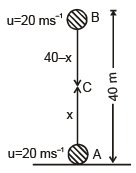
40 - x = 20 × t + 1/2 × 9.8 t2
= 20t + 4.9 t2 ... (ii)
Adding (i) and (ii), 40 = 40 t or t = 1 s
From (i), x = 20 × 1 - 4.9 × (1)2 = 15.1 m
Hence the two balls will collide after 1 s at a height of 15.1 m from the ground.
FAQs on Motion under Gravity
| 1. What is the difference between free fall and motion under gravity? |  |
| 2. How do I calculate the time taken for an object to fall from a height? | |
| 3. Why does a heavier object fall at the same speed as a lighter object in free fall? | |
| 4. What's the difference between velocity and speed in motion under gravity problems? | |
| 5. How do I find the final velocity of an object falling under gravity? | |