Revision Note: Paths to Modernisation


Introduction
East Asia's journey to modernisation was a tale of struggle, adaptation, and transformation. While China grappled with colonial pressures and revolution, Japan rapidly embraced reform to become a global power. Korea endured colonisation and war before rising as an economic force, and Taiwan transitioned from authoritarian rule to democracy. Nationalism, economic policies, and Western influence shaped their distinct yet interconnected paths, defining the region's future.
Japan
Political System
- Centre of Power Kyoto- Power to Shoguns at Edo
- Divided country into 250 domains under daimyo- stayed at Edo to avert any rebel
- Samurai served the shogun and daimyo
- 16th Century-Three Changes-
- (a) Peasantry disarmed to end Frequent War
- (b) Anatomy to daimyo
- (c) land measurement for productivity and revenue
- Growth of a commercial economy and a vibrant culture
- Increased use of money and creation of stock market led the economy in new ways.
- Social and intellectual changes - Chinese influence was questioned and study of ancient Japanese literature promoted.
The Meiji Restoration
- Trade and diplomatic relation with USA.
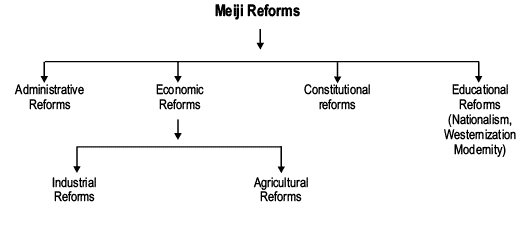
- In 1868, a movement removed Shogun and brought Emperor to Edo (Tokyo).
- Learn new ideas from Europe or Exclude European. Some favoured gradual and limited opening to the outer world.
- Rich country & strong army - A sense of nationhood and to transform subjects into citizens.
- Emperor System - King, bureaucracy and military descendant of sun, birthday - national holiday western style military uniforms.
China
Modern History of China revolved around their issues
a) How to regain Sovereignty
b) End the humiliation of Foreign Occupation
c) Bring out equality and development
Establishing the Republic
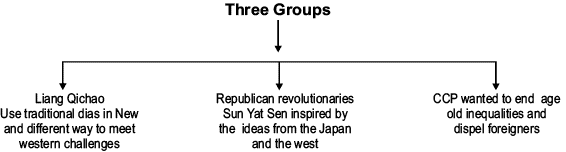
- Manchu dynasty was overthrown and a republic established in 1911 under Sun-Yat-Sen.
- Three Principles - nationalism, democracy, and socialism.
- Revolutionaries asked for - driving out the foreigners to control natural resources, to remove inequalities, reduce poverty.
- Advocated reforms - use of simple language, abolish foot binding and Female subordination, equality in marriage and economic development.
- Four great needs - clothing, food, housing, and transportation.
- Chiang-Kai-Shek (1887 - 1975) military campaign to control the warlords and eliminate the communists.
- Women to cultivate four virtues - Chastity, appearance, speech, and work and confined to the household.
- Sun-Yat-Sen's Programme - regulating capital and equalizing land never carried out. Imposed military order rather than address the problem of Peasantry.
Establishing the New Democracy 1949 - 65
- Economy under government control.
- Private enterprise and Private ownership of land abolished.
- The great leap forward movement in 1958
- Creating a socialist man and five love - father land, People, labour, science and Public property.
- The Commune system modified and backyard furnace was unusable industrially.
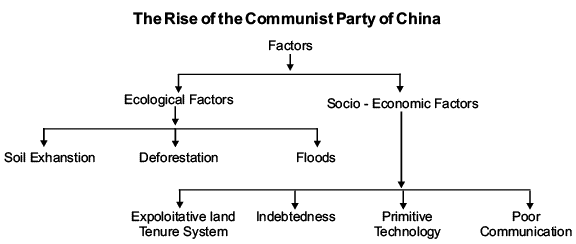
Great Proletarian Cultural Revolution
- Conflict between the concept of 'socialist man' and expertise.
- Red guards (students and army) used against old culture, old customs and old habits.
- Students and professionals were sent to village to learn from masses.
- Ideology and slogan replaced rational debate.
- The cultural revolution weakened the party disrupted economy and educational system.
- In 1975 the party once again laid emphasis on greater social discipline and build an industrial economy.
Reforms of 1978 Deng Xiaoping
- 1. Deng Xiaoping kept party control strong while introducing a socialist market economy
- 2. Four modernisation - Science, industry, agriculture and defence.
- 3. The Fifth modernisation - Democracy.
- 4. May Fourth movement-Tiananmen square
- 5. Emergence of debates on ways to develop China
- 6. growing revival of traditional ideas of Confucianism.
The Story of Taiwan
- Taiwan a Japanese colony since 1894-95 war with Japan. The Cairo (1943) and Portsdom Proclamation (1949) restored to China.
- GMD under Chiangkai-Shek established a repressive govt. Freedom of speech, Political opposition banned.
- Excluded local people from position of power
- Land reforms to increase agricultural productivity and modernise the economy.
- Transformation of Taiwan into a democracy after the death of Chiang in 1975. Martial law lifted in 1987.
- Free elections- local Taiwanese to power.
- Re-unification with China - a Contention issue China - a semi autonomous Taiwan may be acceptable to China.
The Story of Korea
End of Joseon Dynasty (1392-1910):
- Faced internal strife and pressure from China, Japan, and the West.
- Implemented modernization reforms in government, diplomacy, infrastructure, and society.
- Annexed by Japan in 1910, ending the dynasty.
Japanese Colonial Rule (1910-1945):
- Suppressed Korean culture and forced assimilation.
- Koreans resisted with nationwide demonstrations and formed a provisional government.
- Continued efforts by independence activists helped ensure independence post-Japan's WWII defeat.
Division and Korean War (1945-1953):
- Post-WWII, Korea was divided along the 38th parallel: Soviets in the North, UN in the South.
- Korean War (1950-1953) involved US and UN support for South Korea, and China for North Korea.
- Ended with an armistice in 1953; Korea remained divided.
Post-War Challenges and Development:
- South Korea struggled with war destruction, economic dependency on the US, and delayed development.
- Syngman Rhee's extended rule ended with the April Revolution (1960) due to protests against election rigging.
Military Rule and Rapid Industrialization:
- 1961 military coup led by Park Chung-hee, who later became president.
- Implemented state-led, export-oriented economic policies.
- Shifted from light industries to heavy and chemical industries, achieving high economic growth.
Political Developments and Democratisation:
- Park Chung-hee's authoritarian rule ended with his assassination in 1979.
- 1980s saw continued military rule and suppression of democratic movements.
- June Democracy Movement (1987) led to constitutional revisions allowing direct presidential elections.
Economic Crisis and Further Democratisation:
- 1997 Asian Financial Crisis led to IMF intervention.
- Increased political awareness and movements led to further democratization.
- Political transitions in the 2000s marked by peaceful transfers of power.
Key Themes of Modernisation
Role of Nationalism
- China: Anti-foreign sentiment, rejection of imperialism.
- Japan: Used nationalism to modernize but led to militarism and imperialism.
- Korea: Nationalism led to democratisation post-WWII.
Economic Strategies
- China: State-controlled socialism (Mao) → Market reforms (Deng).
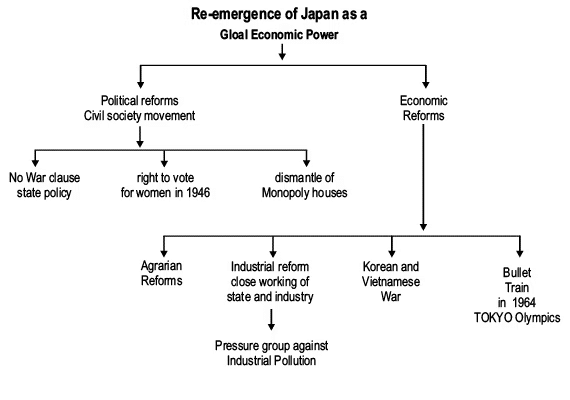
- Japan: Capitalist industrialisation backed by state policies.
- Korea & Taiwan: Export-led growth, foreign investment, and rapid industrialisation.
Impact of Western Influence
- China: Colonised in parts, Communism emerged as a reaction.
- Japan: Selective adoption of Western ideas, retained emperor system.
- Korea & Taiwan: Benefitted from US economic & military support.
Conclusion: Different Paths to Modernisation
- Japan: Modernised early, balanced tradition & Westernisation, but led to imperial wars.
- China: Faced centuries of turmoil, transformed under Communism, later embraced capitalism.
- Korea & Taiwan: Followed export-driven economic growth, with democratisation occurring later.
FAQs on Revision Note: Paths to Modernisation
| 1. What exactly does modernisation mean in history and how did different countries achieve it differently? |  |
| 2. How did Japan modernise so quickly during the Meiji Restoration and what made it different from other countries? | |
| 3. What were the main obstacles to modernisation in colonised countries during the 19th and 20th centuries? | |
| 4. Why did some societies resist modernisation even when it became possible for them to adopt it? | |
| 5. What role did education and technology play in helping societies modernise successfully? | |