NCERT Solutions - International Trade

Q1: Choose the right answers of the following from the given options.
(i) Trade between two countries is termed as
(a) Internal trade
(b) External trade
(c) International trade
(d) Local trade
Ans: (c)
Explanation: International trade refers to the exchange of goods and services between two or more countries. It involves cross-border transactions, unlike internal or local trade which occur within a single country.
(ii) Which one of the following is a land locked harbour?
(a) Vishakhapatnam
(b) Mumbai
(c) Ennor
(d) Haldia
Ans: (d)
Explanation: Haldia is an inland or land-locked harbour located on the Hooghly river estuary and serves as a river port; Mumbai and Vishakhapatnam are open coastal ports, and Ennor (Ennore) is also on the coast.
(iii) Most of India's foreign trade is carried through
(a) Land and sea
(b) Land and air
(c) Sea and air
(d) Sea
Ans: (d)
Explanation: Sea transport handles the largest share of India's foreign trade because ships can carry large volumes at lower cost. India's long coastline and major seaports make maritime transport the dominant mode for imports and exports.
Q2: Answer the following questions in about 30 words.
(i) Mention the characteristics of India's foreign trade.
Ans: India's foreign trade has grown in volume, with imports generally exceeding exports. The share of agricultural products has declined, while petroleum and manufactured goods, including capital goods, have risen, reflecting industrialisation and changing demand.
(ii) Distinguish between port and harbour.
Ans:
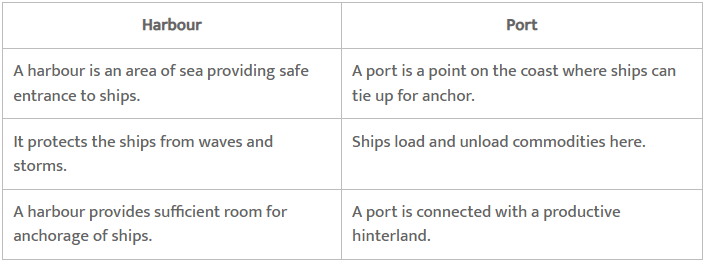
(iii) Explain the meaning of hinterland.
Ans: Hinterland is the inland region served by a port for its imports and exports. It includes the area from which the port draws cargo and to which goods are distributed, usually connected by road, rail or river.
(iv) Name important items which India imports from different countries.
Ans: Petroleum and petroleum products are India's major imports. Other important imports are capital goods such as non-electrical machinery, transport equipment, metal manufactures and machine tools, which support industry and infrastructure.
(v) Name the ports of India located on the east coast.
Ans: Kolkata, Haldia, Paradip, Vishakhapatnam, Ennore, Chennai, Tuticorin are the major ports on the east coast of India.
Q3: Answer the following questions in about 150 words.
(i) Describe the composition of export and import trade of India.
Ans:
- Exports: The share of agricultural and allied products in India's exports has declined over time, while the share of petroleum and related products and other commodities has increased. Manufactured goods form a large part of exports; by 2016-17 manufacturing accounted for about three-quarters of export value. Traditional agricultural exports faced competition, but non-traditional items such as floricultural products, fresh fruits and marine products have risen.
- Imports: Petroleum and petroleum products show a steep rise, reflecting their role as fuel and industrial raw material and indicating rising industrialisation. Imports of capital goods - non-electrical machinery, transport equipment, metal manufactures and machine tools - have grown steadily to meet industrial and export sector needs. Imports of food and allied products have fallen with a decline in edible oil imports.
(ii) Write a note on the changing nature of the international trade of India.
Ans:
- The composition of India's international trade has shifted: the share of agricultural and allied products has fallen, while petroleum, crude products and manufactured items have grown.
- The share of ore minerals and many manufactured goods has remained relatively stable over recent years.
- Imports of petroleum products have increased sharply due to rising energy needs and industrial use.
- Traditional export items such as coffee and cashew have declined in importance, while exports of engineering goods, gems, pearls and manufactured items have risen.
- Overall, India's trade shows a move towards higher industrial content and greater importance of capital and petroleum products, reflecting economic structural change.
FAQs on NCERT Solutions - International Trade
| 1. What is international trade? |  |
| 2. What are the benefits of international trade? | |
| 3. What are the different types of international trade barriers? | |
| 4. How does international trade impact a country's economy? | |
| 5. How do countries resolve trade disputes in international trade? | |