Mechanical Engineering Exam  >  Mechanical Engineering Notes  >  Thermodynamics  >  Entropy Calculations for Ideal Gases

Entropy Calculations for Ideal Gases

Entropy Calculations for Ideal Gases

Entropy is a state property that quantifies the degree of molecular disorder and the availability of energy for useful work. For closed systems undergoing simple compressible-work interactions, entropy changes can be obtained directly from thermodynamic relations. This section derives expressions for the entropy change of an ideal gas between two equilibrium states (T0, P0) and (T, P) and discusses special cases such as reversible adiabatic (isentropic) processes and the constant heat-capacity approximation.

Fundamental relations and starting point

The first law for a closed system is

dU = dQ + dW

For a simple compressible substance undergoing a reversible process with only PdV work, the combined first and second laws yield the Gibbs relation

dU = T dS - P dV

Using the definition of enthalpy H = U + PV and differentiating, we obtain

d(H - PV) = T dS - P dV

Expanding the left-hand side gives

dH - P dV - V dP = T dS - P dV     (4.18)

Entropy differential for any substance

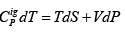
Cancelling -P dV on both sides of equation (4.18) leads to a convenient Gibbs-Duhem form for the entropy differential

T dS = dH - V dP

or equivalently

dS = dH/T - (V/T) dP

Ideal-gas simplification

For an ideal gas, the enthalpy depends only on temperature. In differential form,

dH = Cpig dT     (4.19)

Substituting (4.19) into the entropy differential gives

Ideal-gas simplification

dS = (Cpig / T) dT - (V / T) dP

Ideal-gas simplification

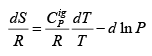
dS = (Cpig / T) dT - (R / P) dP     (4.20)

Here the ideal-gas relation PV = RT (per mole) or p v = R T (per unit mass) has been used to substitute V/T = R/P (R is the appropriate gas constant: molar R or specific R depending on the chosen unit basis).

Integration between two equilibrium states

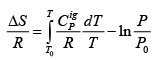
Integrate equation (4.20) between an initial state (T0, P0) and a final state (T, P) to obtain the entropy change of the ideal gas:

Integration between two equilibrium states

ΔS = ∫T0T (Cpig/T) dT - ∫P0P (R/P) dP

Integration between two equilibrium states

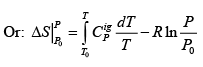
ΔS = ∫T0T (Cpig/T) dT - R ln(P/P0)     (4.21)

This expression gives the exact entropy change for an ideal gas when the temperature dependence of Cpig is known. If molar quantities are used, ΔS is molar entropy change; if specific quantities are used, Δs is specific entropy change. Care must be taken to use a consistent R (molar or specific) and Cp basis.

Special cases

1. Reversible adiabatic (isentropic) process

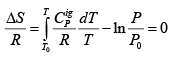
For a reversible adiabatic process, there is no heat transfer (dQ = 0) and hence the entropy change is zero for the closed system:

1. Reversible adiabatic (isentropic) process

dS = 0

Therefore, for an isentropic change between two states, ΔS = 0 and the relation from (4.20) gives

(Cpig/T) dT = (R/P) dP

2. Constant heat-capacity approximation

If the ideal gas heat capacity is approximately constant over the temperature range of interest (Cpig ≈ constant), the temperature integral in (4.21) simplifies to a logarithm yielding a compact formula:

2. Constant heat-capacity approximation

ΔS = Cpig ln(T/T0) - R ln(P/P0)     (4.22)

When expressed in terms of specific heats and the ratio of specific heats k = Cp/Cv, the isentropic relations for ideal gases can be written as

  • T2/T1 = (P2/P1)(k-1)/k
  • P2/P1 = (V1/V2)k
  • T2/T1 = (V1/V2)k-1

These are standard isentropic relations obtained by setting ΔS = 0 and using Cp - Cv = R.

Notes on variables and units

  • Use molar properties (molar enthalpy, molar entropy, R = 8.314 J mol-1 K-1) when working per mole.
  • Use specific properties (per unit mass enthalpy, specific entropy, R specific) when working per unit mass.
  • Ensure consistency between the heat-capacity basis and the gas constant R.
  • If Cpig is temperature-dependent, evaluate the integral ∫(Cp(T)/T) dT using appropriate polynomial or tabulated expressions for Cp(T).

Worked symbolic derivation (stepwise)

The following lines present the derivation in clear sequential steps.

T dS = dH - V dP.

For an ideal gas, dH = Cpig dT.

Substitute into the previous relation.

dS = (Cpig/T) dT - (V/T) dP.

Use the ideal-gas relation PV = RT to write V/T = R/P.

dS = (Cpig/T) dT - (R/P) dP.

Integrate between states (T0, P0) and (T, P):

ΔS = ∫T0T (Cpig/T) dT - ∫P0P (R/P) dP.

Evaluate the pressure integral: ∫P0P (R/P) dP = R ln(P/P0).

Thus the general expression is ΔS = ∫T0T (Cpig/T) dT - R ln(P/P0).

If Cpig is constant, carry out the temperature integral to obtain ΔS = Cpig ln(T/T0) - R ln(P/P0).

Example (symbolic)

Find the entropy change of an ideal gas between (T0, P0) and (T, P) using constant Cp approximation.

Start with equation (4.22).

ΔS = Cpig ln(T/T0) - R ln(P/P0).

Substitute numerical values if given, ensuring consistent units and whether quantities are molar or specific.

Applications and remarks

  • The expressions derived are used in thermodynamic analysis of gas turbines, compressors, nozzles, and heat-exchange processes where ideal-gas behaviour is a reasonable approximation.
  • When precise entropy values are required over wide temperature ranges, use temperature-dependent Cp(T) functions (polynomial fits or tables) and perform the integral numerically or analytically as appropriate.
  • For real gases or processes involving phase change or chemical reaction, the ideal-gas relations no longer apply and more general thermodynamic relations or property tables must be used.

Summary: The entropy change for an ideal gas between two states is given exactly by ΔS = ∫(Cp(T)/T) dT - R ln(P/P0). Under the constant heat-capacity approximation this reduces to ΔS = Cp ln(T/T0) - R ln(P/P0). Reversible adiabatic processes are isentropic (ΔS = 0), yielding the standard isentropic relations between T, P and V.

The document Entropy Calculations for Ideal Gases is a part of the Mechanical Engineering Course Thermodynamics.
All you need of Mechanical Engineering at this link: Mechanical Engineering

FAQs on Entropy Calculations for Ideal Gases

1. What is entropy and how is it calculated for ideal gases?
Ans. Entropy is a thermodynamic property that describes the level of disorder or randomness in a system. For ideal gases, the entropy can be calculated using the equation: $$ S = nR\ln\left(\frac{V}{V_0}\right) $$ where S is the entropy, n is the number of moles of the gas, R is the gas constant, V is the volume of the gas, and V0 is a reference volume.
2. How does the entropy of an ideal gas change with temperature?
Ans. The entropy of an ideal gas increases with temperature. This is because as the temperature increases, the molecules of the gas gain more kinetic energy and move more rapidly, leading to a higher level of disorder and randomness in the system. Thus, the entropy increases as the gas becomes more disordered.
3. Can the entropy of an ideal gas be negative?
Ans. No, the entropy of an ideal gas cannot be negative. Entropy is a measure of disorder, and since disorder cannot be negative, the entropy of an ideal gas is always non-negative. It can only take a value of zero when the gas is in a perfectly ordered state, which is not typically observed in practice.
4. How does the entropy of an ideal gas change with pressure?
Ans. The entropy of an ideal gas does not depend on pressure. The entropy is solely influenced by the temperature and volume of the gas. Changes in pressure do not affect the level of disorder or randomness in the system, and therefore do not impact the entropy.
5. What is the significance of entropy in thermodynamics and engineering?
Ans. Entropy is a fundamental concept in thermodynamics and engineering. It helps to quantify the energy dispersal and level of disorder in a system. It plays a crucial role in various engineering applications, such as heat transfer, combustion, and power generation. Understanding and controlling entropy is essential for optimizing processes and improving the efficiency of engineering systems.
Explore Courses for Mechanical Engineering exam
Get EduRev Notes directly in your Google search
Related Searches
mock tests for examination, Semester Notes, Sample Paper, ppt, Free, Entropy Calculations for Ideal Gases, Entropy Calculations for Ideal Gases, Important questions, study material, Viva Questions, Extra Questions, Objective type Questions, Previous Year Questions with Solutions, practice quizzes, shortcuts and tricks, pdf , video lectures, Entropy Calculations for Ideal Gases, Summary, Exam, past year papers, MCQs;