Fourier Transform as a System


Fourier Transform as a System
The Fourier transform and the inverse Fourier transform can be regarded as two system transformations. One system accepts a time-domain signal and produces its frequency-domain representation (spectrum); the other accepts a frequency-domain signal and produces the corresponding time-domain signal. Treating transforms as systems helps to view and reason about their input-output behaviour using common system properties (linearity, memory, shift-invariance, stability) while keeping in mind that the independent variables for the two domains are different.
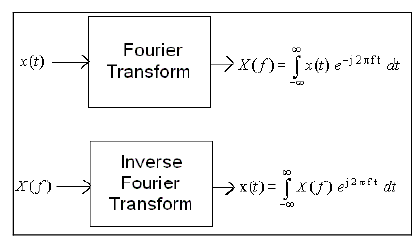
Below we examine useful properties of these two systems and use the notion of duality to draw additional insights.
Duality of the Fourier Transform

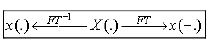
There is a fundamental symmetry between the forward and inverse Fourier transforms. If a time-domain signal y(t) has the Fourier transform Y(f), then a dual relationship links Y(t) and y(f). Using the inverse transform expression for a given spectrum, one can substitute appropriately to obtain the transform of Y(t). The result is the duality theorem, which can be stated informally as: exchanging the time and frequency variables (with a sign change in the argument) interchanges the roles of signal and spectrum.
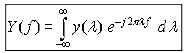
To examine this, recall the inverse transform formula and substitute the frequency variable appropriately to find the transform of Y(t). The algebra yields the important identity that relates the transform pair under variable exchange and sign reversal.

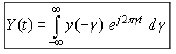
Hence, if Y(f) is the Fourier transform of y(t), then the Fourier transform of Y(t) is y(-f). This is the essence of the duality property.

Duality implies that many properties and theorems for the forward transform have corresponding "dual" statements for the inverse transform. The relationship between the transform and its inverse is therefore tightly coupled; proving a property for one often yields a corresponding result for the other.
Linearity
Both the Fourier transform and its inverse are linear systems. That is, for any signals x1(t), x2(t) and scalars a, b, the transform satisfies
FT{a x1(t) + b x2(t)} = a X1(f) + b X2(f)
The inverse transform obeys the same linearity. Linearity is the most basic and widely used property when analysing signals and systems in the frequency domain.
Memory
Strictly speaking, the usual notion of system memory (dependence of the output on past or future values of the input when both are functions of the same independent variable) does not apply directly here because the input and output variables differ: the forward transform maps time → frequency and the inverse maps frequency → time. Nonetheless, one may ask whether a local change in the input produces a local change in the output. For the Fourier transform the answer is:
- Introducing a localised change (a sharp kink or discontinuity) in the time signal causes a broad, spread-out change in the spectrum.
- The more localised the change in time, the more widely spread the effect in frequency.
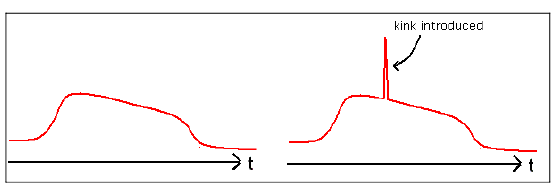
By duality, a localised change in the spectrum produces a widely spread change in the time-domain reconstruction. Thus, local events in one domain typically map to non-local effects in the other domain.
Shift (Time and Frequency) - Effect on Phase and Magnitude
Although the classical shift-invariance notion (input and output as functions of the same independent variable) is not directly applicable, the transform pair has well-known shift relations:
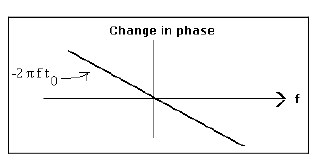
- A time shift of x(t) by t0 results in a multiplication of X(f) by a linear phase factor e^{-j2π f t0}; the magnitude |X(f)| remains unchanged while the phase changes linearly with frequency.
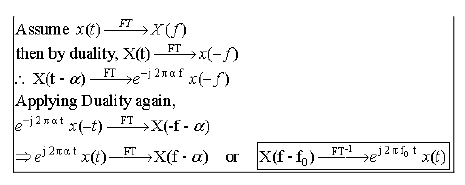
- A frequency shift (modulation) of the spectrum corresponds to a complex exponential multiplication in time - translating the spectrum produces a modulation in the time signal.
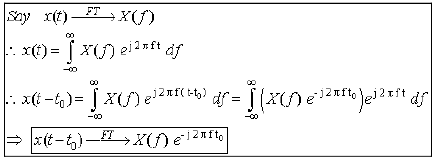
The magnitude of the spectrum does not change under time translation; only the phase undergoes a linear change in frequency.
Using duality, translating the spectrum corresponds to multiplying the time-domain signal by an exponential factor. This is the modulation property of the Fourier transform:
Stability (BIBO) of the Transform Systems
We ask whether the Fourier transform and inverse transform, viewed as systems, are BIBO stable - that is, whether a bounded input always yields a bounded output. The answer is no in the usual sense because the integral expressions defining the transform may fail to converge even for bounded inputs.
For example, a non-zero constant signal in time does not have a convergent Fourier transform as a function (the integral does not converge). To handle such cases we extend the notion of the transform using generalised functions (distributions), such as the Dirac delta.
One important and useful generalized result is the transform of the unit impulse.
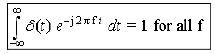
The Fourier transform of the unit impulse δ(t) is the constant (identity) function in frequency. Symbolically, FT{δ(t)} = 1 (for all f). Although the inverse transform integral of a constant spectrum does not converge in the ordinary sense, we accept this relationship in the generalized-function sense.

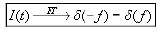
By duality, the Fourier transform of the constant (identity) function is the unit impulse:
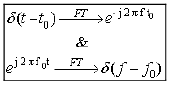
Applying time-shift and frequency-shift properties to these generalized pairs yields further generalised transforms, for example:
Conclusion
- Viewed the Fourier transform and its inverse as systems that map between time and frequency domains.
- Explained the duality between time and frequency representations: exchanging domains yields paired relationships such as FT{Y(t)} = y(-f) when Y(f) = FT{y(t)}.
- Stated that both transform systems are linear.
- Examined properties analogous to memory and shift behaviour and discussed why local changes in one domain typically produce global changes in the other.
- Discussed stability in the BIBO sense and introduced generalized-function (distribution) extensions such as FT{δ(t)} = 1 and FT{1} = δ(f).
FAQs on Fourier Transform as a System
| 1. What is the Fourier Transform? |  |
| 2. How does the Fourier Transform work? | |
| 3. What are the applications of the Fourier Transform? | |
| 4. What is the difference between the Fourier Transform and the Fast Fourier Transform (FFT)? | |
| 5. Can the Fourier Transform be used for non-periodic signals? | |


 | Explore Courses for Electrical Engineering (EE) exam |  |
 | Get EduRev Notes directly in your Google search | |