Sampling & Reconstruction of Band Limited Signals


Band-limited signals
Band-limited signal: A signal whose Fourier transform is zero outside a finite interval of the frequency axis. In other words, there exists a positive number B (the bandwidth) such that the Fourier transform X(f) satisfies
X(f) = 0 for |f| > B.

Smoothness and differentiability
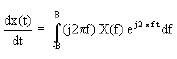
Let x(t) be band-limited with Fourier transform X(f) non-zero only on [-B, B]. The inverse Fourier transform representation is
$x(t) = ∫_{-B}^{B} X(f) e^{j2πft} df.$
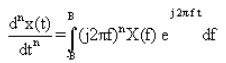
Because the integral is over a bounded frequency interval and the integrand is infinitely differentiable with respect to t, differentiation may be brought inside the integral. Therefore every time-derivative of x(t) exists and is given by differentiating the integrand with respect to t under the integral sign:
$d^n x(t) / dt^n = ∫_{-B}^{B} (j2πf)^n X(f) e^{j2πft} df.$


Thus band-limited signals are infinitely differentiable and therefore very smooth.
Reconstruction of time-limited signals (duality)
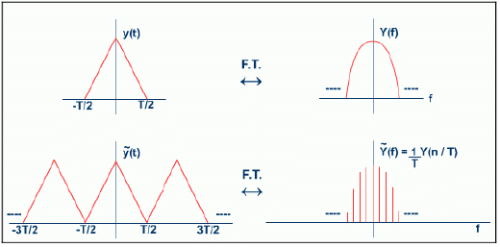
We first examine a dual result: if a signal is time-limited and then periodically extended, its transform becomes sampled (discrete) in frequency. This duality will motivate the sampling result for band-limited signals.
Periodic extension in time and the Fourier series
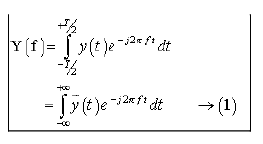
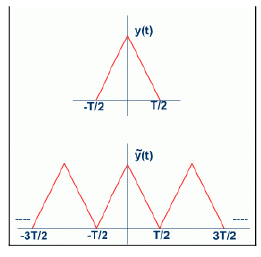
Let y(t) be time-limited to [-T/2, T/2]. Form a periodic signal y_p(t) by concatenating shifted copies of y(t) with period T. The Fourier transform of y(t) and the Fourier series coefficients of y_p(t) are related as follows.
The Fourier series coefficients c_n of a periodic signal x_p(t) of period T are

Comparing the Fourier transform of the time-limited y(t) and the Fourier series coefficients of its periodic extension leads to the result that the Fourier transform of the periodic time signal is essentially composed of discrete samples of the original transform.


Hence, for a time-limited and then periodic signal, all information about the signal is contained in uniformly spaced samples of its Fourier transform (frequency samples). This is the dual statement of the sampling theorem for band-limited signals.
Reconstruction of band-limited signals (sampling and synthesis)
Apply the dual reasoning: if a signal's Fourier transform X(f) is limited to [-B, B], then sampling the time-domain signal uniformly produces a periodic extension of the spectrum. From such samples we can reconstruct the original spectrum (and hence the signal) provided overlapping of the periodic spectral replicas does not occur.
Sampling by an impulse train
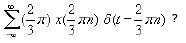
Sampling a continuous-time signal x(t) by multiplying it with an impulse train of period Ts (sampling period) produces the sampled signal
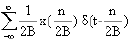
$x_s(t) = x(t) · ∑_{n=-∞}^{∞} δ(t - nTs).$
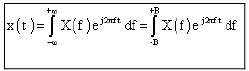
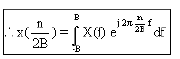
In the frequency domain, multiplication in time corresponds to convolution in frequency. The Fourier transform of the impulse train is itself an impulse train in frequency with spacing 1/Ts, so the sampled spectrum becomes a periodic repetition of the original spectrum with period 1/Ts:
$X_s(f) = (1/Ts) ∑_{k=-∞}^{∞} X(f - k/Ts).$

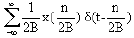
The coefficient corresponding to the n-th term of the periodic extension equals the sample x(nTs) scaled appropriately; in the dual Fourier-series view, the uniform time samples are the Fourier series coefficients of the periodic extension of X(f).

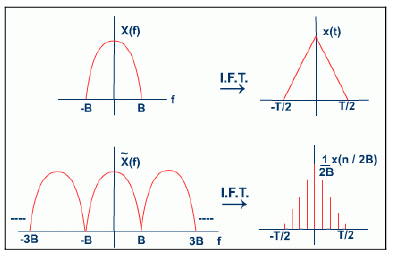
The Fourier inverse of the sampled transform yields the sampled time-domain representation in terms of the individual Fourier series coefficients (the time samples):
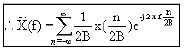
(Fourier series in f - fundamental period is 1/Ts and the Fourier series coefficients are proportional to x(nTs).)


Recovering the original signal (ideal reconstruction)
To recover the original spectrum from the periodic extension created by sampling, we need to keep only the central (baseband) replica of the spectrum and remove the shifted replicas. That is achieved by passing the sampled signal through a low-pass filter whose frequency response is unity over [-B, B] and zero elsewhere (an ideal low-pass filter). The required frequency response is

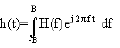
The corresponding impulse response of this ideal low-pass filter is the inverse Fourier transform of the above rectangular frequency response. Using the standard transform pair gives the impulse response
h(t) = sin(2πBt) / (π t) = 2B · sinc(2Bt), where sinc(u) = sin(π u) / (π u).


Thus, if the periodic spectral replicas do not overlap (i.e. if the sampling period is small enough), an ideal low-pass filter with cutoff B recovers the original spectrum exactly. In time domain this corresponds to reconstruction by a sinc-interpolation kernel.
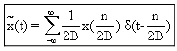
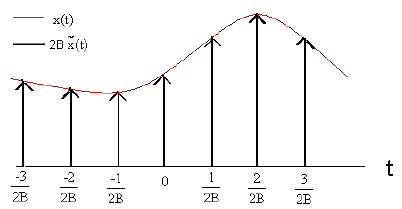
Interpretation: Multiplying the original band-limited signal by a periodic train of impulses (sampling) produces a signal whose Fourier transform is a periodic extension of the original spectrum. Filtering with an ideal low-pass filter that keeps only the baseband replica restores the original signal.


We therefore need to pass the sampled signal through an LSI system whose frequency response is the rectangular function that retains |f| ≤ B and rejects other replicas:
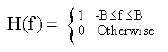
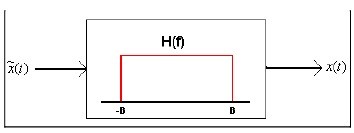
The impulse response of that LSI system (ideal low-pass) is the sinc function shown earlier.

The Sampling Theorem
Shannon-Whittaker-Nyquist Sampling Theorem:
A band-limited signal of bandwidth B (i.e. X(f) = 0 for |f| > B) may be reconstructed exactly from its uniformly spaced samples if the sampling rate fs satisfies
fs > 2B.
Equivalently, the sampling period Ts must satisfy
Ts < 1/(2B).

Why strictly greater than 2B?
Sampling at exactly the Nyquist rate fs = 2B can be problematic if the spectrum has non-zero values or impulses at the band edges ±B. At the exact boundary the periodic spectral replicas meet; pointwise differences may be negligible for continuous spectra but if there are impulses (spectral lines) exactly at ±B they can be aliased or altered by the replica superposition and cause loss of information.
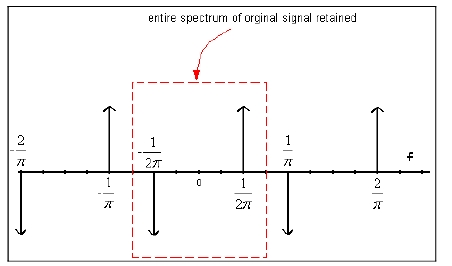
Example: take x(t) = sin t. Its Fourier transform consists of impulses at frequencies ±(1/(2π)). Thus its bandwidth is B = 1/(2π) (in Hz). If we choose the sampling rate equal to the Nyquist rate
fs = 2B = 1/π
then the sampling period is
Ts = π.
Samples are
x(nTs) = sin(nπ) = 0 for all integer n.


All samples are zero, so reconstruction from these samples is impossible. In the frequency domain the periodic extension of the transform can become identically zero (or otherwise corrupted) when sampled at such a rate, so no ideal low-pass filter can retrieve the original spectrum.
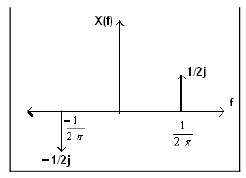

This illustrates why the sampling theorem requires fs to be strictly greater than 2B in general. If X(f) has no energy exactly at the band edges and the sampling is precisely at 2B, reconstruction can still be possible, but in practice one uses a sampling rate higher than 2B to provide margin and to allow non-ideal filters.

Practical remarks
- When the sampling rate is below 2B, spectral replicas overlap (aliasing) and perfect reconstruction is impossible without additional prior information about the signal.
- In practice, ideal low-pass filters do not exist; practical reconstruction uses anti-aliasing analogue filters before sampling and suitable reconstruction filters after sampling. Oversampling (fs > 2B) relaxes filter specifications.
- The ideal reconstruction kernel is the sinc function. Implementations approximate the sinc by finite-length kernels or use digital interpolation methods.
- Signals with impulses (line spectra) at band edges require careful handling; sampling exactly at Nyquist may lose information.
Conclusion
- Band-limited signals are infinitely differentiable and therefore very smooth.
- Sampling a time-domain signal by a periodic impulse train creates a periodic extension of its spectrum; conversely, periodically extending a time-limited signal samples its transform. These are dual viewpoints that help derive sampling/reconstruction results.
- By sampling a band-limited signal at a sufficiently high uniform rate and applying an appropriate low-pass filter (ideal reconstruction filter), one can recover the original signal. The reconstruction kernel is the sinc function (the inverse Fourier transform of the rectangular ideal low-pass).
- Shannon-Whittaker-Nyquist Sampling Theorem: A band-limited signal of bandwidth B can be reconstructed perfectly from uniform samples if the sampling rate is greater than 2B.
Shannon-Whittaker-Nyquist Sampling Theorem:
A band-limited signal with bandwidth B may be reconstructed perfectly from its samples if the sampling rate is greater than 2B.
FAQs on Sampling & Reconstruction of Band Limited Signals
| 1. What is band-limited signal sampling? |  |
| 2. Why is it important to sample band-limited signals? | |
| 3. What is the purpose of reconstruction in band-limited signal processing? | |
| 4. What are the implications of violating the Nyquist-Shannon sampling theorem? | |
| 5. How can we avoid aliasing in band-limited signal sampling? | |


 | Explore Courses for Electrical Engineering (EE) exam |  |
 | Get EduRev Notes directly in your Google search | |