Conservative Field, Stoke’s Theorem

In the last lecture we defined the curl of a vector field as a ratio of the line integral over the boundary of an open surface to the area of the surface, in the limit of the surface becoming infinitesimally small. The direction of the curl was defined as along the outward normal to the surface element. This definition resulted in relating the line integral to the surface integral of the curl of the vector, known as the Stoke's Theorem :
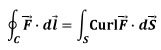
It may be noted that the surface must be an open surface defined by the contour over which the line integral is taken. Note that a given contour does not uniquely specify a surface. For instance, if the contour is a circle, it can define a disk, an open cylinder or any number of other surfaces. It is important to realize that the surface is arbitrary as long as it is bounded by the given curve. This enables us to choose the most convenient surface to evaluate such integrals.
We will now obtain an expression for the curl in the Cartesian coordinates. Consider a rectangular contour ABCD in the yz plane, as shown. Let us consider the rectangular surface bounded by this contour. The direction of the surface is clearly along the positive x direction.
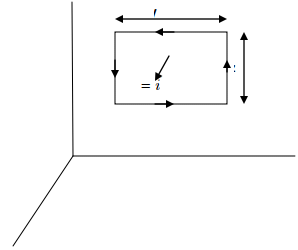
Let us calculate the line integral of a vector field  over this contour. We will enumerate the line integral over the paths AB, BC, CD and DA. Let the corner A have the coordinates (0, y,z). On the path AB, the line integral is
 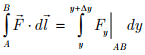 where, we have assumed that over the short length ∆y, the value of the function does not vary much. Likewise, over the path CD, the contribution to the line integral is
 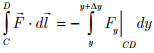 the minus sign appears because the path is traversed in the opposite direction to the path AB. Note that the paths AB and CD differ by having different z components, and, we can express
 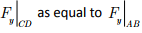 plus terms which are of the order of ∆z or its higher powers. By retaining only the first power in a Taylor expansion, we can write
 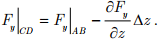 Thus the contribution from these two paths to the line integral is given by
 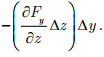 We can do a similar computation of the contribution to the line integral from the pair of paths BC and DA and obtain,
  The net line integral over the path ABCD works out to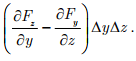
On the other hand, the surface integral of the curl is given by 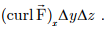 These two, by Stoke's theorem must be equal. Thus we have, for the x-component of the curl of
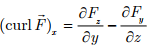
One can similarly obtain the y and z components of the curl of the vector field as follows
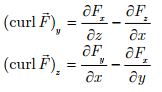
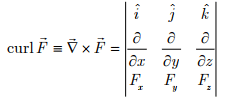
One can observe that the right hand side looks very much like a cross product of vectors, excepting that the first vector seems to have differential operators  as its components. This of course is the familiar gradient operator that we have met before. The curl, therefore, is also written as
  One can write the components of a curl as a determinant, the way we express cross products of vectors :
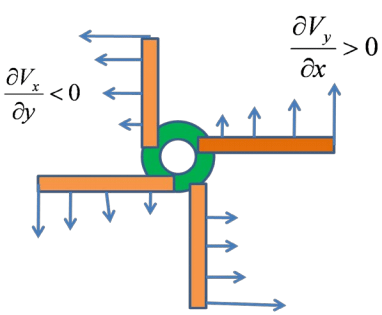
Why do we call it curl? Remember that a lot of terminology of vector calculus developed from fluid dynamics. "Curl", as the name suggests gives the direction of rotation of a fluid (i.e. which direction does the fluid curl) at a point. The magnitude of the curl is the magnitude of rotation and its direction is given by the direction of the axis of rotation. To illustrate it consider what happens when we put a paddle wheel inside a liquid. The wheel would rotate if the velocity field has a nonzero curl in the direction determined by the variation of the velocity components of the fluid.
Example :
Consider a vector field  Calculate its curl. Calculation is straightforward.
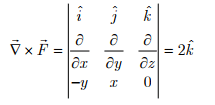
The curl is constant in magnitude and direction. The picture of the field is shown below
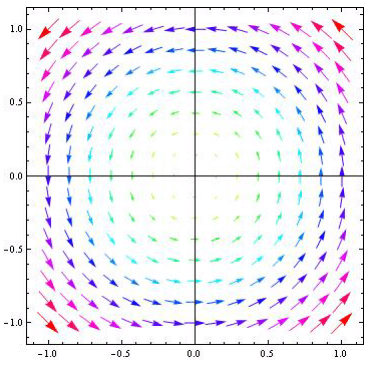
The force field is in the xy plane but the curl is in the z direction as the sense of rotation of the field is like a rotation about the z-axis.
Curl of a conservative field is zero :
This is an important result as it provides a test for whether a vector field is conservative or not. We know that a conservative field can be expressed as the gradient of a scalar field. It can be easily shown that the curl of a gradient is identically zero. (This is left as an exercise for the tutorial.) Because of this, a conservative field is also called an "irrotational" field.
Example 1:A vector field is given by  Show that the field is conservative. Obtain a scalar potential for this field.
We show that the x-component of the curl is zero. One can check similarly for the other components.

The field is conservative. To obtain a scalar potential ϕ, we note the following :
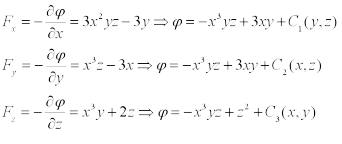
Using these relations we can get an unique expression for the scalar potential ϕ, but for a constant (which we have taken to be zero)

Thus curl 
(1) the line integral 
(2) The integral  is independent of the path connecting A and B and only depends on the two end points A and B.
(3)  be written as a gradient of a scalar potential
Example 2: Use Stoke's theorem to calculate the line integral of  over the path shown below. The contour defines the first quadrant of a circle of radius R.
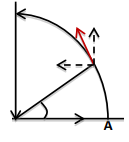
Let us first calculate the line integral by direct integration. Along OA, y=0, z=0 and  The line element is along the x direction
  Similarly, from B to O the integral is also zero. We only need to evaluate the integral along the circular arc from A to B. We can parameterize the curve in polar coordinates
  the line element vector, which has a magnitude
  giving
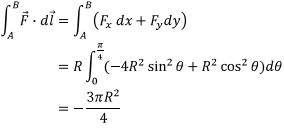
We will now verify this result by calculating the line integral using the Stoke's theorem. The curl of the given vector field is easily computed to be  which gives the surface integral of the curl to be
  consistent with the result obtained by direct evaluation of the line integral.
Example 3: Find the line integral of 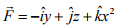 over a circle of radius R in the xy plane centered at the origin.
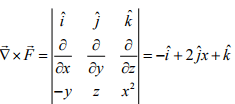
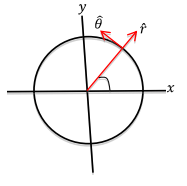
We choose the surface defined by the circle to be the disk of radius R in the xy plane. Since the cdisk is in the xy plane, the outward surface normal is along the z-direction. Thus the surface integral of the curl is given by 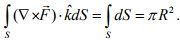 You may find it instructive to calculate the line integral by a direct substitution using the parameterization of the previous example.
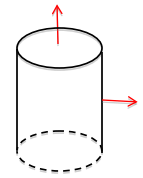
To see that the choice of surface is unimportant, as long as it is defined by the same boundary, let us take the boundary to be the bottom cap of an open cylinder of height h place over it. The top cap is closed.
In this case, the cylinder has two surfaces, the top cap whose Outward normal is along the positive z direction, which clearly gives πR2 since the z component of the curl is constant. For the curved surface, the outward normal is along the polar  of the xy plane. The surface element is
We can express the curl of the field in the cylindrical coordinates
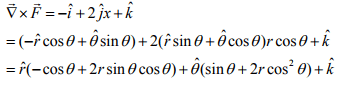
Thus the surface integral is  The angle integral vanishes. The total surface integral is thus the contribution from the top cap, which is πR2.
Tutorial Problems :
1. Calculate the curl of the vector field 
2. Show that the curl of a conservative vector field is zero.
3. Show that the divergence of a curl is zero.
4. Consider two different surfaces S1 and S2, both bounded by the same curve C. Show that the curl a vector field has the same surface integral over both the surfaces.
5. Using Stoke's theorem calculate the line integral of  over a circle of radius R in the xy plane cantered at the origin. Take the open surface to be a hemisphere in z>0.
Solutions toTutorial Problems
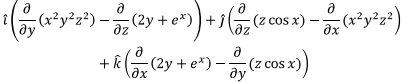
1. The curl is given by

2. A conservative field can be written as a gradient of a scalar field  Using Cartesian coordinates
  Curl of this is zero, as can be seen, e.g. by calculating x component of the curl
  It can be checked that the y and z components also vanish.
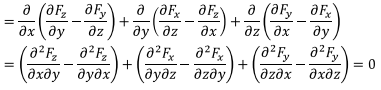
3. 
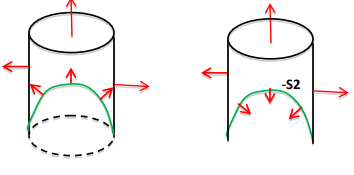
4. 4. As S1 and S2 are both bounded by the same boundary, if we reverse the direction of the normal of one of the surfaces, say S2, the resulting surface S1-S2 is a closed surface. (This can be visualized in the figure below).
Thus 
Where the last integral is over a closed surface. Becauseof this it can be converted to a volume integral using theDivergence theorem,  as the divergence of a curl is identically zero. In the figure to the left, both S1 and S2 are described by the dashed contour. When the directions of the normals to S2 are reversed, the resulting surface S1-S2 is a closed surface.
5. The curl of the vector field is  The unit normal on the surface of the hemisphere being in the radially outward direction is given by
  Thus we need to calculate the surface integral
 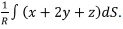 The hemisphere being symmetrical with respect to x and y coordinates, the first two integrals vanish and we are left with
  The integral is conveniently done in spherical coordinates
  The azimuthal integral gives 2π . The surface integral is thus given by
  The line integral can be directly calculated. Since the circle is in the xy plane, the line integral is
The first and the third terms on the right give zero as z=0 on the contour. We are left with  which can be parameterized in polar coordinates
  so that we get the integral to be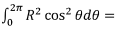

Self Assessment Quiz
1. If a vector field  where M, N and P are functions of x, y and z, show that the field is conservative if
  the subscripts indicating partial differentiation with respect to these variables. Using this show that the field
  conservative. Here
2. Verify Stokes theorem for the vector field  where the contour is a circle of radius R in the xy plane centered at the origin. Take the surfaces to be (1) a disk (2) a hemisphere
 a right circular cone radius R and height h.
3. Evaluate  over a circle of radius 2 whose centre is located at (0,2,2).
4. Show that the line integral of 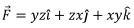 along any closed contour is zero.
5. Find the contour integral of  along a triangle whose vertices are at the points (1,0,0), (0,1,0) and (0,0,1).
Solutions toSelf Assessment Quiz
1. The curl of the given field is  Thus the curl becomes zero when the quantities inside each bracket vanishes. For the given vector field



2. Let us first calculate the line integral directly. We have  Since the contour is in the xy plane (z=0), the second and the third integrals vanish. The first integral can be evaluated by polar parameterization
  This gives the line integral to be
The curl of the given field is seen to be 
a. For a disk, if the contour is in the xy plane and in counterclockwise direction, the outward normal is along the 

b. For the hemisphere, the outward normal is in the radially outward direction. The unit normal is given by  so that the surface integral of the flux is
 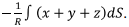 The integral is readily evaluated in a spherical polar coordinates
 The flux integral is thus given by -
  The first two terms are zero because the azimuthal integral vanishes .The last term gives the flux to
c. (this is a hard problem)
The equation to the cone is given by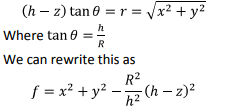
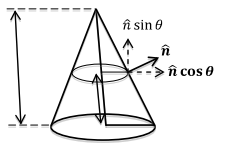
The normal to the surface is along the gradient of f i.e. along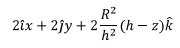
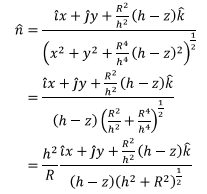
The area element on the surface is  where dl is along the slant of the cone,
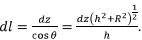 Thus the surface integral of the curl is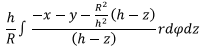
Substitute 

Using these the surface integral becomes 
The first two terms vanish as the azimuthal integration gives zero, leaving us with the last term, which gives - πR2.
3. The curl of the given field is  Since the contour is in the yz plane, x=0 and the normal to the disk is in the x direction. . This leaves us with a single surface integral
 The line integral is equally easy as x=0 on the contour leaving us with a single integral
  Since the center of the circle is at (2,2) in the yz plane, the polar parameterization is
  The line integral becomes
4. The curl of the given field being zero, the line integral; on any closed contour which is equal to the surface integral of the curl would vanish.
5. (this is a hard problem) The line integral is easy to calculate directly. Since the corners of the triangle are at (1,0,0), (0,1,0) and (0,0,1), the equation to the plane is x+y+z=1. Defining the boundary in anticlockwise direction gives the first line in xy plane  second line in yz plane
  and the third line in xz plane
  Because of the symmetry of the integrand we need to calculate any of the three line integrals and multiply by 3. Let us take the first line in xy plane with z=0. The integral is
  Note that on this line x=y=1 so that the integral can be written as
  Thus the value of the integral over the boundary is -1. To get this result by application of Stoke's theorem, we first calculate the curl of the field which is
 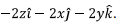 The unit normal to the surface is
  Thus we have to evaluate
 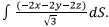 To evaluate this we need to take a projection of the surface into any convenient plane. Taking the projection onto xy plane for which the normal is along
  we can write
  Thus the surface integral is
 Since the equation to the plane is
  we can eliminate z and write the integral as
  The limits are as follows :
  The integral is
 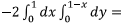 -1.
-1.
FAQs on Conservative Field, Stoke’s Theorem
| 1. What is a conservative field? |  |
| 2. How can Stoke’s Theorem be applied to a conservative field? | |
| 3. Can Stoke’s Theorem be used to evaluate the circulation of a conservative field? | |
| 4. What are some practical applications of Stoke’s Theorem in physics and engineering? | |
| 5. Can Stoke’s Theorem be used in three-dimensional space? | |


 | Explore Courses for Electrical Engineering (EE) exam |  |
 | Get EduRev Notes directly in your Google search | |